




 here!
I’m your shopping assistant for PC builds, upgrades, and everything tech.
Got questions? Ask away!
Start a conversation
here!
I’m your shopping assistant for PC builds, upgrades, and everything tech.
Got questions? Ask away!
Start a conversationShipped by GUANGZHOU PINTECH CO LTD




Any questions? Ask CelesteSM will help you find out quickly.
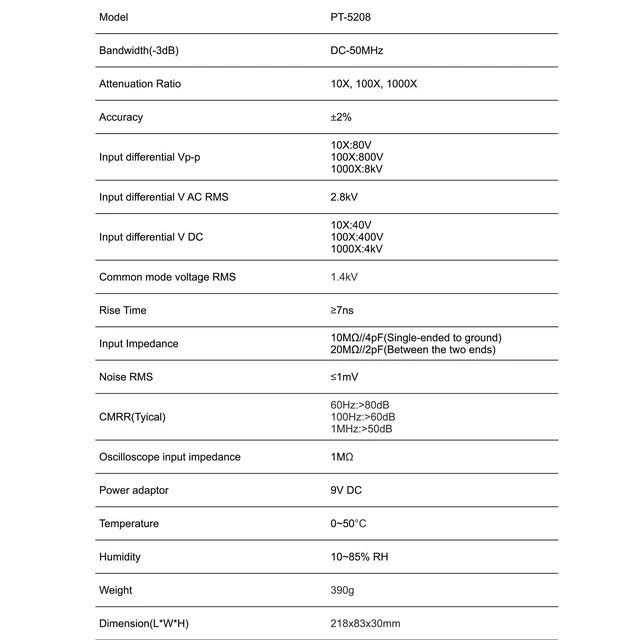
MODEL: PT-5208
Bandwidth (-3dB): DC-50MHz
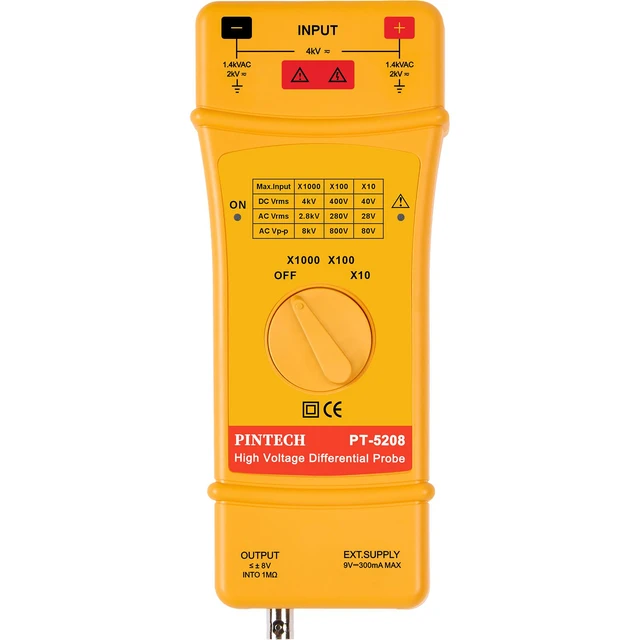
Testing Voltage(Vp-p): 10X: 80V; 100X: 800V; 1000X: 8kV
Input DC Voltage: 10X: 40V; 100X: 400V; 1000X: 4kV
Common-mode voltage RMS: 1.4kV
Attenuation Rate: 10X/100X/1000X
Rising Time: 7ns
Accuracy: ±2%
Input Impedance: Between the two ends: 20M//2pF, Single-ended to ground: 10M//4pF
CMRR: 60Hz:>80dB; 100Hz:>60dB; 1MHz:>50dB
Noise: 1mV rms
Oscilloscope Input Impedance: 1M
Weight: 390g/0.86lb
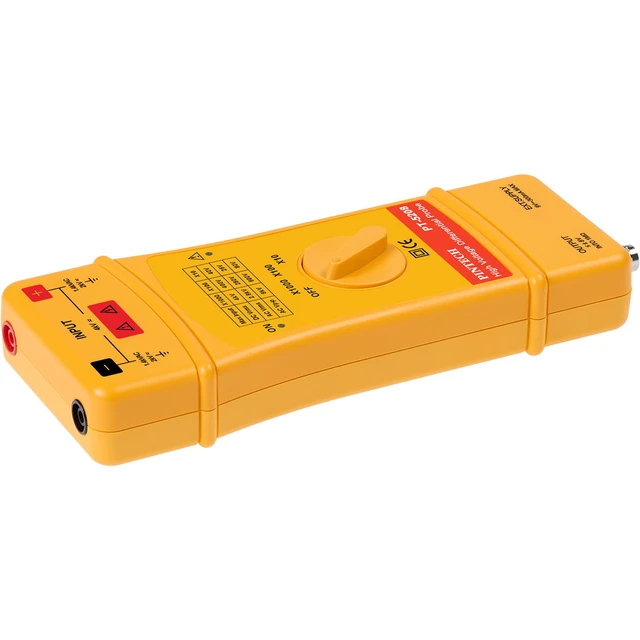
Dimension(LxWxH): 218x83x30 mm
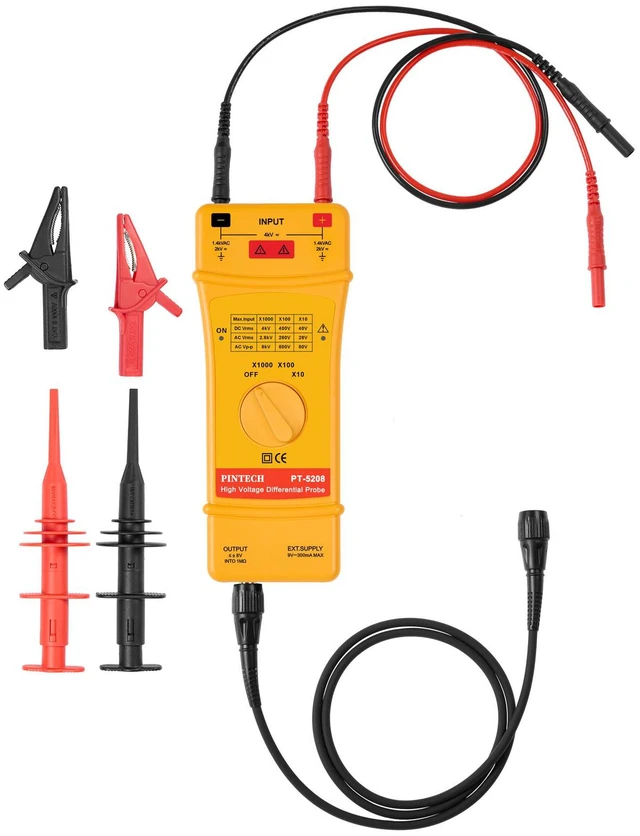
The PINTECH PT-5208 is an active high-voltage differential oscilloscope probe for engineers, technicians, and lab users who need to measure floating or high-voltage signals up to 8 kVp-p with selectable 10X, 100X, or 1000X attenuation and bandwidth up to 50 MHz.
| Attribute | Value |
|---|---|
| Best For | Measuring differential signals with oscilloscopes, meters, and data-acquisition equipment—particularly motor and other high-voltage circuits where two-point signals must be converted to ground-referenced signals |
| Electrical And Frequency Specs | Maximum differential test voltage 8 kV peak-to-peak with DC–50 MHz bandwidth |
| Attenuation And Accuracy | Selectable attenuation 10X / 100X / 1000X with typical accuracy ±2% |
| Compatibility And Interface | BNC interface compatible with oscilloscopes; active differential probe converts two-point signals to ground for oscilloscopes, meters, and data acquisition equipment |
| Physical And Packaging | Probe dimensions 218×83×30 mm; kit includes PT-5208 differential probe, adapter, 2 probe hooks, 2 alligator clips, BNC cable, and manual |
| Safety And Certification | CE certified |
| Identifiers And Warranty | Brand PINTECH, Model PT-5208; product type Electrical Testing & Measuring; 1 Year warranty |
| Selling Unit | Sold individually (each) |
Q: Should I choose the PINTECH PT-5208 or a typical 100MHz differential probe like the Micsig DP10013?
A: Choose the PT-5208 when your main need is higher differential voltage handling and flexible attenuation options for power electronics, inverter, or motor-drive work. Official specs position the PT-5208 at 50MHz with up to 8kVp-p and 10X/100X/1000X attenuation, while the Micsig DP10013 is positioned more toward higher bandwidth measurement at 100MHz with a much lower maximum differential voltage range. In practice, a 100MHz probe is the better fit for faster edge fidelity and higher-frequency detail, while the PT-5208 is the better fit when voltage headroom matters more than extra bandwidth.
Q: Is the PT-5208 better than a lower-voltage differential probe for general bench work?
A: Choose the PT-5208 if you want one probe that can cover both lower-voltage troubleshooting and substantially higher-voltage measurement without changing tools. Lower-voltage differential probes often offer less voltage range and can be more optimized for smaller signals, but the PT-5208 adds wider measurement headroom and a 10X setting that is more practical than high-attenuation-only probes when the signal is not extremely large. For mixed lab work that includes mains-referenced or higher-energy circuits, the PT-5208 is the more versatile choice.
Q: Should I buy the PT-5208 or move up to a higher-bandwidth PINTECH differential probe?
A: Choose the PT-5208 if your priority is high-voltage differential measurement and your signals are comfortably within a 50MHz measurement envelope. Move up to a higher-bandwidth model if you need cleaner visibility into faster switching edges, timing behavior, or higher-frequency content. PINTECH's broader lineup shows a common trade-off: higher-end probes add bandwidth and sometimes tighter performance positioning, but the PT-5208 stays focused on combining substantial voltage range with mainstream oscilloscope compatibility.
Q: Is the PT-5208 a better choice than older high-voltage differential probes that only offer 100X or higher attenuation?
A: Yes, the PT-5208 is often the more practical choice when you need to measure both moderate and high voltages on the same bench. A common limitation with older or simpler high-voltage probes is that high minimum attenuation reduces displayed signal size on the oscilloscope during lower-voltage work. The PT-5208 includes 10X, 100X, and 1000X settings, so it is easier to use across a wider range of signal amplitudes without giving up the high-voltage capability that users look for in this category.
Q: Who is the PT-5208 best suited for?
A: The PT-5208 is best suited for users who need to measure high-voltage differential signals on a standard BNC oscilloscope, especially in power electronics, motor drives, inverters, and other non-ground-referenced circuits. Its 8 kVp-p maximum differential voltage, active differential design, and selectable 10X/100X/1000X attenuation make it more appropriate for bench diagnostics and lab troubleshooting than for casual electronics work.
Q: Do I need a differential probe like this, or can I just use a standard passive oscilloscope probe?
A: Buy a differential probe if you need to measure the voltage between two non-ground points safely and with less measurement error. A standard passive probe is fine for ground-referenced signals, but it is not the right tool for floating, half-bridge, motor-drive, or mains-side measurements. The main trade-off is cost and setup complexity versus safer high-voltage differential measurement.
Q: Is 50 MHz enough, or should I buy a higher-bandwidth differential probe instead?
A: 50 MHz is enough for many power electronics, motor control, inverter, and general high-voltage waveform checks, but it is not ideal for fast digital edges or detailed high-speed switching analysis. If your work is mainly on lower-frequency switching waveforms and general diagnostics, 50 MHz is usually a practical value. If you need cleaner visibility into very fast transients, higher-bandwidth differential probes are the better choice.
Q: What is the practical benefit of the 10X, 100X, and 1000X settings?
A: The selectable attenuation lets you trade signal size for voltage headroom and measurement safety. Lower attenuation is better when the signal is smaller and you want more visible amplitude on the scope. Higher attenuation is better when the measured voltage is much larger and you need to keep the oscilloscope input within range. In practice, 100X and 1000X settings are the more relevant ones for high-voltage work, while 10X is more useful when the signal is comparatively modest.
Q: Is this a good alternative to more expensive Tektronix, Keysight, or Micsig differential probes?
A: It can be a reasonable alternative if your priority is basic high-voltage differential measurement on a standard oscilloscope and you do not need premium bandwidth, ecosystem integration, or top-tier documentation. The trade-off is that established premium brands typically offer stronger validation, accessory ecosystems, and support for demanding measurement workflows. The PT-5208 makes more sense for budget-conscious users who mainly care about compatible BNC connection, high-voltage capability, and selectable attenuation.
Q: Who is the PT-5208 suitable for?
A: The PT-5208 is mainly suitable for users who need to measure high-side or floating voltages safely on a grounded oscilloscope, especially in motor drives, power electronics, inverter, and mains-referenced circuits. It is less suitable if your work is mostly low-voltage general-purpose debugging, where a standard passive probe is simpler and cheaper.
Q: Is the PT-5208 worth buying instead of using two scope channels and math subtraction?
A: It is worth buying if you regularly measure differential signals with high common-mode voltage or need safer probing on non-ground-referenced circuits. Compared with using two standard probes and channel subtraction, a dedicated differential probe is usually the better choice for safety and practical use in high-voltage circuits. The trade-off is cost and added complexity versus a simpler passive-probe setup.
Q: What are the main trade-offs of the PT-5208?
A: The main advantage is safe differential measurement up to 8 kVp-p with selectable 10X, 100X, and 1000X attenuation, which makes it more useful across a wider voltage range than a fixed-ratio probe. The trade-offs are that 50 MHz bandwidth is moderate rather than high-end, and high attenuation settings reduce signal amplitude at the scope input, which can make small signals harder to view. It is a fit for power electronics work, but not the best choice if your priority is very high bandwidth or very small low-level signals.
Q: Can the PT-5208 still be used for lower-voltage measurements, or is it only for high voltage?
A: Yes. It can be used for lower-voltage differential measurements, but it is a specialized high-voltage differential probe, so it is usually most justified when you also need isolation from ground-referenced scope inputs or expect higher common-mode voltage. For routine low-voltage bench work, it may be more probe than you need.
Q: Will the PT-5208 work with most oscilloscopes?
A: Usually yes, if your oscilloscope accepts a standard BNC input, because the PT-5208 is designed as an active differential probe for scope use. Compatibility is generally straightforward at the connection level, but buyers should still confirm their scope's input expectations and measurement setup before use, especially for attenuation scaling and safe operating limits.


