




 here!
I’m your shopping assistant for PC builds, upgrades, and everything tech.
Got questions? Ask away!
Start a conversation
here!
I’m your shopping assistant for PC builds, upgrades, and everything tech.
Got questions? Ask away!
Start a conversationShipped by GUANGZHOU PINTECH CO LTD




Any questions? Ask CelesteSM will help you find out quickly.
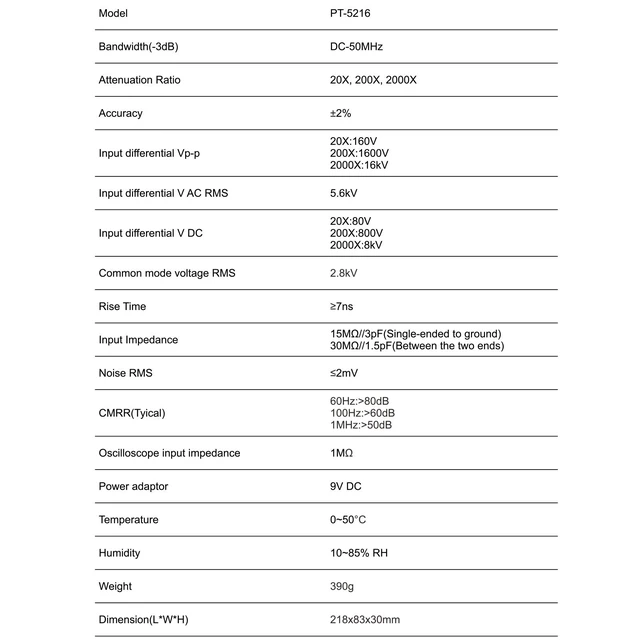
MODEL: PT-5216
Bandwidth (-3dB): DC-50MHz
Testing Voltage(Vp-p): 20X: 160V; 200X: 1.6kV; 2000X: 16kV
Input DC Voltage: 20X: 80V; 200X: 800V; 2000X: 8kV
Common-mode voltage: 2.8kV rms Attenuation Rate: 20X/200X/2000X
Rising Time: 7ns
Accuracy: ±2%
Input Impedance: Between the two ends: 30M//1.5pF, Single-ended to ground: 15M//3pF
CMRR: 60Hz:>80dB; 100Hz:>60dB; 1MHz:>50dB
Oscilloscope Input Impedance: 1M
Noise: 2mV rms
Weight: 390g/0.86lb
Dimension(LxWxH): 218x83x30 mm
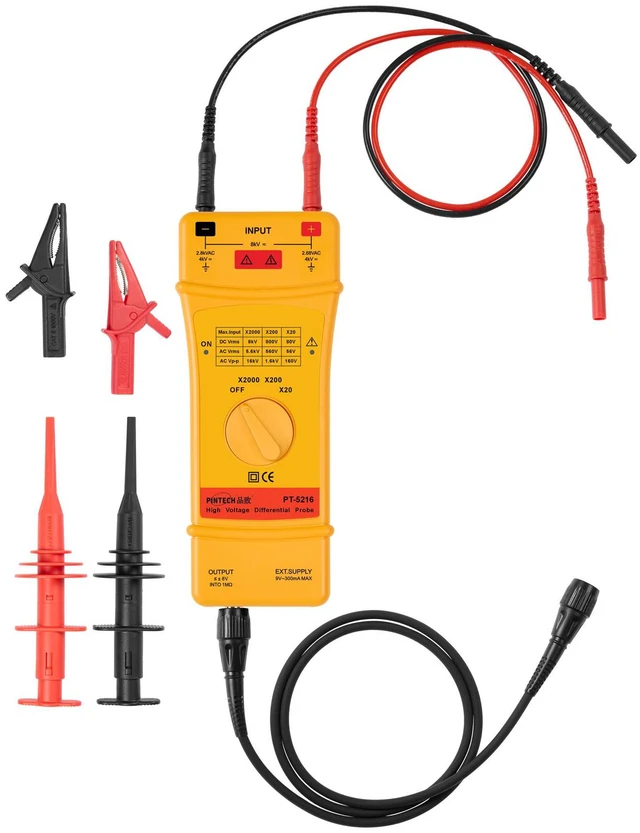
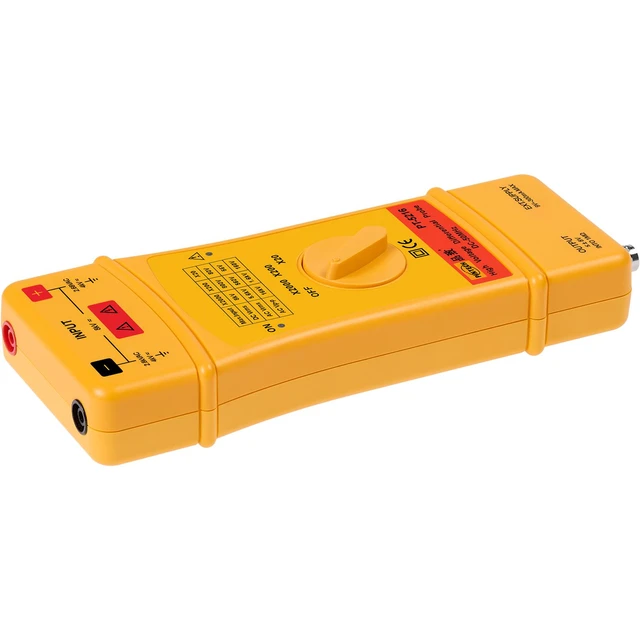
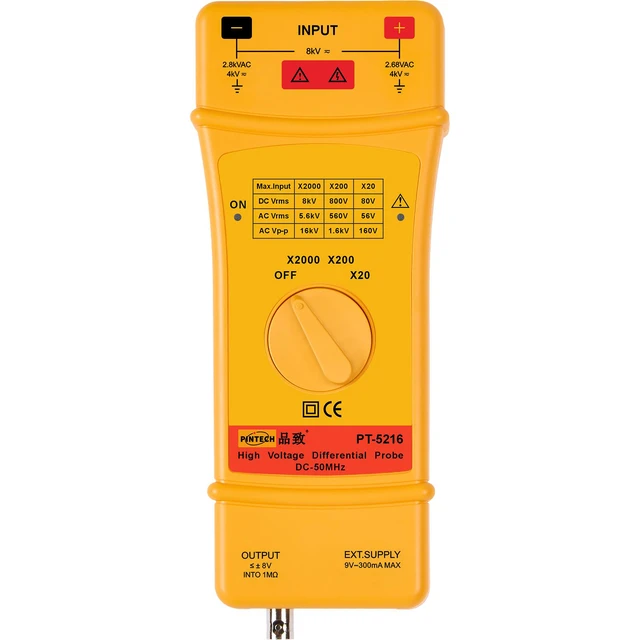
The PINTECH PT-5216 is a 16kVp-p active high-voltage differential probe kit for oscilloscopes, built for engineers and technicians who need to safely measure floating or high-voltage signals in motor drives, power electronics, and general circuit testing with selectable 20X, 200X, and 2000X attenuation.
| Attribute | Value |
|---|---|
| Best For | Active differential measurements with oscilloscopes and other electrical test equipment; suited to converting two-point/differential signals to ground-referenced measurements and troubleshooting motor circuits |
| Model Identifiers | PINTECH PT-5216 differential probe |
| Physical Dimensions | 218 × 83 × 30 mm (probe housing external dimensions) |
| Accuracy And Standards | Typical accuracy ±2% and CE certified |
| Product Type And Unit | Electrical testing & measuring device; sold as Each |
Q: Should I choose the PINTECH PT-5216 or a lower-voltage 100 MHz differential probe for inverter and motor-drive work?
A: Choose the PINTECH PT-5216 when voltage headroom matters more than extra bandwidth. Its core position is high-voltage measurement: up to 16 kVp-p with switchable 20X, 200X, and 2000X attenuation, which fits DC bus, inverter output, and motor-drive testing better than many 700 V to 1.5 kV differential probes. A lower-voltage 100 MHz probe is the better fit when your circuits stay well below the PT-5216's voltage range and you want more bandwidth for faster switching edges. In short: PT-5216 for higher-voltage power electronics; lower-voltage 100 MHz probes for lower-voltage, faster-edge analysis.
Q: Is the PINTECH PT-5216 better than using two standard oscilloscope channels in A-B math mode?
A: Choose the PT-5216 when you need a safer, purpose-built way to measure floating or high-side signals. Community guidance consistently treats a real differential probe as the right tool for high-voltage work because it provides dedicated differential measurement and isolation behavior that two passive probes and scope math do not match in practice. Two-channel subtraction can still work for lower-risk bench measurements, but the PT-5216 is the better choice for repeated power-electronics debugging, especially around motor drives, switching nodes, and non-ground-referenced signals.
Q: Should I buy the PINTECH PT-5216 or a higher-bandwidth 200 MHz differential probe?
A: Choose the PT-5216 if your main need is measuring higher-voltage waveforms and switching activity up to a moderate bandwidth range. Its 50 MHz bandwidth is aligned with many power-conversion and motor-control tasks, while 200 MHz probes are typically chosen when users need cleaner visibility into faster switching transitions, higher-frequency ringing, or wide-bandgap power designs. The trade-off is straightforward: PT-5216 gives more voltage range; a 200 MHz model gives more high-frequency detail.
Q: Is the PINTECH PT-5216 a better fit than a compact low-voltage differential probe for portability and general bench use?
A: Choose the PT-5216 when your bench work includes mains-referenced, inverter, or high-side measurements and you want one probe with broad voltage coverage. Choose a compact low-voltage differential probe when portability, battery operation, or small-signal work matters more than maximum voltage. Community discussions around differential probes regularly separate these two use cases: high-voltage isolation probes for power electronics, and lower-voltage compact probes for convenience and lighter bench tasks.
Q: Who is the PT-5216 best suited for?
A: The PT-5216 is best suited for bench technicians, power electronics work, motor-drive troubleshooting, inverter testing, and other floating or high-common-mode measurements where a standard ground-referenced passive probe is not appropriate. It is less suitable for basic low-voltage hobby troubleshooting, where a normal 10X passive probe is usually simpler and cheaper.
Q: Will it work with my oscilloscope?
A: Usually yes, if your oscilloscope has a standard BNC input and the scope can accept the probe's output range. The PT-5216's BNC interface makes it broadly compatible, but buyers should still verify the scope's input characteristics and remember that standard BNC does not provide automatic scaling or built-in power for active probes. In practice, this means compatibility is broad, but setup may be more manual than with brand-specific powered probe interfaces.
Q: Is 50 MHz enough, or should I buy a higher-bandwidth differential probe?
A: 50 MHz is usually enough for general power electronics, motor drives, SMPS debugging, and many industrial waveforms. It is not the best fit for fast digital edges, higher-speed switching analysis, or work where you need more waveform detail above tens of megahertz. Buyers choosing between similar probes often trade price for bandwidth: 50 MHz is the practical choice for mainstream high-voltage differential measurements, while 100 MHz or higher is better for faster signals.
Q: What is the main trade-off versus a standard passive probe?
A: The main advantage is safety and measurement correctness on floating or high-side signals: a differential probe lets you measure between two points without tying oscilloscope ground directly into the circuit. The trade-offs are higher cost, external power or active-probe complexity, and lower convenience than a basic passive probe for everyday grounded measurements. If most of your work is ordinary low-voltage signals, a passive probe remains the better value.
Q: Is this a better buy than lower-voltage differential probes?
A: It is a better buy only if you actually need very high differential voltage range. The PT-5216's key value is its 16 kVp-p capability plus multiple attenuation settings, which makes it more suitable for higher-voltage lab and field work than lower-voltage probe options. The trade-off is that if your measurements stay far below that range, a lower-voltage probe with similar or higher bandwidth may be the more cost-efficient choice.
Q: Who is the PT-5216 best suited for?
A: It is best suited for users who need to measure high-voltage differential or floating signals on a standard BNC oscilloscope, especially in power electronics, mains-related work, and motor-drive debugging. It is less suited for general low-voltage bench work where a standard passive probe is simpler and usually more practical.
Q: Is the PT-5216 a good choice if I need to measure mains or motor-drive signals safely on a grounded oscilloscope?
A: Yes, that is the main use case it fits. A differential probe is the right type of tool when the signal is not safely referenced to scope ground. The PT-5216 adds high-voltage differential capability, 16 kVp-p maximum differential voltage, and BNC compatibility, which makes it more appropriate for mains and motor-circuit measurements than a normal passive probe.
Q: Can the PT-5216 also be used for low-voltage signals, or is it only for high voltage?
A: It can be used on lower-voltage differential signals, but it is not an ideal everyday low-voltage probe. Its 20X, 200X, and 2000X attenuation settings are optimized for high-voltage work, so small signals will appear reduced at the oscilloscope input and may be less convenient to view accurately than with a lower-attenuation probe.
Q: What are the main trade-offs of choosing the PT-5216?
A: The main trade-off is specialization. It offers high-voltage differential measurement, multiple attenuation ratios, and 50 MHz bandwidth, but that comes with the usual compromises of this probe class: it is more niche than a standard probe, less convenient for small-signal work, and mainly worth buying if you regularly measure floating or hazardous high-voltage nodes.


