




 here!
I’m your shopping assistant for PC builds, upgrades, and everything tech.
Got questions? Ask away!
Start a conversation
here!
I’m your shopping assistant for PC builds, upgrades, and everything tech.
Got questions? Ask away!
Start a conversationShipped by GUANGZHOU PINTECH CO LTD




Any questions? Ask CelesteSM will help you find out quickly.
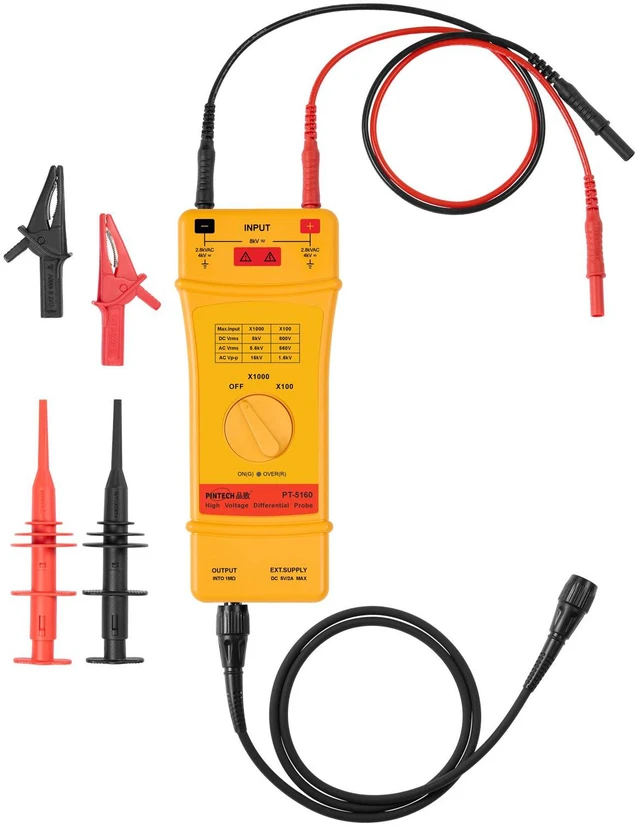
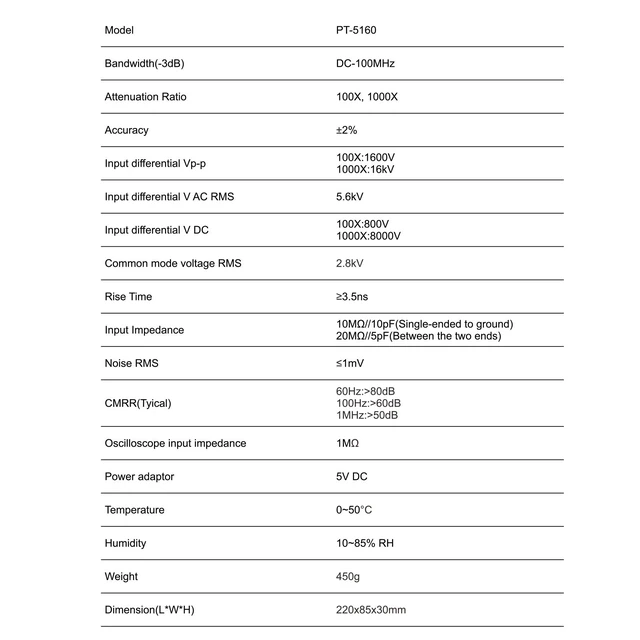
MODEL: PT-5160
Bandwidth (-3dB): DC-100MHz
Testing Voltage(Vp-p): 100X: 1.6kV; 1000X: 16kV
Input DC Voltage: 100X: 800V; 1000X: 8kV
Attenuation Rate: 100X/1000X
Rising Time: 3.5ns
Accuracy: ±2%
Input Impedance: Between the two ends: 20M//5pF, Single-ended to ground: 10M//10pF
Common-mode voltage: 2.8kV RMS
CMRR: 60Hz:>80dB; 100Hz:>60dB; 1MHz:>50dB
Oscilloscope Input Impedance: 1M
Noise: 1mV rms
Weight: 450g/0.99lb
Dimension(LxWxH): 220x85x30 mm
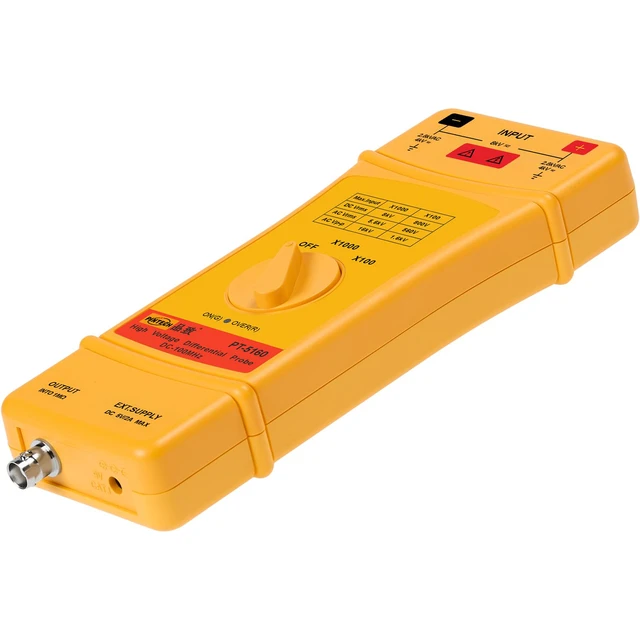
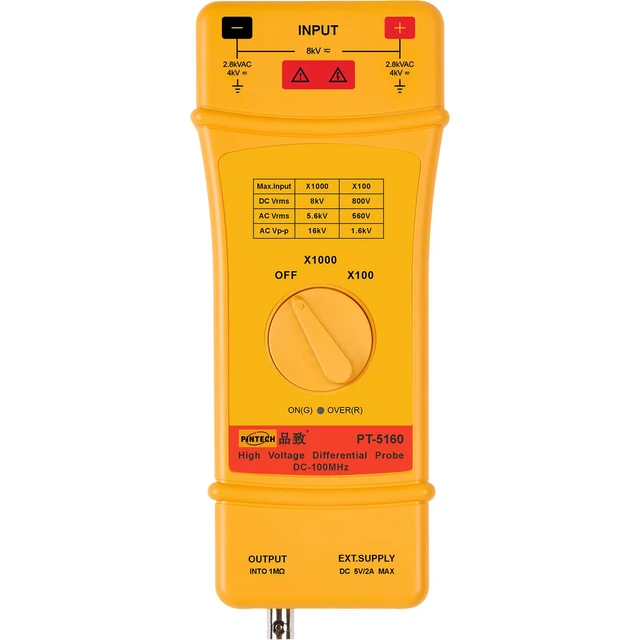
The PINTECH PT-5160 is a high-frequency differential oscilloscope probe designed for engineers and technicians who need to measure high-voltage differential signals up to 16 kVp-p with bandwidth up to 100 MHz. It is best suited for lab, electronics testing, and power measurement setups that use standard BNC oscilloscopes.
| Attribute | Value |
|---|---|
| Best For | Technicians and engineers who need a high-voltage differential oscilloscope probe for measuring isolated signals; intended to be used with standard oscilloscope inputs (BNC) |
| Model Identifiers | PINTECH PT-5160 |
| Product Type | Electrical testing & measuring equipment (probe) suitable for oscilloscope measurement tasks |
| Physical Dimensions | Probe housing measures 220 x 85 x 30 mm |
| Accuracy And Compliance | Typical accuracy ±2% with CE certification |
| Packaging And Unit | Sold individually (Each) |
Q: Should I choose the PINTECH PT-5160 or a 70 MHz / 7 kV differential probe like the Siglent DPB5700?
A: Choose the PT-5160 when you need more bandwidth and much higher peak differential voltage headroom in one probe. Official specs place the PT-5160 at DC-100 MHz with 100X/1000X attenuation and up to 16 kVp-p differential measurement, while the Siglent DPB5700 is 70 MHz with 100X/1000X attenuation and 7000 V maximum differential voltage. A 70 MHz class probe is still suitable for many power electronics tasks, but the PT-5160 is the stronger fit for users who expect faster edges or larger high-voltage waveforms.
Q: Is the PT-5160 a better choice than a 50 MHz or 70 MHz high-voltage differential probe?
A: The PT-5160 is the better choice when your priority is preserving waveform detail on faster switching edges. Its published 100 MHz bandwidth and 3.5 ns rise time give it more margin than 50 MHz or 70 MHz probes, which are more often chosen for lower-frequency inverter, mains, or general SMPS troubleshooting. The trade-off is that lower-bandwidth probes can still be enough for routine service work if your signals do not require the extra bandwidth.
Q: Should I buy the PT-5160 or a lower-voltage 100 MHz differential probe such as a 1500 V class model?
A: Buy the PT-5160 if you specifically need high-voltage measurement headroom. Many 100 MHz differential probes in the market are in the 700 V, 1500 V, or 3000 V class, while the PT-5160 is positioned for much higher-voltage work with 1000X mode supporting up to 16 kVp-p. If your actual measurements stay well below those levels, a lower-voltage 100 MHz probe may cover the same bandwidth needs with less excess range. The decision mainly comes down to required voltage margin, not just bandwidth.
Q: Can I use two standard oscilloscope channels in math-difference mode instead of buying the PT-5160?
A: Use the PT-5160 when the measurement is floating, high voltage, or safety-sensitive. Community guidance consistently treats a true high-voltage differential probe as the safer and more appropriate tool for non-ground-referenced measurements, especially when common-mode voltage is significant. Two-channel math subtraction can work for some lower-risk cases, but it does not replace the isolation, voltage rating, and common-mode handling that a dedicated differential probe is designed to provide.
Q: Is the PT-5160 better for performance-first bench testing or for portable field use?
A: The PT-5160 is better matched to performance-first bench testing. Its positioning centers on broad oscilloscope compatibility through a standard BNC interface, 100 MHz bandwidth, and very high differential voltage capability, which aligns with lab and development measurements on power electronics. For portability-focused use, some buyers may prefer lower-voltage or lighter-duty probes if they mainly need convenience rather than maximum voltage range and bandwidth.
Q: Who is the PT-5160 best suited for?
A: The PT-5160 is best suited for bench testing of high-voltage differential signals where a standard ground-referenced passive probe would be unsafe or impractical. Based on its stated 100 MHz bandwidth, 100X/1000X attenuation options, BNC output, and 16 kVp-p maximum differential voltage, it fits power electronics, inverter, motor drive, SMPS, and mains-side waveform troubleshooting better than general low-voltage hobby probing.
Q: Can I use this with any oscilloscope that has a BNC input?
A: Usually yes for basic connectivity, because the PT-5160 uses a standard BNC interface. However, buyers should still confirm three things before purchase: the oscilloscope input is standard 1 MΩ, the scope can be set to match the probe attenuation factor correctly, and the voltage/frequency range of the measurement stays within the probe’s safe operating limits. A BNC connector helps compatibility, but it does not guarantee correct scaling or safe high-voltage use on every scope.
Q: Is this a good choice for measuring mains, inverter, or floating high-side signals?
A: Yes, this is the kind of probe intended for that job. Differential probes are commonly chosen when the signal cannot be safely referenced to oscilloscope ground, such as mains-side switching power supplies, inverter outputs, or floating nodes. The PT-5160’s high differential voltage rating and differential input design make it much more suitable for those cases than a standard passive probe, provided the user stays within its safety limits and understands high-voltage measurement practice.
Q: What is the main trade-off versus a regular 10X passive probe?
A: The main trade-off is specialization. A regular 10X passive probe is simpler and often better for routine low-voltage, ground-referenced measurements. The PT-5160 is the better choice when you need differential measurement and much higher voltage handling, but its 100X/1000X attenuation reduces signal amplitude at the scope input, so it is less convenient for very small signals. In short: better for safety and floating high-voltage work, less ideal for everyday low-level debugging.
Q: Is 100 MHz enough, or should I buy a higher-bandwidth differential probe instead?
A: 100 MHz is enough for many power electronics, industrial, and general-purpose high-voltage waveform checks, especially where the main need is safe differential measurement rather than RF detail. You may want a higher-bandwidth probe if you are debugging faster edges, higher-frequency switching transitions, or signal integrity issues where more waveform detail matters. The PT-5160 is a practical fit when voltage range and general bench compatibility matter more than top-end bandwidth.
Q: Who is the PT-5160 actually suitable for?
A: The PT-5160 is best suited for users measuring high-voltage differential signals on a standard oscilloscope, especially in power electronics, inverter, SMPS, or mains-referenced work. It is less suitable for routine low-voltage bench work, because its 100X and 1000X attenuation modes reduce small signals substantially.
Q: Is the PT-5160 a good choice for low-voltage measurements?
A: Usually no, unless you specifically need isolation or differential measurement. For low-voltage signals, the PT-5160's 100X and 1000X attenuation make the displayed signal much smaller, which reduces practical sensitivity compared with ordinary 1X or 10X probes.
Q: Is the PT-5160 worth buying if I need to probe high-side or mains-referenced circuits safely?
A: It can be a sensible fit if your main requirement is safely viewing high-voltage differential signals with a BNC oscilloscope. Its stated 16 kVp-p maximum differential rating and differential format match the kind of measurement users commonly discuss for high-side switching nodes and non-ground-referenced circuits. The trade-off is that it is a specialized tool, not a general-purpose probe.
Q: What are the main trade-offs of choosing the PT-5160 instead of a regular oscilloscope probe?
A: The main advantage is safe differential measurement of high-voltage signals on grounded oscilloscopes. The main trade-offs are lower usefulness for small signals, fixed high attenuation, and more specialized use than a normal passive probe. It is a better fit for power and high-voltage diagnostics than for everyday electronics debugging.


