




 here!
I’m your shopping assistant for PC builds, upgrades, and everything tech.
Got questions? Ask away!
Start a conversation
here!
I’m your shopping assistant for PC builds, upgrades, and everything tech.
Got questions? Ask away!
Start a conversationShipped by GUANGZHOU PINTECH CO LTD




Any questions? Ask CelesteSM will help you find out quickly.
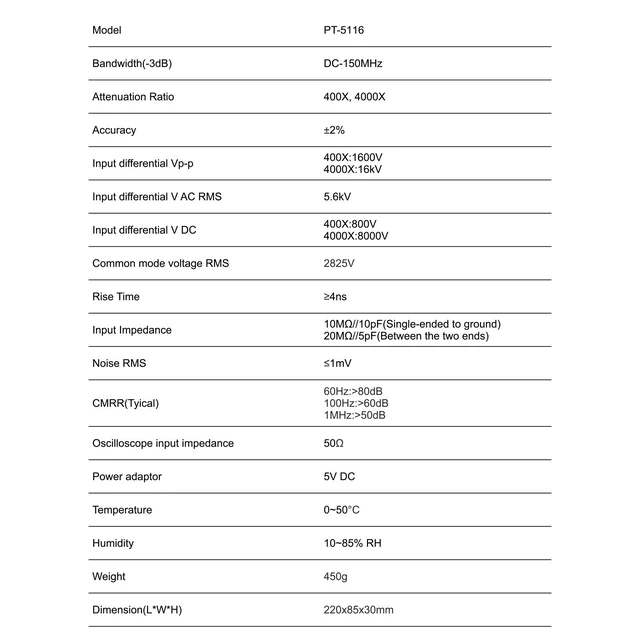
MODEL: PT-5116
Bandwidth (-3dB): DC-150MHz
Testing Voltage(Vp-p): 400X: 1.6k; 4000X: 16kV
Input DC Voltage: 400X: 800V; 4000X: 8kV
Attenuation Rate: 400X/4000X
Rising Time: 2.3ns
Accuracy: ±2%
Input Impedance: Between the two ends: 20M//5pF, Single-ended to ground: 10M//10pF
CMRR: 60Hz:>80dB; 100Hz:>60dB; 1MHz:>50dB
Oscilloscope Input Impedance: 50M
Noise: 1mV rms
Weight: 450g/0.99lb
Dimension(LxWxH): 220x85x30 mm
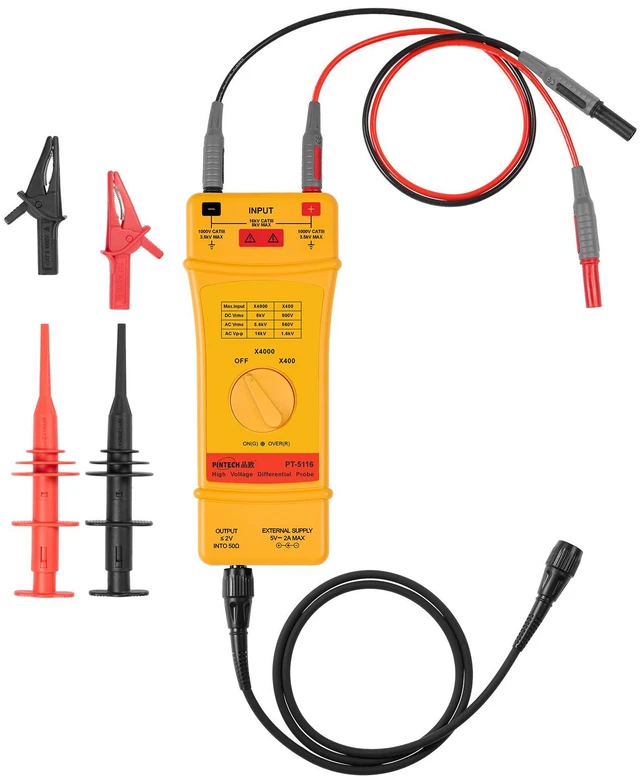
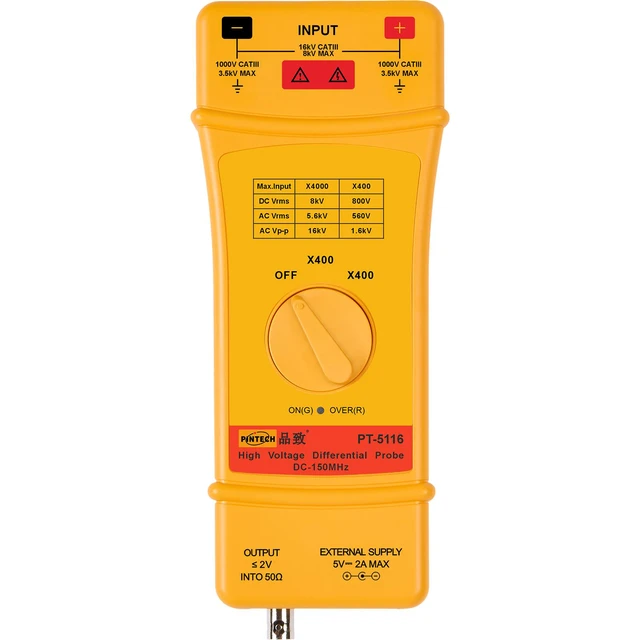
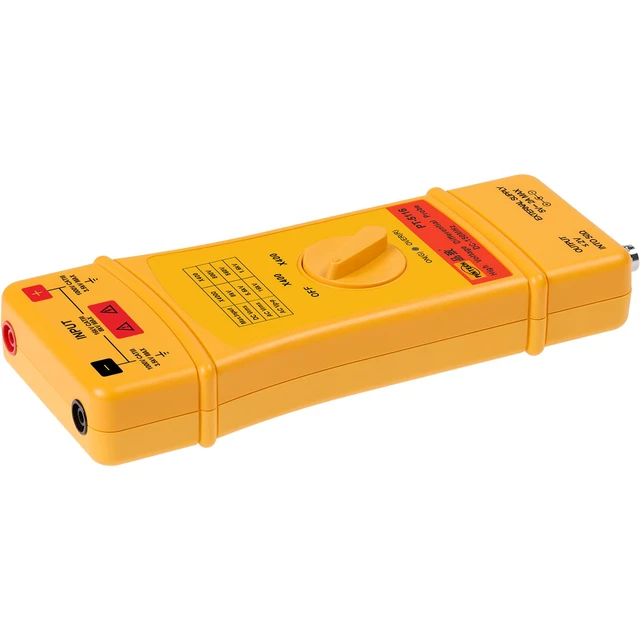
The PINTECH PT-5116 is a 150MHz high-voltage differential oscilloscope probe with 400X/4000X attenuation and up to 16kVp-p differential measurement, suited for engineers and technicians testing fast-rising, high-voltage signals on standard BNC oscilloscopes.
| Attribute | Value |
|---|---|
| Best For | Differential oscilloscope measurements and high-voltage signal testing; pairs with standard BNC-equipped oscilloscopes for lab and field electrical testing |
| Model Identifiers | PINTECH PT-5116 |
| Function | Electrical Testing & Measuring |
| Physical | 220 x 85 x 30 mm enclosure |
| Accuracy And Standards | Typical accuracy ±2%; CE certified |
| Selling Information | Sold individually (each) |
Q: Should I choose the PINTECH PT-5116 or a 100MHz/1500V differential probe for inverter and mains work?
A: Choose the PINTECH PT-5116 when your priority is much higher differential voltage headroom. Its published positioning is a 150MHz high-voltage differential probe with 400X/4000X attenuation and up to 16kVp-p maximum differential test voltage, which fits applications where voltage range matters more than lower-attenuation sensitivity. A 100MHz/1500V class probe is the more practical choice when your signals stay far below that range and you want attenuation options such as 50X/500X for better vertical sensitivity on lower-voltage measurements.
Q: Is the PT-5116 a better fit than a 70MHz high-voltage differential probe?
A: The PT-5116 is the better fit when you need more bandwidth for faster edges and higher-frequency switching waveforms. PINTECH positions the PT-5116 at 150MHz with a 2.3ns rise time, while common lower-tier high-voltage differential probes in the same broader category are often around 70MHz. A 70MHz model still makes sense when your measurements are slower and you mainly want a simpler lower-bandwidth option without needing the extra response margin of a 150MHz probe.
Q: PT-5116 vs a 150MHz/3000V differential probe: which one makes more sense?
A: Choose the PT-5116 if your buying decision is driven by high-voltage capability first. A 150MHz/3000V class probe can be a better fit when you need similar bandwidth but lower attenuation and lower-capacitance characteristics that are often preferred for lower-voltage power electronics work. In practice, the trade-off is straightforward: PT-5116 favors voltage headroom, while 3000V-class 150MHz probes are usually chosen when the circuit voltage is lower and signal loading or sensitivity matters more.
Q: Should I buy the PT-5116 or a higher-bandwidth 300MHz to 400MHz differential probe?
A: Buy the PT-5116 when your measurements are primarily high-voltage and 150MHz already covers the waveform content you need to capture. Move to a 300MHz to 400MHz differential probe when edge fidelity and wider bandwidth are more important than maximum voltage range, such as advanced switching analysis where probe bandwidth becomes the limiting factor. The main trade-off is bandwidth versus voltage headroom, not a simple good-versus-bad choice.
Q: For bench portability and broad scope compatibility, is the PT-5116 better than a scope-specific active probe?
A: The PT-5116 is the more flexible choice when you want a standard BNC-connected differential probe that can work across many oscilloscopes. That makes it easier to move between benches or mixed-brand setups. A scope-specific active probe can be the better match when you want tighter integration, such as direct oscilloscope power or model-specific probe features, but that convenience usually depends on compatible instrument families.
Q: Who is the PT-5116 most suitable for?
A: The PT-5116 is best suited for engineers, technicians, and advanced hobbyists who need to measure high-voltage differential signals on a standard oscilloscope. Its 150 MHz bandwidth, 2.3 ns rise time, 400X/4000X attenuation, and 16 kVp-p maximum differential voltage make it a better fit for power electronics, motor drives, switch-mode power supplies, and inverter work than for basic low-voltage bench debugging.
Q: Will this probe work with my oscilloscope?
A: Usually yes, if your oscilloscope has a standard BNC input and 1 MΩ input impedance. The PT-5116 is described as using a standard BNC interface and being compatible with oscilloscopes broadly, but buyers should still confirm their scope's input impedance, voltage limits, and whether external probe power or attenuation setup is required. Compatibility is generally easier with mainstream bench scopes than with specialty inputs such as SMA-only instruments.
Q: Is a high-voltage differential probe like this worth buying instead of using two standard probes and math subtraction?
A: Yes, if you regularly measure floating, non-ground-referenced, or high-voltage switching signals. A dedicated differential probe is the safer and more practical choice because it is designed for differential measurement without tying oscilloscope ground to the circuit. The trade-off is cost and added setup complexity versus simply using standard passive probes for low-risk, ground-referenced work.
Q: What are the main trade-offs of the PT-5116 versus a lower-voltage or general-purpose differential probe?
A: The PT-5116 appears optimized for higher-voltage measurement headroom and broad oscilloscope compatibility, which is useful for power electronics work. The trade-off is that it is more specialized than a basic bench probe: for low-voltage digital signals, audio, or everyday troubleshooting, a simpler passive probe or lower-voltage differential probe may be cheaper, easier to handle, and sufficient. Buyers should choose the PT-5116 mainly when they actually need high differential voltage capability.
Q: Is 150 MHz bandwidth enough for fast switching and power electronics work?
A: For many power electronics and high-voltage switching tasks, yes. A 150 MHz bandwidth and 2.3 ns rise time are typically appropriate for observing switching edges, converter waveforms, motor-drive signals, and similar measurements. It is less ideal for very high-speed digital validation or RF work, where probe bandwidth well above 150 MHz may be necessary.
Q: Who is the PT-5116 actually suitable for?
A: The PT-5116 is best suited for users who need to measure high-voltage differential signals on a bench oscilloscope, such as power electronics, mains-referenced circuits, motor drives, or tube-amplifier work. Reddit discussions repeatedly point to differential probes as the safer and more appropriate choice when measuring mains or floating high-side signals, instead of using standard ground-referenced probes. It is less suitable for casual low-voltage debugging where a normal passive probe is usually simpler and gives more signal at the scope.
Q: Is the PT-5116 a good choice for measuring mains or other high-voltage signals safely?
A: Yes, if your use case specifically requires a high-voltage differential probe. The PT-5116 is specified for up to 16 kVp-p differential measurement and is designed for exactly the kind of isolated high-side or mains-related measurements that Reddit users warn are risky with standard probes. The trade-off is that safe operation still depends on using the probe within its ratings and following proper oscilloscope and test setup practice.
Q: What are the main trade-offs of the PT-5116 versus a standard oscilloscope probe?
A: The main advantage is safe differential measurement at high voltage. The main trade-offs are attenuation and specialization. With 400X and 4000X ranges, the PT-5116 is intended for large signals, so small low-voltage signals will appear much smaller on the oscilloscope and may be less convenient to inspect. Community discussions around differential probes regularly highlight that they solve grounding and common-mode problems, but they are not the most convenient tool for routine low-voltage probing.
Q: Will the PT-5116 work with most oscilloscopes?
A: Usually yes, but only if the oscilloscope input matches what the probe expects. The product uses a standard BNC connection, which helps with physical compatibility, but differential probe discussions show that electrical compatibility still matters. Buyers should confirm the required oscilloscope input conditions before purchase rather than assuming any BNC-equipped scope is fully compatible.


