




 here!
I’m your shopping assistant for PC builds, upgrades, and everything tech.
Got questions? Ask away!
Start a conversation
here!
I’m your shopping assistant for PC builds, upgrades, and everything tech.
Got questions? Ask away!
Start a conversationShipped by GUANGZHOU PINTECH CO LTD




Any questions? Ask CelesteSM will help you find out quickly.
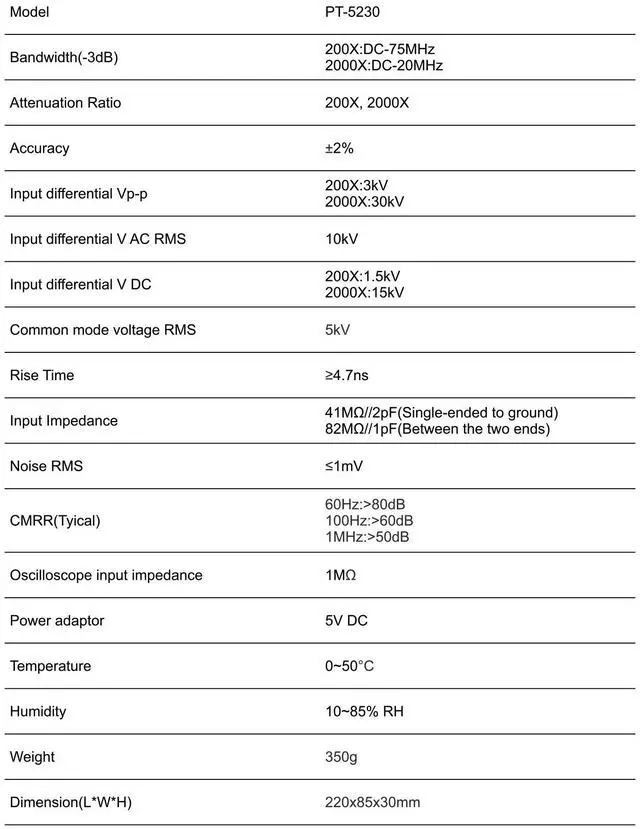
MODEL: PT-5230
Bandwidth (-3dB): DC-75MHz(x200), DC-20MHz(x2000)
Testing Voltage(Vp-p): 200X: 3kV; 2000X: 30kV
Input DC Voltage: 200X:1.5kV; 2000X: 15kV
Attenuation Rate: 200X/2000X
Rising Time: 4. 7ns
Accuracy: ±2%
Common-mode voltage RMS: 5kV
Input Impedance: Between the two ends: 82M//1pF, Single-ended to ground: 41M//2pF
CMRR: 60Hz:>80dB; 100Hz:>60dB; 1MHz:>50dB
Oscilloscope Input Impedance: 1M
Noise: 1mV rms
Weight: 350g/0.77lb
Dimension(LxWxH): 220x85x30 mm
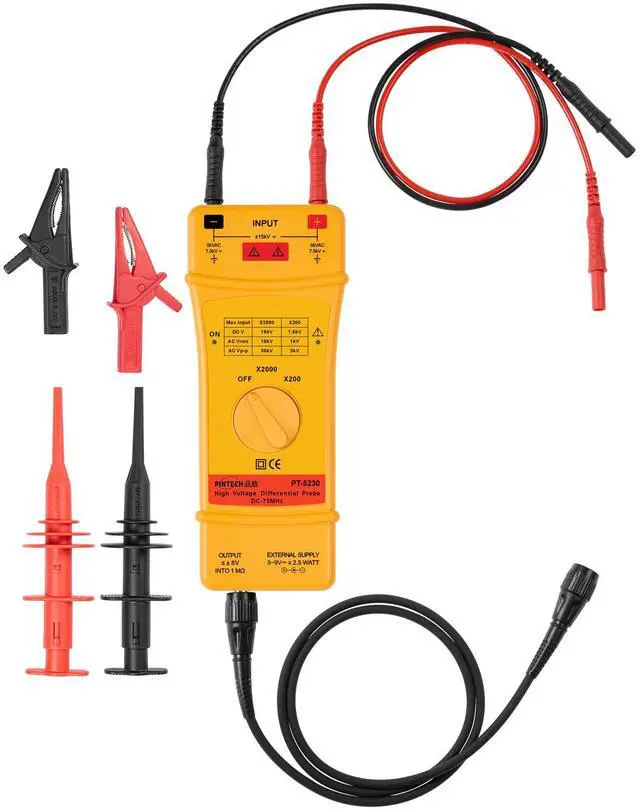
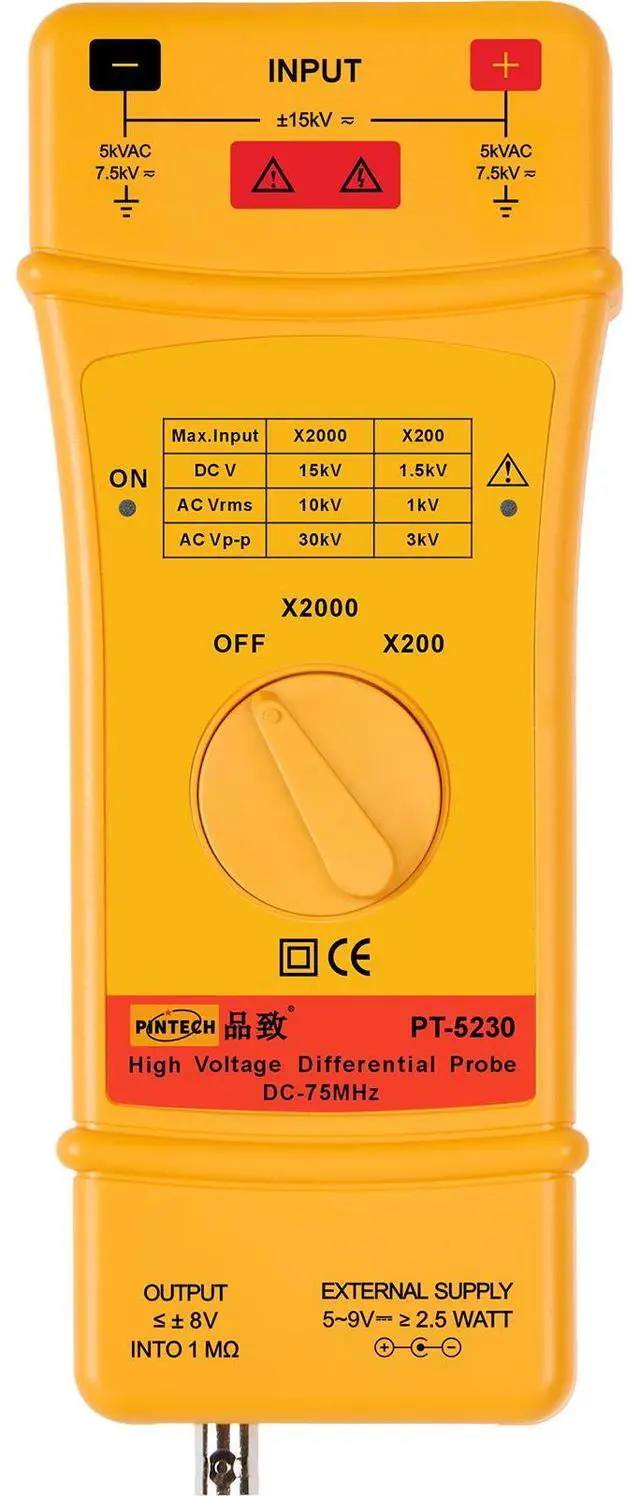
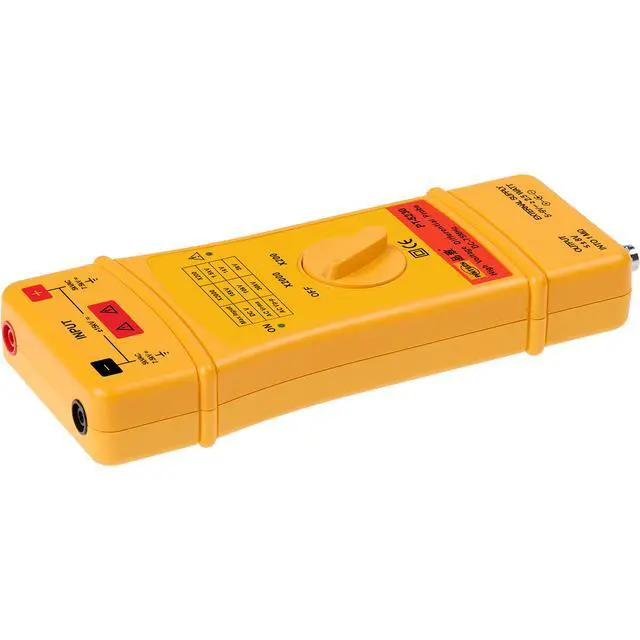
The PINTECH PT-5230 is an active high-voltage differential probe for oscilloscopes, built for engineers, technicians, and advanced electronics users who need to measure floating or differential signals up to 30kVp-p with 75MHz bandwidth and 200X/2000X attenuation.
| Attribute | Value |
|---|---|
| Best For | Measuring high-voltage differential signals and converting two-point signals to ground-referenced signals for oscilloscopes, meters, and data-acquisition equipment; suited to power- and motor-circuit troubleshooting and general high-voltage oscilloscope work |
| Electrical Performance | Maximum differential test voltage 30 kVp-p with DC–75 MHz bandwidth and selectable attenuation rates 200X or 2000X |
| Accuracy And Certification | Typical accuracy ±2% and CE certification |
| Compatibility And Connectivity | BNC interface for use with oscilloscopes; converts differential (two-point) signals to a ground-referenced signal for oscilloscopes, meters, and data-acquisition systems |
| Physical Dimensions | 220 x 85 x 30 mm probe body |
| Model Identifiers | PINTECH PT-5230 |
| Product Type And Selling Unit | Active electrical testing & measuring differential probe; sold individually (Each) |
| Package Contents And Warranty | Includes PT-5230 probe, 1 adapter, 2 probe hooks, 2 alligator clips, 1 BNC cable, and manual; 1 year warranty |
Q: Should I buy the PINTECH PT-5230 or a lower-voltage differential probe like the Micsig DP10013?
A: Choose the PINTECH PT-5230 when your main requirement is safely measuring much higher differential voltage, such as high-voltage power electronics, CRT, inverter, or industrial motor-drive work. The PT-5230 is positioned as a 30 kVp-p, 75 MHz probe with 200X and 2000X ranges, while the Micsig DP10013 is positioned for lower-voltage but higher-bandwidth work at about 100 MHz and roughly 1.3-1.5 kV class input capability depending on source version. In practice, the PT-5230 fits users who prioritize voltage headroom, while probes like the DP10013 fit users who work at lower voltage and want somewhat more bandwidth for switching-edge detail.
Q: Is the PINTECH PT-5230 better than a standard 10X or 100X passive oscilloscope probe for high-voltage testing?
A: Yes, if the job involves floating measurements or high common-mode voltage. The PT-5230 is an active differential probe designed to convert two-point measurements into a ground-referenced oscilloscope signal, which is the key reason users choose this category instead of a standard passive probe. A passive 10X or 100X probe is still appropriate for simpler grounded measurements, but the PT-5230 is the more suitable tool when safety, isolation from scope ground, and line-to-line measurement matter more than simplicity.
Q: Should I choose the PINTECH PT-5230 or a higher-bandwidth differential probe?
A: Choose the PT-5230 when voltage range is the primary constraint and 75 MHz is enough for your measurements. Choose a higher-bandwidth differential probe when you need more visibility into faster switching transitions, ringing, or harmonics in lower-voltage power electronics. This makes the PT-5230 the better fit for high-voltage coverage first, while higher-bandwidth models are a better fit for waveform-detail-first workflows.
Q: For motor drives and inverter work, should I get the PINTECH PT-5230 or a smaller portable measurement setup?
A: Choose the PT-5230 when the measurement priority is safe differential probing on high-voltage motor or inverter circuits using a standard oscilloscope with BNC input. Community discussion around mains and power electronics measurements consistently favors a proper differential probe over trying to rely on portability alone. A more portable setup can help in field use, but the PT-5230 is the more appropriate choice when measurement method and voltage rating matter more than compactness.
Q: Should I choose the PINTECH PT-5230 or another budget differential probe for occasional bench use?
A: Choose the PT-5230 if your occasional bench work can still involve genuinely high voltage, because its official positioning is centered on high-voltage differential measurement rather than entry-level low-voltage probing. Choose a lower-cost probe instead when your circuits stay far below the PT-5230's voltage class and you mainly want an affordable way to view differential signals. The practical trade-off is that the PT-5230 buys voltage margin and application range, while a budget probe may be sufficient for lighter-duty lab work.
Q: Is this a good fit for measuring floating high-voltage signals on a standard grounded oscilloscope?
A: Yes. This type of active differential probe is meant for floating measurements where neither test point should be tied directly to scope ground. The PT-5230 converts a two-point high-voltage signal into a ground-referenced output for a BNC oscilloscope, which is the main reason buyers choose a differential probe instead of a standard passive probe. It is best suited to power electronics, inverter, motor-drive, and other high-voltage bench work where safe differential measurement matters.
Q: Who is this probe suitable for?
A: It is suitable for engineers, technicians, and advanced electronics users who need to measure high-voltage differential waveforms safely. It makes the most sense for power conversion, motor control, SMPS, industrial drive, and R&D work. It is not an entry-level accessory for casual low-voltage troubleshooting, because its cost, voltage range, and active-probe setup are aimed at specialized measurement tasks rather than general hobby use.
Q: What are the main trade-offs versus a lower-voltage or lower-cost differential probe?
A: The trade-off is that you gain much higher voltage capability, but you typically accept more specialized use, higher cost, and less need for that range in everyday bench work. On this model, the high-voltage 2000X mode extends input range substantially, but the published bandwidth is lower in that mode than in 200X mode. Buyers who mainly measure lower-voltage, faster signals may get better value from a lower-voltage differential probe with higher bandwidth and simpler day-to-day handling.
Q: Is 75 MHz enough for most intended use cases?
A: Usually yes for high-voltage power electronics work, switching waveforms, motor-drive signals, and many lab measurements. It is less ideal if your priority is capturing very fast edges or higher-frequency detail beyond the probe's rated bandwidth. Also note that the higher-attenuation 2000X setting is typically paired with lower bandwidth than the 200X setting, so the practical answer depends on whether your work is more voltage-driven or speed-driven.
Q: Will it work with any oscilloscope that has a BNC input?
A: Usually it will work with many standard oscilloscopes that accept a BNC signal, but buyers should not treat 'BNC compatible' as universal compatibility. You still need to confirm the scope's input characteristics, safe operating method, and whether the probe expects a grounded-input measurement instrument. In practice, this is a better fit for conventional bench oscilloscopes than for every isolated or specialty scope.
Q: Who is the PT-5230 suitable for?
A: The PT-5230 is mainly suitable for users who need to measure high-side, floating, or mains-referenced signals on a standard oscilloscope more safely than with a normal ground-referenced probe. Reddit and YouTube discussions around differential probes consistently point to power electronics, motor drives, inverters, and mains waveform work as the main use cases. It is less suitable if you only measure low-voltage logic, where a standard probe or logic analyzer is often the simpler choice.
Q: Is the PT-5230 worth buying for mains and high-voltage oscilloscope work?
A: It can be worth buying if your main need is safer differential measurement of mains or other high-voltage floating signals with a standard oscilloscope. The product specs fit that role well: 30 kVp-p maximum differential voltage, 75 MHz bandwidth, and 200X/2000X attenuation. Community discussion consistently treats a proper high-voltage differential probe as the correct tool for this job. It is less compelling if your work is mostly low-voltage bench circuits, because the high attenuation and specialized design are not the most convenient trade-off there.
Q: Can the PT-5230 also be used for lower-voltage signals?
A: Yes, but it is best viewed as a high-voltage differential probe that can also handle lower-voltage differential measurements. Discussions around similar probes show that low-voltage use is possible, but often not ideal unless you specifically need differential isolation or floating measurements. The main trade-off is attenuation: with 200X or 2000X settings, small signals are reduced heavily, so signal resolution on the oscilloscope can become a limitation.
Q: What are the main trade-offs of choosing the PT-5230?
A: The main trade-off is specialization. The PT-5230 is designed for high-voltage differential work, so it gives you safer floating measurements and broad oscilloscope compatibility through BNC, but it is not the most convenient probe for small low-voltage signals. Community discussions around differential probes repeatedly mention cost, noise, and reduced practicality versus standard probes for everyday bench debugging. In short: it is a better fit for power and high-voltage measurement tasks than for general-purpose low-voltage probing.



