




 here!
I’m your shopping assistant for PC builds, upgrades, and everything tech.
Got questions? Ask away!
Start a conversation
here!
I’m your shopping assistant for PC builds, upgrades, and everything tech.
Got questions? Ask away!
Start a conversationShipped by GUANGZHOU PINTECH CO LTD

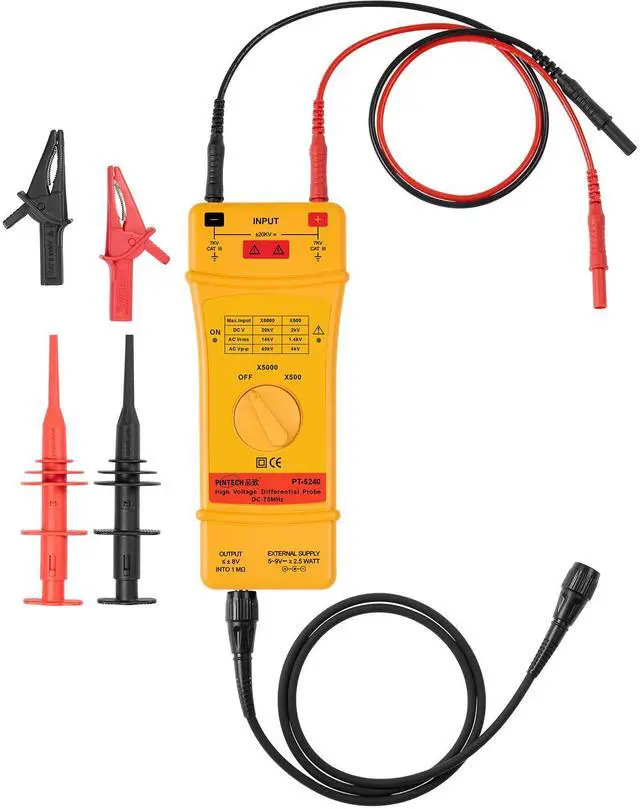
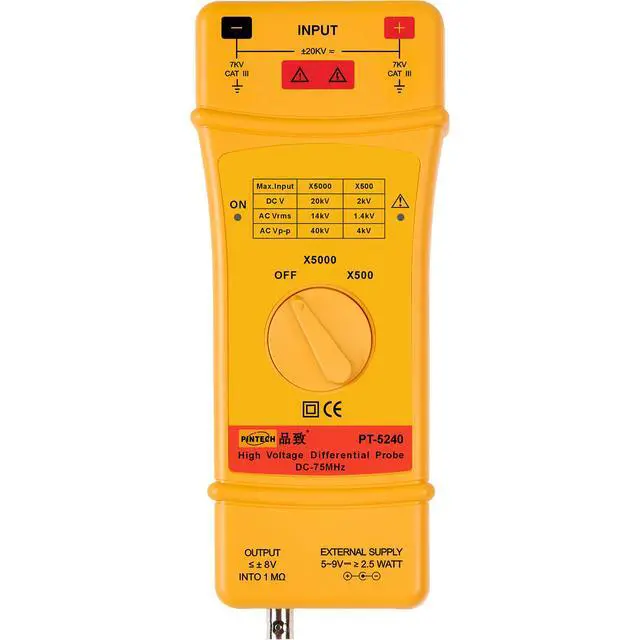
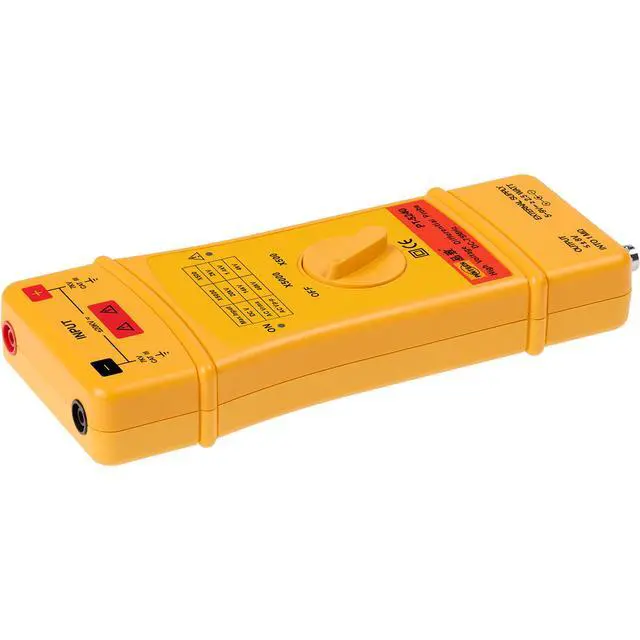



Any questions? Ask CelesteSM will help you find out quickly.
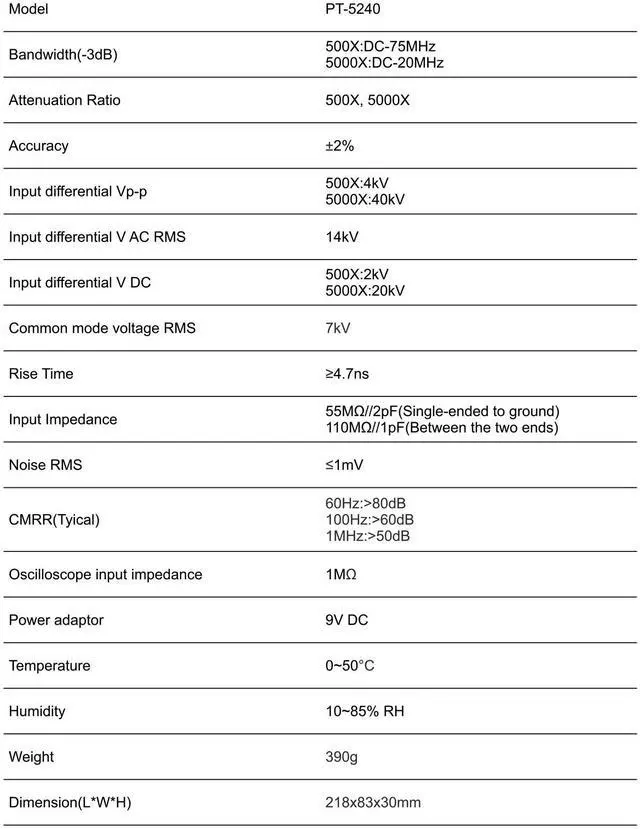
MODEL: PT-5240
Bandwidth (-3dB): DC-75MHz(x500), DC-20MHz(x5000)
Testing Voltage(Vp-p): 500X: 4kV;5000X: 40kV
Input DC Voltage: 500X: 2kV;5000X: 20kV
Attenuation Rate: 500X/5000X
Rising Time: 4. 7ns
Common-mode voltage: 7kV RMS
Accuracy: ±2%
Input Impedance: Between the two ends: 110M//1pF, Single-ended to ground: 55M//2pF
CMRR: 60Hz:>80dB;100Hz:>60dB;1MHz:>50dB
Oscilloscope Input Impedance: 1M
Noise: 1mV rms
Weight: 390g/0.86lb
Dimension(LxWxH): 218x83x30 mm
The PINTECH PT-5240 is a 40kV high-voltage active differential oscilloscope probe with 75MHz bandwidth and 500X/5000X attenuation, suited for engineers, technicians, and lab users measuring floating or high-voltage signals in motor drives, power electronics, and general circuit testing.
| Attribute | Value |
|---|---|
| Best For | Hands-on oscilloscope testing of differential and high-voltage two-point signals; suited for troubleshooting motor circuits and converting two-point signals into ground-referenced measurements |
| Model Identifiers | PINTECH PT-5240 differential probe |
| Measurement Accuracy | ±2% accuracy for differential measurements |
| Product Type | Electrical testing and measuring device |
| Physical Dimensions | 218 x 83 x 30 mm (L x W x H) |
| Compliance | CE certified |
| Selling Unit | Sold individually (Each) |
Q: Should I choose the PINTECH PT-5240 or a 1.3 kV class differential probe like the Micsig DP10013?
A: Choose the PINTECH PT-5240 when your main requirement is safely measuring much higher differential voltage, including applications such as HV power electronics, motor drives, or floating points that can exceed the range of common bench differential probes. The PT-5240 is positioned as a 40 kVp-p probe with 500X and 5000X ranges, while probes such as the Micsig DP10013 are positioned for much lower voltage work around the 1.3 kV class with higher bandwidth. The trade-off is that the lower-voltage probe class is usually better for smaller-signal visibility and general-purpose lab use, while the PT-5240 is the more suitable choice when voltage headroom matters more than sensitivity.
Q: Is the PT-5240 better than a 700 V to 1.5 kV differential probe for EV and mains troubleshooting?
A: The PT-5240 is the better fit only when your measurements can genuinely require multi-kilovolt differential range. For typical EV subsystem checks, mains-related troubleshooting, and electronics service work, lower-range probes such as 700 V to 1.5 kV models are often the more practical choice because they are designed around lower attenuation and easier viewing of smaller waveform details. In short: pick the PT-5240 for high-voltage headroom; pick the lower-range class for everyday power diagnostics where signal detail is more important than extreme voltage capability.
Q: Should I buy the PT-5240 or a higher-bandwidth differential probe?
A: Buy the PT-5240 if your work is dominated by high-voltage measurement and 75 MHz bandwidth is enough for the switching edges and waveform content you need to observe. A higher-bandwidth probe is the better choice when you are working on faster edges, lower-voltage switching nodes, or signal-integrity style debugging where bandwidth takes priority over extreme voltage range. The practical trade-off is simple: the PT-5240 favors voltage capability, while higher-bandwidth alternatives favor transient detail.
Q: For motor drives and floating high-voltage nodes, is the PT-5240 a better choice than a standard passive probe setup?
A: Yes, if the measurement point is floating or at high common-mode voltage, the PT-5240 is the more appropriate tool than a standard passive probe setup. Differential probes in this class are specifically intended to convert a two-point floating measurement into a scope-friendly ground-referenced output. Compared with passive probes, the advantage is safer measurement of non-ground-referenced high-voltage nodes. The trade-off is that a dedicated differential probe adds cost and has its own attenuation and bandwidth limits, so it makes the most sense when safety and measurement topology are the deciding factors.
Q: Who is this high-voltage differential probe best suited for?
A: The PINTECH PT-5240 is best suited for bench and field users who need to measure floating or high-side voltages safely with a grounded oscilloscope, especially in motor drives, power electronics, inverters, and high-voltage troubleshooting. Its 40 kVp-p maximum differential voltage and active differential design make it more suitable for industrial and power-circuit work than for low-voltage general electronics.
Q: Do I need a differential probe like this, or can I just use two standard oscilloscope probes and math?
A: Buy a differential probe if you need safer, cleaner measurements on floating, high-side, or high-common-mode circuits. Two standard probes plus math can work for some low-risk cases, but a true differential probe is the better choice when common-mode voltage is high, signal rejection matters, or you are working on motor drives and power converters. The PT-5240 is positioned for those higher-risk measurement scenarios.
Q: Is 75 MHz enough bandwidth for this kind of probe?
A: Yes for most power electronics, inverter, motor-drive, and switching waveform work; no if you need to capture faster edges or higher-frequency detail. A 75 MHz differential probe is generally a practical fit for troubleshooting and validating many high-voltage switching circuits, but users doing faster transient analysis may prefer 100 MHz or higher alternatives.
Q: What are the main trade-offs versus a lower-voltage or lower-cost differential probe?
A: The main advantage of the PT-5240 is voltage headroom: it is built for much higher differential voltage than entry-level differential probes, which makes it a better fit for demanding power applications. The trade-off is that high-voltage probes are typically more specialized, bulkier, and less necessary for low-voltage lab work. If your circuits are well below high-voltage ranges, a lower-voltage differential probe may be simpler and more cost-efficient.
Q: Will it work with my oscilloscope?
A: It should work with most oscilloscopes that accept a standard BNC input, because the PT-5240 outputs a scope-friendly signal through a BNC connection and uses 500X or 5000X attenuation. Compatibility is strongest when your scope can accurately account for the probe attenuation and when your measurement setup matches the probe’s voltage and safety limits. It is less about brand matching and more about BNC input compatibility, attenuation handling, and safe operating range.
Q: Who is the PT-5240 best suited for?
A: The PT-5240 is best suited for users who need to measure high-voltage, non-ground-referenced signals with a standard oscilloscope, such as power electronics, motor drives, mains-related circuits, or inverter work. It is less suitable if your work is mostly low-voltage bench debugging, where a standard passive probe is usually simpler and more cost-effective.
Q: Is the PT-5240 worth buying instead of using regular oscilloscope probes?
A: It is worth buying if you need safe differential measurements at high voltage, because regular grounded probes can be unsafe or unusable on floating mains, half-bridge, or line-to-line measurements. It is not the best value if you only measure ground-referenced or low-voltage signals, since its 500X and 5000X attenuation trades away sensitivity for high-voltage range.
Q: Can the PT-5240 be used for low-voltage measurements too?
A: Yes, but it is not ideal for that role. A differential probe can measure low-voltage signals, but the PT-5240's very high attenuation ratios of 500X and 5000X are optimized for high-voltage work, so small signals will appear much smaller at the oscilloscope input and may be harder to resolve accurately than with a lower-attenuation probe.
Q: What are the main trade-offs of the PT-5240?
A: Its main advantage is very high differential voltage capability, but the trade-offs are lower sensitivity for small signals and a more specialized use case than a general-purpose probe. For buyers, the key decision is whether the 40 kVp-p range matters more than having better visibility on low-level waveforms.



