




 here!
I’m your shopping assistant for PC builds, upgrades, and everything tech.
Got questions? Ask away!
Start a conversation
here!
I’m your shopping assistant for PC builds, upgrades, and everything tech.
Got questions? Ask away!
Start a conversationShipped by GUANGZHOU PINTECH CO LTD

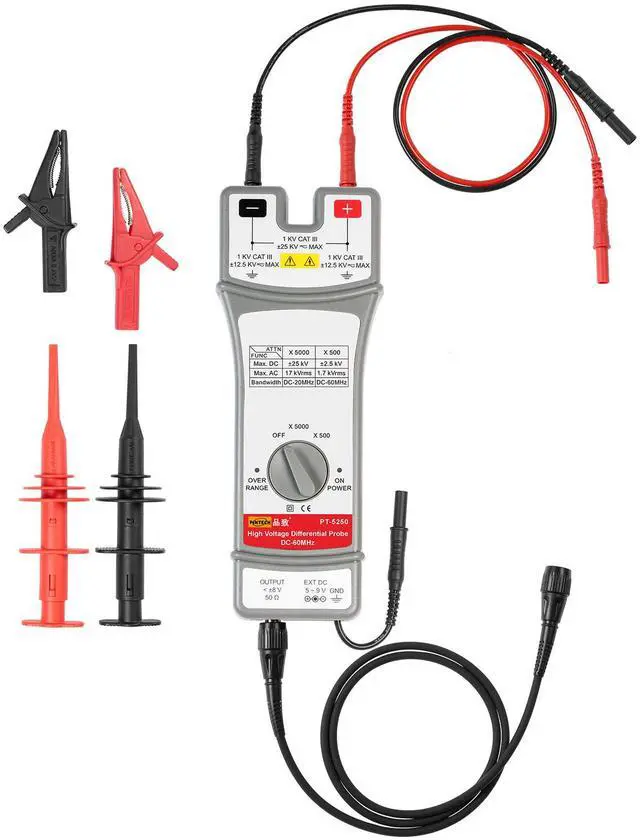
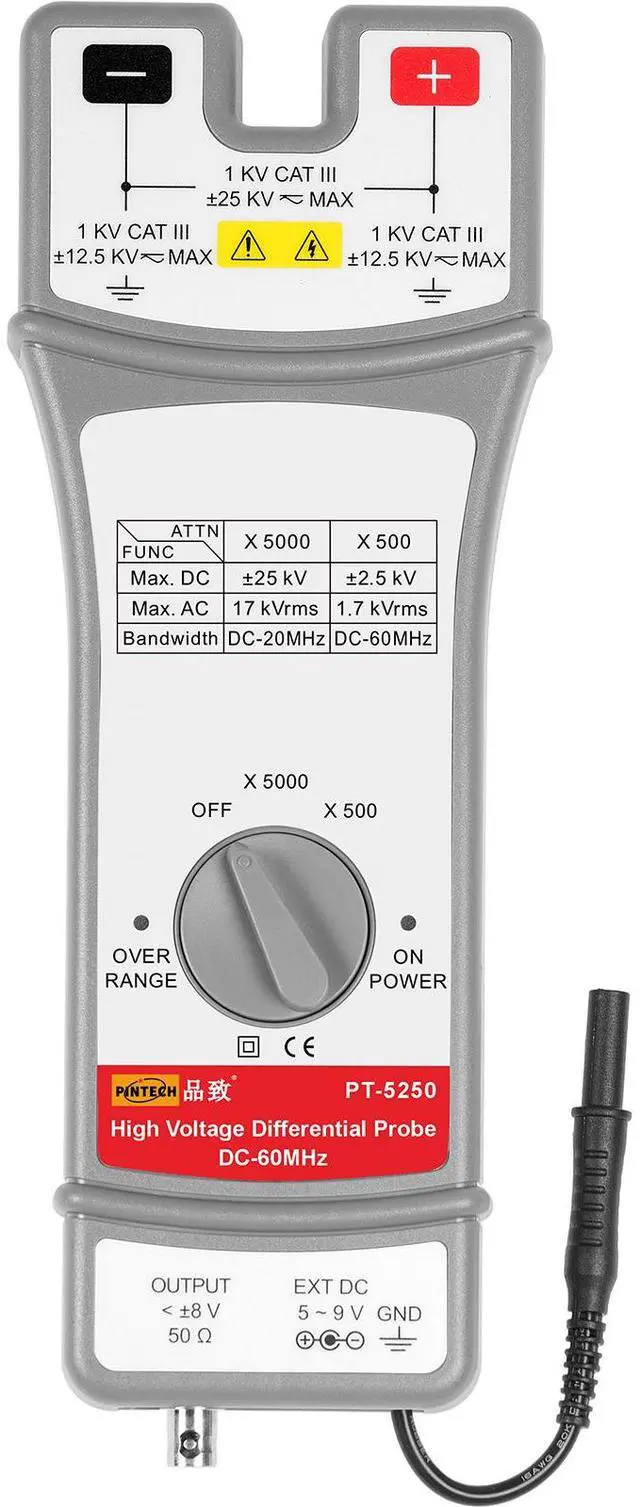
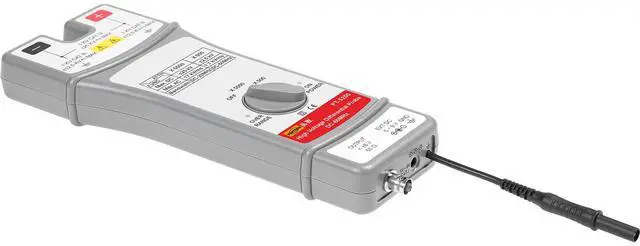



Any questions? Ask CelesteSM will help you find out quickly.
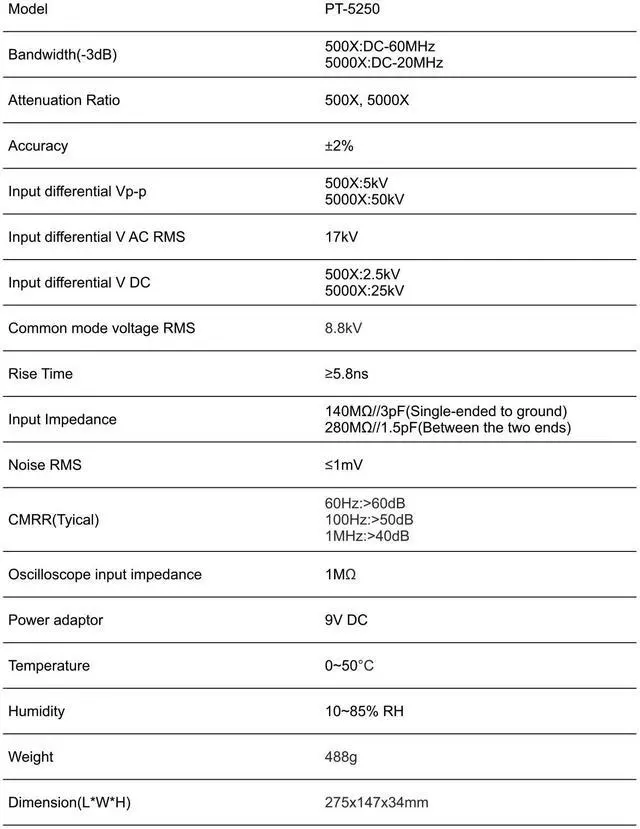
MODEL: PT-5250
Bandwidth (-3dB): DC-60MHz(x500), DC-20MH(x5000)
Testing Voltage(Vp-p): 500X: 5kV; 5000X: 50kV
Input DC Voltage: 500X: 2.5kV; 5000X: 25kV
Common-mode voltage: 8.8kV rms
Attenuation Rate: 500X/5000X
Rising Time: 5.8ns
Accuracy: ±2%
Input Impedance: Between the two ends: 280 M // 1.5 pF, Single-ended to ground: 140M//3pF
Oscilloscope Input Impedance: 1M
CMRR: 60Hz:>80dB; 100Hz:>60dB; 1MHz:>50dB
Noise: 1mV rms
Weight: 488g/1.08lb
Dimension(LxWxH): 275x147x34 mm
The PINTECH PT-5250 is a 50kV high-voltage active differential probe for oscilloscopes, designed for engineers and technicians who need to safely measure floating or high-voltage signals in motor drives, power electronics, and other demanding circuit tests.
| Attribute | Value |
|---|---|
| Best For | Measuring high-voltage differential signals (up to 50kVp-p) in power and motor circuits and converting two-point signals to ground-referenced inputs for oscilloscopes, meters, and data-acquisition equipment |
| Frequency And Accuracy | DC to 60 MHz bandwidth with typical accuracy ±2% |
| Electrical Ratings | Maximum differential test voltage 50kVp-p |
| Attenuation And Modes | Selectable 500X and 5000X attenuation in an active differential probe design to extend the oscilloscope input range for high-voltage measurements |
| Interface And Compatibility | BNC interface compatible with all oscilloscopes; converts two-point signals to ground-referenced inputs for oscilloscopes, meters, and data-acquisition equipment |
| Physical Dimensions | Dimensions 275×147×34 mm |
| Package And Accessories | Includes PT-5250 differential probe; adapter; 2 probe hooks; 2 alligator clips; BNC cable; grounding cable; high-voltage extension cord; manual |
| Warranty | 1 Year warranty |
| Model Identifiers | PINTECH PT-5250 active differential probe (Electrical Testing & Measuring); categorized as Pintech / Test & Measurement Tools |
| Selling Info | Sold as an individual unit (Each) |
Q: Should I choose the PINTECH PT-5250 or a typical 1.3 kV to 1.5 kV 100 MHz differential probe?
A: Choose the PT-5250 when your priority is high-voltage headroom. Official specs position it for up to 50 kVp-p with 500X and 5000X attenuation, which is far above the voltage range of common 100 MHz bench differential probes such as Micsig DP10013 or Siglent DPB5150A-class models. Choose a 100 MHz 1.3 kV to 1.5 kV probe instead when you mostly measure lower-voltage power electronics and want more bandwidth with lower attenuation for smaller signals.
Q: Is the PT-5250 better than a lower-voltage differential probe for motor drives and inverter work?
A: The PT-5250 is the better fit when motor drives, inverter outputs, or other high-energy circuits can produce voltage levels beyond the safe range of standard bench differential probes. Its official positioning is specifically for high-voltage differential measurement, and its BNC output works with general-purpose oscilloscopes. A lower-voltage probe is the better fit when your circuits stay well below the PT-5250's range and you want finer sensitivity on smaller waveforms.
Q: Should I buy the PT-5250 or move up to a higher-bandwidth professional high-voltage probe?
A: Choose the PT-5250 when 60 MHz bandwidth is enough and the main requirement is very high differential voltage capability. Move up to a higher-bandwidth professional probe when you need more waveform detail on faster edges, lower probe loading, or broader ecosystem support. Tektronix and Siglent both offer higher-bandwidth options, but their high-voltage models typically trade much lower maximum differential voltage for that added bandwidth.
Q: PT-5250 vs Tektronix-style high-voltage differential probes: which makes more sense?
A: The PT-5250 makes more sense if your buying decision starts with maximum measurable voltage and basic BNC oscilloscope compatibility. Tektronix-style probes make more sense when you want a premium instrument ecosystem, stronger published safety positioning, and models optimized for lower-voltage but higher-performance lab measurements. In short, PT-5250 is the practical choice for very high-voltage reach, while Tektronix-style options are the stronger fit for users prioritizing instrument integration and refinement over voltage range.
Q: For portability-focused use, is the PT-5250 a better choice than compact bench differential probes?
A: Choose a compact lower-voltage differential probe for portability-focused bench work. Choose the PT-5250 when voltage capability matters more than compactness. Its larger body and 500X or 5000X operating modes fit specialized high-voltage measurement tasks better than everyday portable troubleshooting of lower-voltage electronics.
Q: Who is this probe suitable for?
A: This probe is best suited to engineers, technicians, and advanced electronics users who need to measure floating or high-common-mode signals on an oscilloscope, especially in motor drives, power electronics, and other high-voltage circuits. It is not a general-purpose probe for routine low-voltage bench work; its main value is safe differential measurement up to 50 kVp-p with 500X or 5000X attenuation.
Q: Will it work with my oscilloscope?
A: Usually yes, if your oscilloscope accepts a standard BNC input and is configured appropriately. The product description says it uses a BNC interface and is compatible with oscilloscopes, while the closely related DP-50K manual states the BNC output is designed for a 1 MΩ oscilloscope input. Buyers should still verify their scope's input impedance and bandwidth settings before purchase.
Q: Is this a good choice for low-voltage signals too, or mainly for high-voltage work?
A: It is mainly a high-voltage measurement tool. It can measure lower-voltage differential signals, but the 500X and 5000X attenuation settings make it less practical when you need maximum sensitivity on small signals. Buyers choosing between this and a lower-voltage differential probe should prefer this model when high-voltage safety and range matter more than fine low-level signal detail.
Q: What are the main trade-offs versus a lower-voltage or higher-bandwidth differential probe?
A: The main trade-off is range versus signal detail. This model prioritizes very high voltage handling, with up to 50 kVp-p differential capability, but its bandwidth is 60 MHz and the related DP-50K documentation shows only 20 MHz in the 5000X range. A lower-voltage probe may offer better sensitivity or higher bandwidth for fast, small signals, while this one is the better fit for demanding high-voltage isolation work.
Q: Is this a safer and more accurate option than using two standard probes and scope math for motor drives or mains-referenced circuits?
A: Yes, for high-voltage floating measurements it is usually the better choice. Differential probes are designed to measure the voltage difference between two non-ground-referenced points, which reduces grounding risk and improves measurement reliability in applications with common-mode voltage. For motor circuits, mains-referenced power electronics, and similar setups, this is generally a more appropriate tool than improvised two-probe subtraction.
Q: Who is the PT-5250 actually suitable for?
A: The PT-5250 is best suited to bench users who need to measure floating or high-side signals that a standard ground-referenced oscilloscope probe cannot safely handle directly. Based on the product specs, it fits motor-drive, power electronics, inverter, and other high-voltage differential measurements. It is less suitable for casual hobby use if your work is mostly low-voltage, ground-referenced circuits, because its main value is differential high-voltage measurement rather than general-purpose probing.
Q: Can the PT-5250 replace a normal oscilloscope probe?
A: No. It can cover measurements from low voltage upward, but it is not a practical replacement for a standard passive probe in everyday scope work. Its 500X and 5000X attenuation modes are intended for high-voltage differential measurements, so small signals will appear much smaller at the scope input and may be less convenient to measure. It is a specialized probe for jobs where isolation from the oscilloscope ground and high differential voltage capability matter.
Q: Is the PT-5250 worth buying for SMPS, inverter, or motor-drive debugging?
A: It can be a sensible buy if your main need is safely viewing high-side or floating waveforms in power electronics. The product data matches the use cases repeatedly discussed in Reddit threads about differential probes: switch-mode supplies, motor circuits, and situations where standard scope grounds create risk or bad measurements. The trade-off is specialization: if you rarely measure high-voltage differential nodes, a standard probe setup is more cost-effective and simpler.
Q: What are the main trade-offs of the PT-5250?
A: The main advantages are high differential voltage capability, BNC scope compatibility, and safer measurement of non-ground-referenced signals. The main trade-offs are lower convenience for small-signal work, the need to respect scope input and probe setup requirements, and the fact that a differential probe is still not a substitute for good high-voltage measurement practice. In short: better safety and measurement flexibility for difficult nodes, but more complexity than a normal probe.



