




 here!
I’m your shopping assistant for PC builds, upgrades, and everything tech.
Got questions? Ask away!
Start a conversation
here!
I’m your shopping assistant for PC builds, upgrades, and everything tech.
Got questions? Ask away!
Start a conversationShipped by GUANGZHOU PINTECH CO LTD





Any questions? Ask CelesteSM will help you find out quickly.
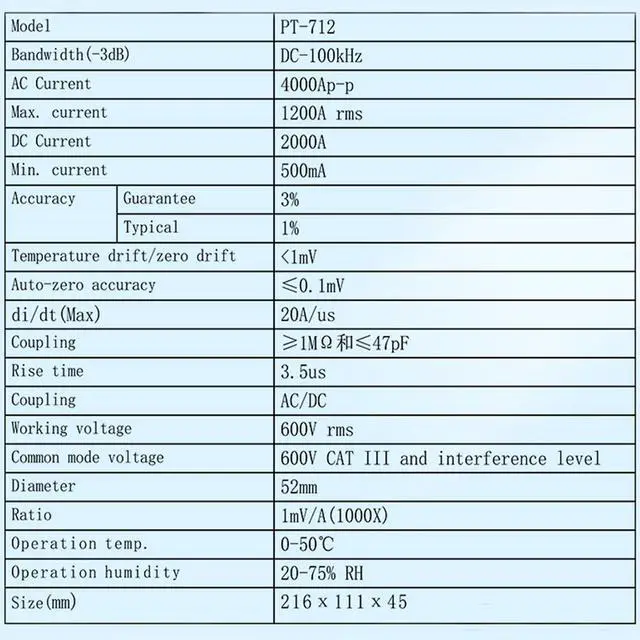
MODEL: PT-712
Bandwidth (-3dB): DC-100kHZ
AC Current: 4000Ap-p
Max Current: 1200A rms
DC Current: 2000A
Min Current: 500mA
Accuracy: 3%(Guaranteed); 1%(Typical)
Noise: 0.5mV
Temperature Drift/Zero Dift: <1mV
Auto-zero Accuracy:0.1mV
di/dt(Max): 20A/us
Load Impedance: 1M and 47pF
Coupling:AC/DC
Rise Time: 3.5s
Clamp Diameter: 52mm/2.05in
Ratio: 1mV/A(1000:1)
Size: 216 x 111 x 45 mm
Weight:650g/1.43lb
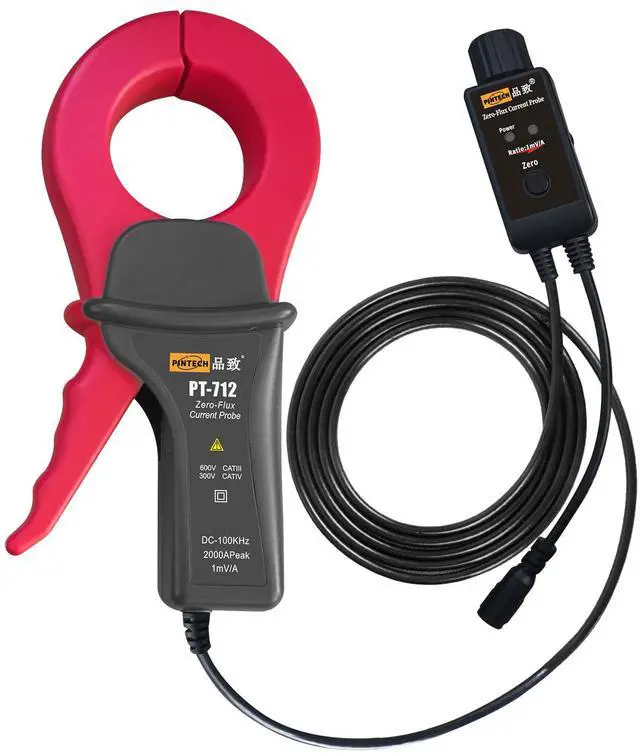
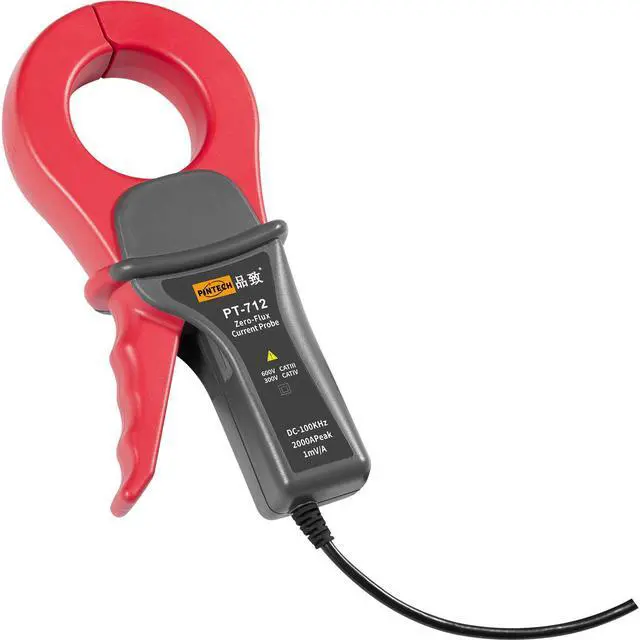
The PINTECH PT-712 is an AC/DC zero-flux current clamp probe for oscilloscopes, built for measuring high current up to 4000A with 100kHz bandwidth and ±1% accuracy. It is best suited for engineers, lab technicians, and industrial power users who need non-intrusive current measurement on high-current electrical systems through a standard BNC connection.
| Attribute | Value |
|---|---|
| Best For | Technicians and engineers performing electrical testing and measurement who need a current clamp probe with ±1% accuracy |
| Model Identifiers | PINTECH PT-712 |
| Measurement Accuracy | ±1% measurement accuracy suitable for precise electrical measurements |
| Product Type | Electrical Testing & Measuring device |
| Physical Dimensions | 216 × 111 × 45 mm (product dimensions) |
| Standards And Certifications | CE certified |
| Packaging | Sold individually (Each) |
Q: Should I choose the PINTECH PT-712 or a lower-bandwidth clamp like the PT-702?
A: Choose the PT-712 if you need the same 4000Ap-p class current range as the PT-702 but want more waveform detail. Official PINTECH specifications place the PT-712 at DC-100 kHz bandwidth versus DC-50 kHz for the PT-702, while keeping the same 1200 A RMS rating, 52 mm jaw diameter, 1 mV/A output ratio, and AC/DC zero-flux design. The PT-702 is the better fit when 50 kHz coverage is already sufficient and you want to stay within the same large-current probe family with fewer performance requirements.
Q: Is the PINTECH PT-712 worth choosing over the higher-bandwidth PT-722?
A: Choose the PT-712 when 100 kHz bandwidth is enough and you want the same 4000Ap-p range and 1200 A RMS capability without stepping up to the faster model. In PINTECH's own PT-700 series table, the PT-722 raises bandwidth to DC-200 kHz and shortens rise time to 1.75 µs, while the PT-712 is DC-100 kHz with 3.5 µs rise time. The PT-722 makes more sense for faster switching edges and higher-frequency current analysis; the PT-712 is the more balanced option for general high-current oscilloscope work.
Q: Should I buy the PT-712 or a lower-current, higher-bandwidth oscilloscope current probe?
A: Choose the PT-712 if your main need is measuring very large AC/DC currents with a clamp probe and standard BNC oscilloscope connection. Compared with common bench probes such as the Tektronix A622 or TCP0150, the PT-712 is positioned for much higher current capacity, while those Tektronix models are positioned for substantially higher bandwidth and lower current ranges. In practice, the trade-off is simple: PT-712 fits inverter, power, busbar, and industrial high-current work; lower-current probes are the better match for electronics debugging where smaller currents and faster edges matter more than maximum current range.
Q: Is the PT-712 a better choice than a proprietary Tek-style current probe system?
A: Choose the PT-712 when you want a large-current AC/DC probe that can connect to a wide range of oscilloscopes through BNC rather than a brand-specific probe interface. Community discussions regularly point out that many Tektronix current probe systems depend on proprietary amplifier or scope interfaces, while universal BNC-based probes are easier to use across mixed oscilloscope setups. A proprietary Tek-style system is the better fit when you specifically need that ecosystem's higher-bandwidth probe options, integrated scaling, or matching amplifier platform.
Q: Is the PT-712 a good fit if I need to measure both DC and AC current on an oscilloscope?
A: Yes, if your main need is viewing both DC and AC current waveforms on a scope at very high current levels. The PT-712 is specified as an AC/DC probe with DC to 100 kHz bandwidth, zero-flux design, and BNC output, so it is better suited to power electronics, inverter, battery, and industrial current analysis than AC-only clamp probes. The trade-off is that 100 kHz bandwidth is useful for low- to mid-frequency power work, but not for fast switching details that require MHz-class current probes.
Q: Who is the PT-712 suitable for?
A: The PT-712 is mainly suitable for engineers and technicians working with high-current electrical systems, not casual electronics users. Its 4000 A peak range, 1200 A RMS limit, DC capability, and oscilloscope-focused BNC connection make more sense for EV, motor drive, power conversion, battery, welding, and industrial maintenance work than for bench-level low-current circuit debugging.
Q: Will the PT-712 work with my oscilloscope?
A: Usually yes, but only if your setup matches a standard BNC current-probe workflow. The PT-712 uses a BNC connection and lists a 1 mV/A output ratio, so it should work with many general-purpose oscilloscopes that accept BNC inputs and allow manual volts-to-amps scaling. The trade-off versus brand-specific probe systems is that you may not get automatic probe detection, auto scaling, or integrated power features that some Tektronix or Keysight current probes provide.
Q: Is the PT-712 better than a typical lower-current AC/DC current probe?
A: It is better only when you need much higher current range. The PT-712 stands out for very high current capability, but that usually comes with a trade-off in bandwidth and low-current sensitivity compared with many smaller AC/DC probes. If you mostly test lower-current, faster-switching electronics, a lower-range MHz-class current probe can be the better choice. If you need to capture large DC or power-current waveforms safely on a scope, the PT-712 is the more appropriate class of tool.
Q: What are the main trade-offs before buying the PT-712?
A: The main reason to buy it is high-current AC/DC measurement on a standard oscilloscope. The main trade-offs are its moderate 100 kHz bandwidth, large physical form factor, and likely need for manual setup and scaling rather than plug-and-play integration. It is a specialized measurement tool, so buyers who only need low-current bench testing or high-frequency switching analysis may be better served by a smaller or faster probe.
Q: Who is the PINTECH PT-712 best suited for?
A: The PT-712 is best suited for users who need to view high current waveforms on an oscilloscope, especially AC/DC current in power electronics, industrial equipment, or lab diagnostics. It is a better fit for professional or specialized measurement work than for casual hobby use, because community discussion around oscilloscope current probes consistently focuses on bandwidth limits, zeroing behavior, and the cost/benefit trade-off versus cheaper clamp options.
Q: Is the PT-712 a good choice if I need to measure both AC and DC current on a scope?
A: Yes, if your main requirement is oscilloscope measurement of both AC and DC current. The PT-712 is specified as an AC/DC zero-flux current probe with a 100 kHz bandwidth, 1000:1 ratio, and up to 4000 A range. That makes it more suitable for mixed AC/DC waveform analysis than simple AC-only clamps or low-cost probes that are mainly used for rough current viewing.
Q: What are the main trade-offs of the PT-712?
A: The main trade-off is capability versus specialization. The PT-712 offers high current capacity and DC-capable zero-flux measurement, but its 100 kHz bandwidth means it is not the best choice for fast switching edges or higher-frequency current analysis. It is also likely more tool than many users need if they only want occasional, approximate current checks.
Q: Is the PT-712 worth buying instead of a cheaper current clamp for an oscilloscope?
A: It is worth buying if you need higher-current capability, better DC measurement behavior, and a probe intended for oscilloscope waveform analysis rather than basic clamp-meter style readings. It is less compelling if your use case is occasional troubleshooting at modest currents, where lower-cost probes may be sufficient despite weaker precision, more noise, or more zeroing limitations.



