




 here!
I’m your shopping assistant for PC builds, upgrades, and everything tech.
Got questions? Ask away!
Start a conversation
here!
I’m your shopping assistant for PC builds, upgrades, and everything tech.
Got questions? Ask away!
Start a conversationShipped by GUANGZHOU PINTECH CO LTD

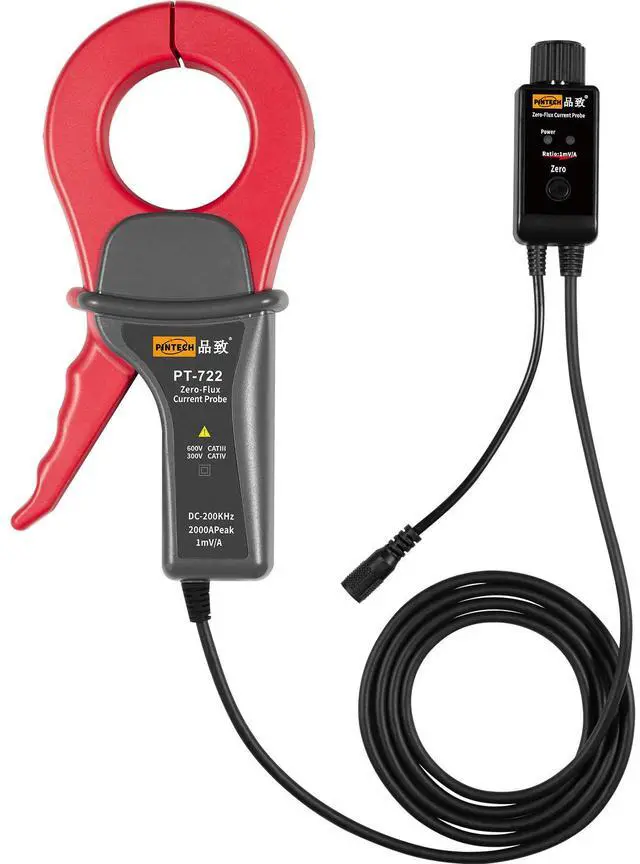
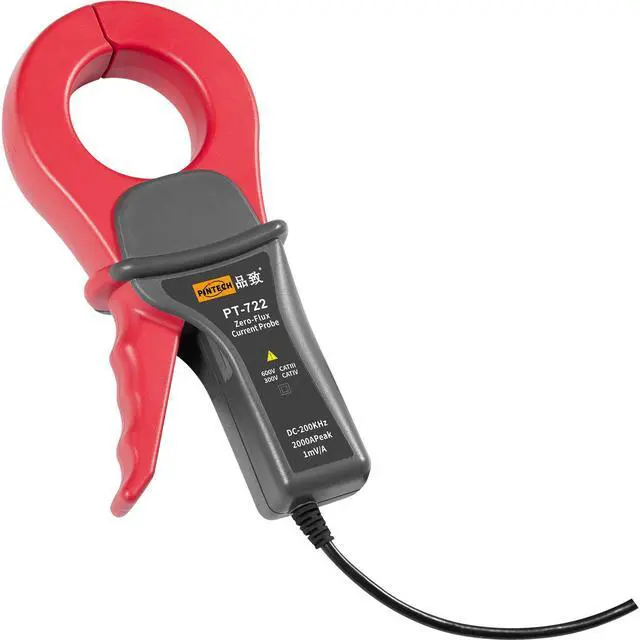

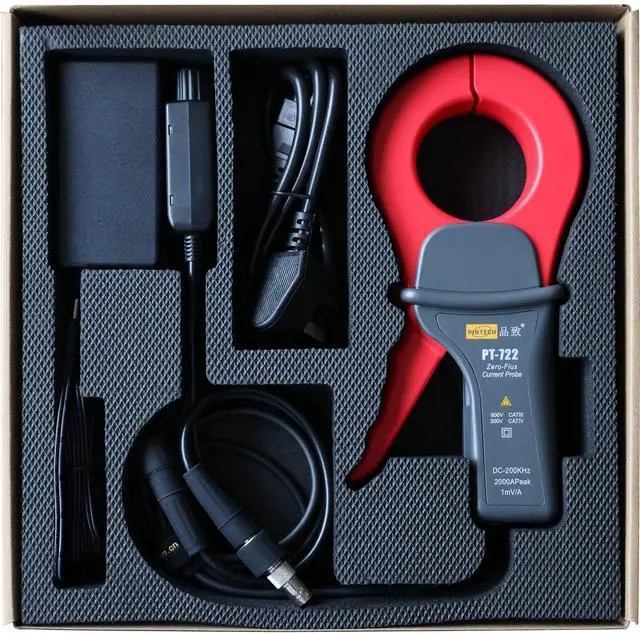



Any questions? Ask CelesteSM will help you find out quickly.
MODEL: PT-722
Bandwidth (-3dB): DC-200kHZ
AC Current: 4000Ap-p
Max Current: 1000A rms
DC Current: 2000A
Min Current: 500mA
Accuracy: 3%(Guaranteed); 1%(Typical)
Noise: 0.5mV
Temperature Drift/Zero Dift: <1mV
Auto-zero Accuracy:0.1mV
di/dt(Max): 40A/us
Load Impedance: 1M and 47pF
Coupling:AC/DC
Rise Time: 1.75s
Clamp Diameter: 52mm/2.05in
Ratio: 1mV/A(1000:1)
Size: 216 x 111 x 45 mm
Weight:650g/1.43lb
The PINTECH PT-722 is a zero-flux AC/DC current clamp probe for oscilloscopes, built for engineers, technicians, and lab users who need accurate measurement of high currents up to 4000A with broad compatibility through a standard BNC connection.
| Attribute | Value |
|---|---|
| Best For | High-current AC/DC measurement tasks with oscilloscopes and electrical test benches—suitable for lab and field diagnostics and troubleshooting |
| Model Identifiers | PINTECH PT-722 clamp probe, sold individually |
| Physical Dimensions | Compact clamp-probe housing measuring 216 x 111 x 45 mm |
| Measurement Accuracy & Compliance | ±1% measurement accuracy; CE certified |
Q: Should I choose the PINTECH PT-722 or the PINTECH PT-712 for oscilloscope current measurement?
A: Choose the PT-722 if you need more bandwidth for faster current waveforms while staying in the same 4000Ap-p class. Official PINTECH specs position the PT-722 at DC to 200 kHz with 1.75 microsecond rise time, while the PT-712 is DC to 100 kHz with 3.5 microsecond rise time. Both are zero-flux AC/DC probes with similar 4000Ap-p capability, 2000 A DC capability, 500 mA minimum current, and typical ±1% accuracy, so the main decision is waveform speed. The PT-712 is the more practical choice when 100 kHz coverage is sufficient and you do not need the extra transient response headroom.
Q: Is the PINTECH PT-722 worth choosing over a lower-cost clamp like the Hantek CC-65?
A: Choose the PT-722 when you need true oscilloscope-focused AC/DC current analysis at much higher current and substantially higher bandwidth. The PT-722 is a zero-flux probe rated for 4000Ap-p and DC to 200 kHz, while the Hantek CC-65 is positioned as a lower-range AC/DC clamp for up to 65 A and about 20 kHz bandwidth. That makes the PT-722 the better fit for high-current power electronics, inverter work, busbar testing, and waveform analysis where bandwidth and overload margin matter. The CC-65 is the more practical option for lower-current bench work where cost and basic waveform visibility matter more than high-current headroom.
Q: Should I buy the PINTECH PT-722 or a higher-bandwidth probe like the Micsig CP2100A?
A: Choose the PT-722 if your priority is measuring very large currents. Choose the Micsig CP2100A if your priority is capturing faster edges at lower current. Official specs place the PT-722 at 4000Ap-p, 1000 A rms, and DC to 200 kHz, while the CP2100A is designed around 10 A and 100 A ranges with DC to 800 kHz bandwidth. Community discussion around oscilloscope current probes also consistently treats higher bandwidth as valuable when waveform detail is the goal. In practice, the PT-722 fits heavy-current applications, while the CP2100A fits switching analysis and lower-current lab work where higher bandwidth matters more than maximum current range.
Q: How does the PINTECH PT-722 compare with the older lower-bandwidth PT-702?
A: The PT-722 is the stronger choice when you want the same 4000Ap-p class but better transient response. In PINTECH's own lineup, the PT-702 is the lower-tier version at DC to 50 kHz with 7 microsecond rise time, while the PT-722 increases that to DC to 200 kHz with 1.75 microsecond rise time. Both are zero-flux AC/DC probes with the same 1 mV/A ratio and similar published accuracy positioning. The PT-702 remains a sensible fit for slower power-frequency or general current monitoring tasks, while the PT-722 is the better match for faster switching behavior and more detailed waveform capture.
Q: Is the PINTECH PT-722 a better fit than a premium Tektronix current probe setup?
A: Choose the PT-722 when you need far higher current capacity and standard BNC oscilloscope compatibility. Choose a Tektronix TCPA300 plus TCP312A-class setup when your work depends on much higher bandwidth and lower-current detail. Tektronix positions the TCP312A system at 100 MHz-class bandwidth with a maximum current around 30 A DC, which is a very different design target from the PT-722's 4000Ap-p and 200 kHz positioning. The practical trade-off is simple: PT-722 is aimed at heavy-current measurement, while the Tektronix setup is aimed at high-speed signal fidelity in lower-current applications.
Q: Who is the PT-722 best suited for?
A: The PT-722 is best suited for technicians, power electronics engineers, and industrial users who need to view both AC and DC current waveforms on an oscilloscope at very high current levels. Its key fit is non-intrusive current measurement up to 4000 A peak-to-peak, with zero-flux design for better DC accuracy than basic AC-only clamp accessories. It is less suitable for casual bench use where current is low and much higher bandwidth is more important than current range.
Q: Can the PT-722 measure both AC and DC current, or is it AC-only?
A: Yes. The PT-722 is an AC/DC current probe, so it can measure DC current as well as changing AC waveforms. That matters because many clamp accessories sold for scopes or meters are AC-only, which makes them a poor fit for battery systems, motor drives, inverters, and other circuits with DC content. If you specifically need DC waveform analysis, the PT-722 is a better match than an AC-only clamp.
Q: Will the PT-722 work with my oscilloscope?
A: Usually yes, if your oscilloscope accepts a standard BNC input and can be set up for the probe's scaling. The PT-722 uses a standard BNC connection and a 1000:1, 1 mV/A output ratio, so compatibility is broader than probes that depend on a proprietary probe interface or a dedicated external amplifier. The trade-off is that you may need to enter the scale manually on the oscilloscope rather than getting automatic probe recognition.
Q: Is 200 kHz bandwidth enough, or should I buy a higher-bandwidth current probe instead?
A: A 200 kHz current probe is usually enough for general power electronics, industrial current monitoring, inverter output checks, motor-drive work, and many switching power investigations. It is not the best choice if you need to analyze very fast edges, high-frequency ripple in detail, or wide-band transient behavior where MHz-class probes are preferred. In short: choose the PT-722 for high-current AC/DC measurement and broad waveform visibility, not for premium high-speed signal analysis.
Q: What is the main trade-off versus a smaller or cheaper current clamp?
A: The PT-722's main advantage is high-current AC/DC measurement with zero-flux accuracy and oscilloscope-ready output. The trade-off is that it is a specialized tool: larger, heavier, and less optimized for small-current or very high-bandwidth lab work than lower-range probes. Buyers choosing between this and a cheaper clamp should pick the PT-722 when high current capacity and DC capability matter more than portability, entry price, or MHz-level bandwidth.
Q: Who is the PT-722 suitable for?
A: The PT-722 is most suitable for users who need to view both AC and DC current waveforms on an oscilloscope at very high current levels. Based on the product data, it fits bench, power-electronics, industrial, or lab work where a BNC-output current probe is preferred over a basic clamp meter. It is less suitable for casual hobby use if the job only needs simple current readings rather than waveform analysis.
Q: Is the PT-722 a good choice if I need to measure DC current on a scope?
A: Yes, if DC measurement on an oscilloscope is a core requirement, the PT-722 is a relevant option because it is specified as an AC/DC zero-flux current probe. That makes it a better fit than AC-only clamp solutions when the job includes DC bus, battery, or power-supply current waveforms. The main decision point is whether you actually need oscilloscope waveform visibility and the PT-722's very high current range.
Q: What are the main trade-offs of buying the PT-722?
A: The main trade-off is specialization. The PT-722 is designed for oscilloscope-based current waveform measurement, with a 4000A range, 200kHz bandwidth, BNC connection, and quoted ±1% accuracy. That makes it more useful for high-current signal observation than for general-purpose electrical troubleshooting. If you only need quick current checks, a standard clamp meter may be simpler; if you need waveform detail and DC capability, the PT-722 is the more suitable tool.
Q: Can the PT-722 replace a normal clamp meter?
A: Not fully. The PT-722 can handle clamp-style current measurement, but its design is centered on feeding current waveforms into an oscilloscope through BNC. It is a better replacement for an oscilloscope current probe than for a handheld everyday clamp meter. Choose it if your workflow depends on time-domain waveform analysis; choose a regular clamp meter if portability and quick standalone readings matter more.
Q: Is the PT-722 worth buying for occasional hobby use?
A: Usually only if your hobby work genuinely involves high-current waveform analysis on an oscilloscope. Community discussion around oscilloscope current probes tends to frame them as more specialized tools than entry-level essentials. For occasional use, the PT-722 may be more capability than needed; for repeat work on power electronics, motor drives, inverters, or DC current profiling, it is easier to justify.



