




 here!
I’m your shopping assistant for PC builds, upgrades, and everything tech.
Got questions? Ask away!
Start a conversation
here!
I’m your shopping assistant for PC builds, upgrades, and everything tech.
Got questions? Ask away!
Start a conversationShipped by GUANGZHOU PINTECH CO LTD

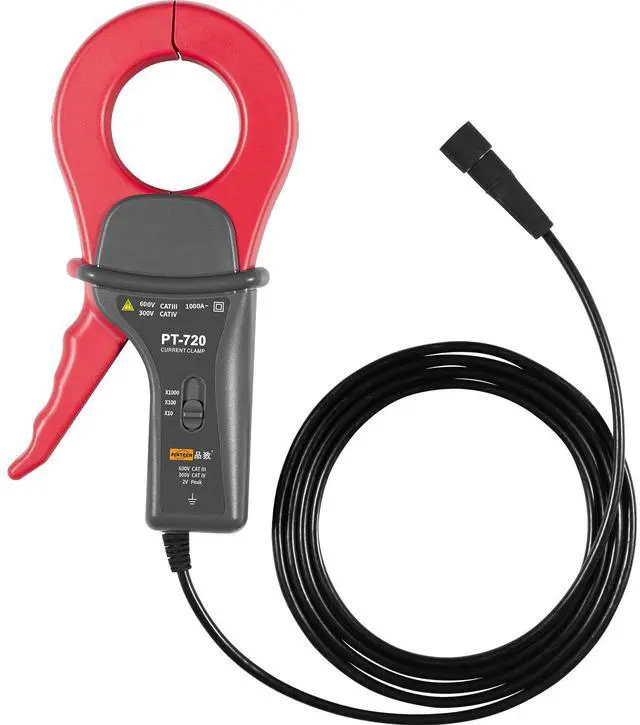
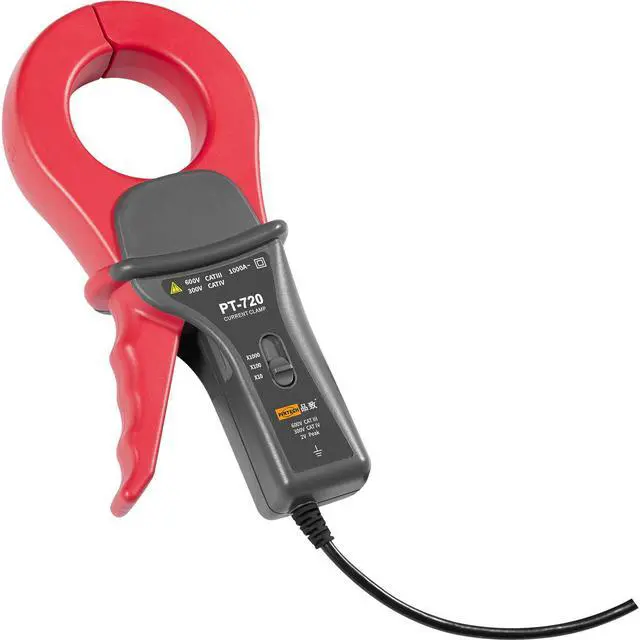
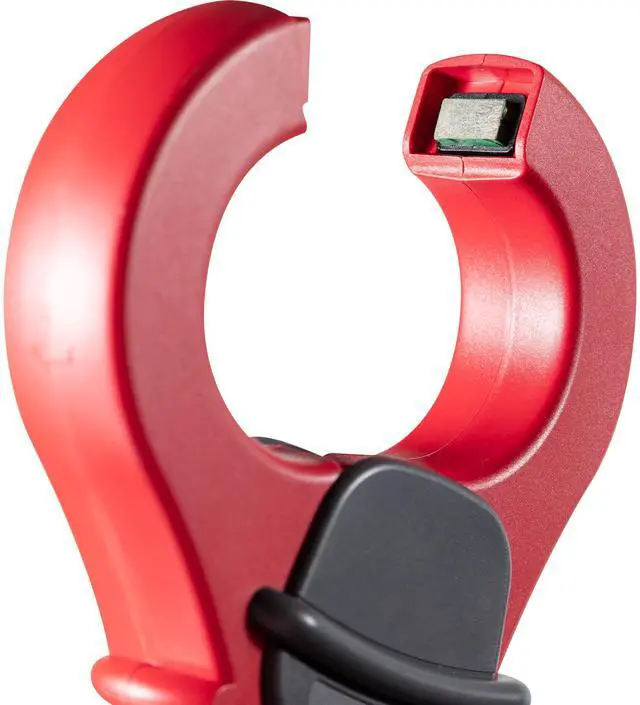



Any questions? Ask CelesteSM will help you find out quickly.
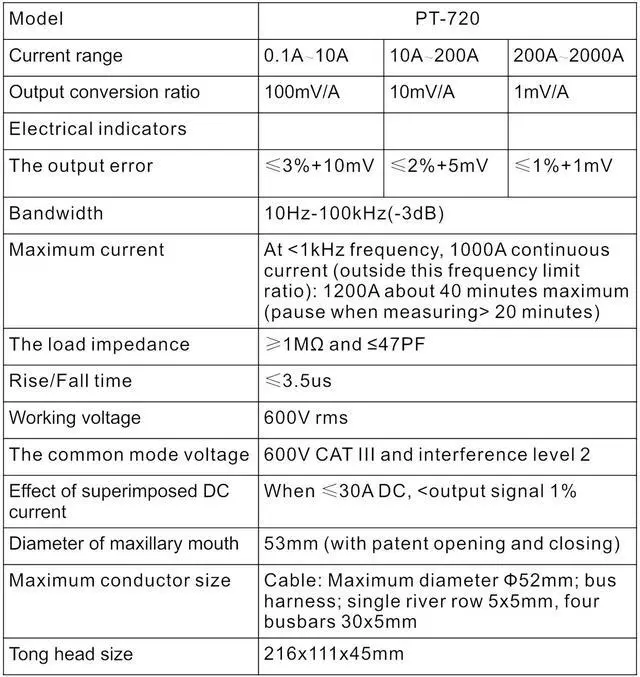
MODEL: PT-720
Bandwidth (-3dB): 10Hz~100kHz(-3dB)
Current Range: 0.1A~10A; 10A~200A; 200A~2000A
Output Conversion Ratio: 100mV/A; 10mV/A; 1mV/A
Output Error: 3%+10mV; 2%+5mV; 1%+1mV
Bandwidth: 10Hz~100kHz(-3dB)
dV/dt(Max): 10A/s
Maximum Current: 1000A continuous current at >1kHz frequency (limits proportionality outside of this frequency): 1200A for approx. 20 minutes maximum test time
Load Impedance: 1M and 47pF
Rise Time:3.5 s
Working Voltage: 600V rms
Common-mode Voltage: 600V CAT III and Interference Class 2
Effects of Superimposed DC Current:<1% of output signal at 30A DC
Diameter of Maximum Mouth: 53mm/2.17in
Weight: 500g/1.1lb
Size: 216 111 45 mm
The PINTECH PT-720 is an AC current clamp probe for oscilloscopes, multimeters, and recorders, built for measuring AC current from 0.1A to 2000A without breaking the circuit. It is best suited for electricians, technicians, and lab users who need broad current range, BNC connectivity, and up to 100kHz bandwidth.
| Attribute | Value |
|---|---|
| Best For | Technicians and engineers needing a clamp-style AC current probe for oscilloscope and multimeter measurements |
| Identification | PINTECH PT-720 current clamp probe |
| Electrical Performance | Measurement accuracy =1% + 1mV, intended for precision AC current measurements |
| Physical Dimensions | 216 × 111 × 45 mm |
| Compliance | CE certification |
| Packaging | Sold individually (Each) |
Q: Should I choose the PINTECH PT-720 or a typical 20A/200A AC current clamp for oscilloscope work?
A: Choose the PINTECH PT-720 if you need one probe to cover both low-current waveform checks and much higher current measurements up to 2000A. A typical 20A/200A AC clamp is the simpler fit when your work stays in lower ranges and you mainly value a familiar utility-brand accessory. The trade-off is that the PT-720 adds a third high-current range and oscilloscope-oriented BNC output, while many common AC clamps stop at 200A and are aimed more at meter or general service use.
Q: Is the PINTECH PT-720 a better fit than an AC/DC oscilloscope current probe?
A: The PT-720 is the better fit when you only need AC current measurement and want broad current range coverage with a direct BNC connection. An AC/DC current probe is the better choice when you need to see DC current, inrush with DC offset, or mixed AC+DC waveforms in power electronics. The trade-off is straightforward: the PT-720 is positioned as an AC-only clamp probe, while AC/DC probes support more diagnostic scenarios but are usually more specialized and more expensive.
Q: Should I buy the PINTECH PT-720 or move up to a higher-bandwidth current probe?
A: Buy the PT-720 when your priority is measuring AC current waveforms in power, mains, inverter, or general electrical troubleshooting where 100kHz bandwidth is enough. Move up to a higher-bandwidth probe if you need to inspect faster switching edges, detailed transient behavior, or higher-frequency current content. The practical trade-off is bandwidth versus cost and complexity: the PT-720 covers up to 100kHz, while higher-tier probes from test-equipment brands are designed for much faster events and often cost substantially more.
Q: Is the PINTECH PT-720 better for oscilloscope use than a standard clamp meter?
A: Yes, if your goal is viewing current as a waveform on an oscilloscope or recorder. The PT-720 is built around probe-style use with an insulated BNC coaxial lead, so it fits scopes and other instruments that accept an analog input. A standard clamp meter is the better fit when you only need a numeric current reading on the meter itself. The trade-off is waveform visibility versus standalone convenience.
Q: For bench testing, should I choose the PINTECH PT-720 or a compact portable probe setup?
A: Choose the PT-720 when bench testing flexibility matters more than minimum size, especially if you want clamp-on measurement without opening the circuit and need compatibility with scopes, meters, or recorders through BNC. A more compact portable setup makes more sense when field carry size is the main priority. The trade-off is that the PT-720 is positioned as a general instrument probe for multi-range measurement, not as an ultra-compact handheld-only accessory.
Q: Will this work with an oscilloscope, or is it mainly for a clamp meter?
A: It is primarily an AC current probe for instruments that accept a BNC-style current probe input. The PT-720 includes an insulated BNC coaxial cable and is positioned for use with oscilloscopes, recorders, and some meters. Buyers should still confirm input compatibility and scaling on their instrument, because many standard handheld multimeters use banana-plug current accessories instead of BNC.
Q: Is this a good choice for measuring high-current AC loads without breaking the circuit?
A: Yes, that is the main use case. The PT-720 is a clamp-style AC current probe with ranges from 0.1A to 2000A and a 600V rms working voltage, so it is suited to non-intrusive checks on larger AC conductors where inserting a meter in series would be inconvenient or unsafe. It is a better fit for load monitoring and waveform viewing than for low-level bench electronics current measurement.
Q: Is it suitable for low-current precision work, or is it better for heavier electrical jobs?
A: It is better for heavier AC current work than for very fine low-current analysis. Its lowest range starts at 0.1A to 10A, but the product is clearly optimized around 10A, 200A, and 2000A ranges, large-conductor clamping, and oscilloscope-style current observation. If your main need is sub-amp troubleshooting on small electronics, a lower-range probe or a dedicated meter is usually a better fit.
Q: What is the main trade-off versus a standard clamp multimeter?
A: The trade-off is flexibility versus simplicity. A standard clamp multimeter is easier if you just want a direct numeric current reading in one handheld tool. The PT-720 is more useful when you want to feed current signals into an oscilloscope or compatible instrument to view waveforms and higher-frequency AC behavior up to 100kHz, but it depends on the external instrument for display and interpretation.
Q: Who is this most suitable for?
A: This is most suitable for electricians, field technicians, power troubleshooting users, and oscilloscope owners who need non-intrusive AC current measurement on higher-current circuits. It is less suitable for casual home users who only need a basic clamp meter, because the PT-720 is a specialized probe rather than an all-in-one meter.
Q: Who is the PINTECH PT-720 best suited for?
A: The PT-720 is best suited for users who need non-intrusive AC current waveform measurement on an oscilloscope or meter, especially for moderate-frequency power and electronics work. It fits buyers who want clamp-on convenience, BNC connectivity, and a wide AC range up to 2000A. It is less suitable if you need DC current measurement, long-term precision logging, or very high-bandwidth switching analysis.
Q: Is the PT-720 a good choice instead of using a shunt resistor?
A: It is a good choice when you need isolated, clamp-on AC current measurement without breaking the circuit. That makes it more convenient for viewing live current waveforms on a scope. A shunt-based setup is usually the better choice for long-term logging or when drift and absolute low-current accuracy matter more than convenience.
Q: Is 100kHz bandwidth enough for this kind of current clamp probe?
A: 100kHz is generally enough for basic AC power analysis, mains-related work, and many general troubleshooting tasks. It is a trade-off if you want to inspect faster switching edges or higher-frequency detail in power electronics. Buyers working on SMPS or fast transients may want a higher-bandwidth probe, but for routine AC current viewing, 100kHz is often adequate.
Q: Is the PT-720 worth buying for occasional bench and field troubleshooting?
A: It can be worth buying if your main need is occasional AC current measurement with a scope or compatible meter and you value clamp-on speed over maximum precision. Its main advantages are broad AC range, no need to open the circuit, and easy BNC hookup. The trade-offs are that it is AC-only and may not be the best tool for very low-current logging or advanced high-frequency work.



