




 here!
I’m your shopping assistant for PC builds, upgrades, and everything tech.
Got questions? Ask away!
Start a conversation
here!
I’m your shopping assistant for PC builds, upgrades, and everything tech.
Got questions? Ask away!
Start a conversationShipped by GUANGZHOU PINTECH CO LTD




Any questions? Ask CelesteSM will help you find out quickly.
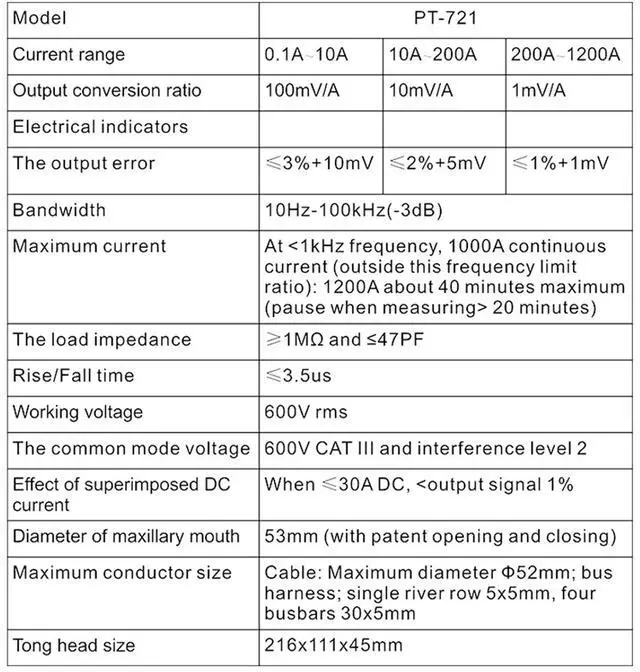
MODEL: PT-721
Bandwidth (-3dB): 10Hz~100kHz(-3dB)
Current Range: 0.1A~10A; 10A~200A; 200A~1200A
Output Conversion Ratio: 100mV/A; 10mV/A; 1mV/A
Output Error: 3%+10mV; 2%+5mV; 1%+1mV
Bandwidth: 10Hz~100kHz(-3dB)
dV/dt(Max): 10A/s
Maximum Current: 1000A continuous current at >1kHz frequency (limits proportionality outside of this frequency): 1200A for approx. 20 minutes maximum test time
Load Impedance: 1M and 47pF
Rise Time:3.5 s
Working Voltage: 600V rms
Common-mode Voltage: 600V CAT III and Interference Class 2
Effects of Superimposed DC Current:<1% of output signal at 30A DC
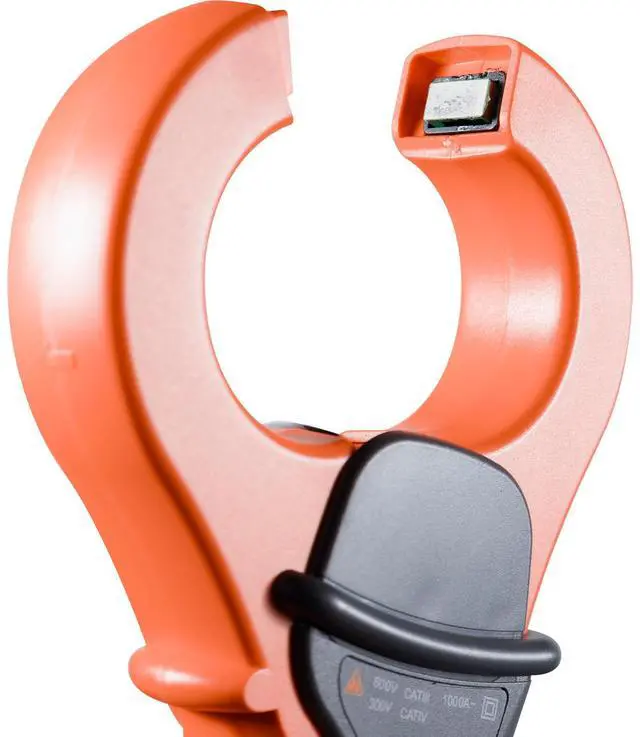
Diameter of Maximum Mouth: 53mm/2.17in
Weight: 500g/1.1lb
Size: 216 111 45 mm
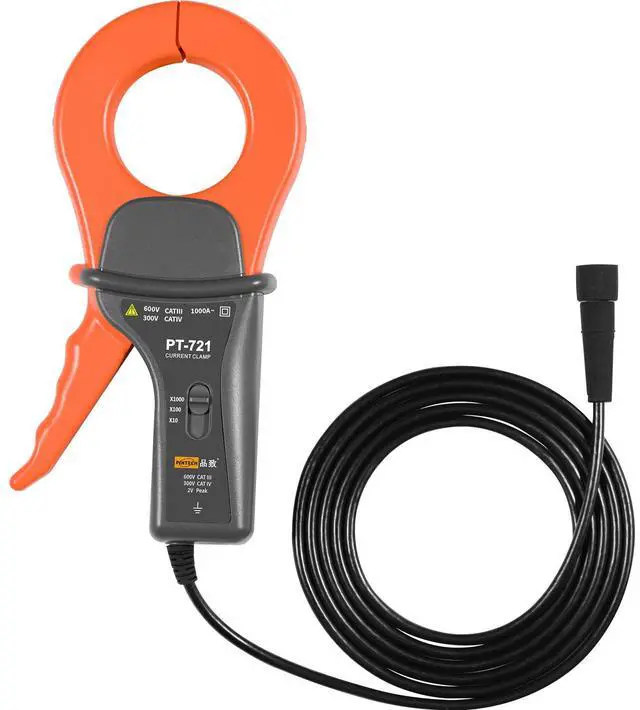
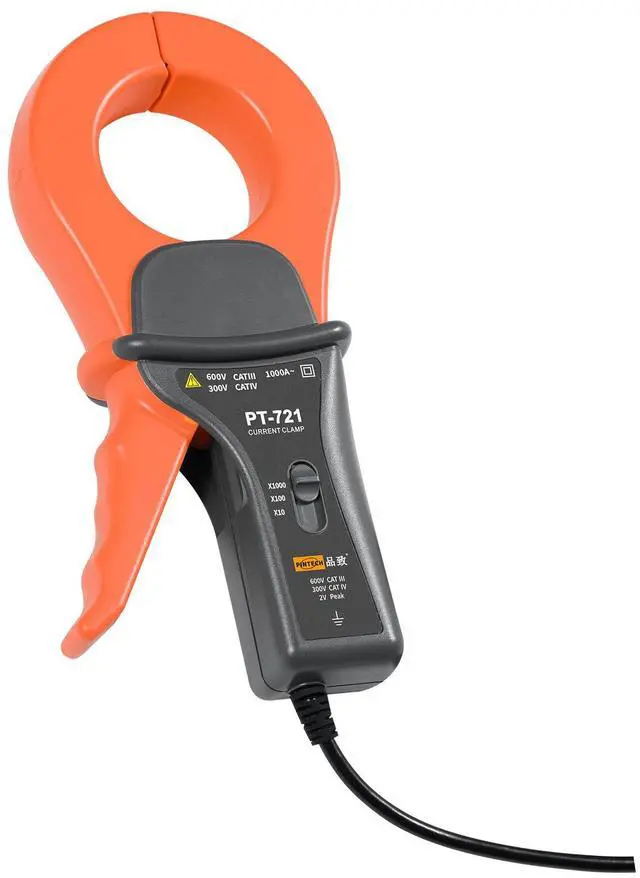
The PINTECH PT-721 is an AC current clamp probe for oscilloscopes, multimeters, and recorders, suited to electricians, electronics technicians, and lab users who need non-intrusive current measurement from 0.1A up to 1200A with up to 100kHz bandwidth.
| Attribute | Value |
|---|---|
| Best For | Technicians and engineers needing an electrical testing & measuring clamp probe for AC current measurement |
| Model Identifiers | PINTECH PT-721 clamp probe |
| Device Type | Electrical testing & measuring clamp probe |
| Accuracy And Measurement | 1% + 1 mV accuracy |
| Physical Dimensions | 216 × 111 × 45 mm |
| Standards And Certifications | CE certified |
| Packaging And Unit | Sold as each (single unit) |
Q: Should I choose the PINTECH PT-721 or a standard clamp meter for current measurement?
A: Choose the PT-721 when you want to view current waveforms on an oscilloscope or feed a BNC-based instrument directly. Its three output ranges, 10 Hz to 100 kHz bandwidth, and 53 mm jaw make it more suitable for waveform observation and higher-frequency AC analysis than a typical handheld clamp meter. A standard clamp meter is the better fit when you mainly need direct on-screen RMS readings, portability, and one-tool field use rather than a probe for a scope or recorder.
Q: Is the PINTECH PT-721 a better fit than the Fluke i400s for oscilloscope work?
A: The PT-721 is the better fit if your main job is capturing higher-frequency AC current waveforms or measuring much higher current levels on a scope. PINTECH positions it at 10 Hz to 100 kHz with ranges up to 1200 A, while the Fluke i400s is designed more as a compact accessory for scopes and meters with 40 A and 400 A ranges and typical bandwidth of 5 Hz to 10 kHz. The Fluke i400s is the stronger choice when safety category, compact size, and general electrical troubleshooting matter more than bandwidth and maximum current range.
Q: Should I buy the PINTECH PT-721 or move up to an AC/DC current probe like the Micsig CP2100A?
A: Choose the PT-721 if you mainly measure AC current, need a larger current envelope, or want a simpler clamp probe for mains, inverters, and general power waveform checks. Move to an AC/DC probe such as the Micsig CP2100A when you need to see DC current, low-frequency drift, or mixed AC+DC behavior in electronics work. The trade-off is that the CP2100A adds DC capability and higher bandwidth, but it is positioned for much lower current ranges than the PT-721.
Q: PINTECH PT-721 vs Pico TA167: which one makes more sense?
A: The PT-721 makes more sense if your work is AC-only and you want wider frequency response for waveform viewing, since it is specified to 100 kHz and up to 1200 A. The Pico TA167 makes more sense if you need both AC and DC measurement and want easy integration with diagnostic or lab workflows that use a BNC current probe, but its frequency range is lower at DC to 20 kHz and it is aimed at dual 200 A and 2000 A ranges. In practice, this is a choice between higher-frequency AC analysis and broader AC/DC versatility.
Q: Should I choose the PT-721 or a higher-frequency Rogowski-style current probe?
A: Choose the PT-721 for general-purpose AC current measurement when you want a clamp probe with straightforward setup, scope compatibility, and better low-frequency coverage down to 10 Hz. Choose a Rogowski-style probe when your priority is very high-frequency current events, faster rise times, or larger pulsed-current applications. The trade-off is that Rogowski probes are commonly selected for speed and wide bandwidth, while the PT-721 is easier to use for routine AC waveform measurement across three fixed ranges.
Q: Is the PINTECH PT-721 a good choice for oscilloscope-based AC current measurement?
A: Yes, if you specifically need an AC current clamp probe for an oscilloscope or recorder. The PT-721 uses a BNC output, supports 10 Hz to 100 kHz bandwidth, and offers three ranges up to 1200 A, which makes it more suitable for waveform observation and higher-frequency AC analysis than a basic clamp meter. It is less suitable if you mainly want an all-in-one handheld meter with built-in voltage, resistance, or continuity functions.
Q: Can I use the PT-721 with a regular multimeter, or is it mainly for an oscilloscope?
A: It is mainly aimed at instruments that can accept its BNC-style current-probe output, such as oscilloscopes, recorders, and some compatible meters. The listing says it is compatible with multimeters and oscilloscopes, but buyers should verify that their meter supports external current-probe input and the probe's output scaling. It is not the same as a standard clamp multimeter that measures current directly on its own screen.
Q: Who is the PT-721 best for?
A: The PT-721 is best for technicians, engineers, and advanced users who need non-intrusive AC current measurement on live conductors and want to view the signal on external test equipment. Its strengths are wide current range, clamp-on convenience, and oscilloscope-friendly bandwidth. It is usually overkill for casual household troubleshooting, where a lower-cost clamp multimeter is often the simpler choice.
Q: What are the main trade-offs versus a standard clamp meter?
A: The PT-721 gives you broader AC measurement capability for external instruments, including up to 1200 A range and 100 kHz bandwidth, but it is less self-contained than a standard clamp meter. A normal clamp meter is easier for quick field checks because it displays readings directly and often adds voltage, resistance, continuity, and other functions. The PT-721 is the better fit when current waveform analysis matters more than convenience.
Q: Is the PT-721 suitable for high-current industrial AC work?
A: It can be suitable for high-current AC diagnostics because it supports ranges up to 1200 A and a 600 V rms working voltage, with CAT III 600 V noted in the listing. It is a better match for intermittent measurement and signal capture than for replacing a dedicated industrial power analyzer. Buyers should also note the listing's limit that 1200 A is for about 20 minutes maximum test time, so it should be used within its stated duty limits.



