




 here!
I’m your shopping assistant for PC builds, upgrades, and everything tech.
Got questions? Ask away!
Start a conversation
here!
I’m your shopping assistant for PC builds, upgrades, and everything tech.
Got questions? Ask away!
Start a conversationShipped by GUANGZHOU PINTECH CO LTD

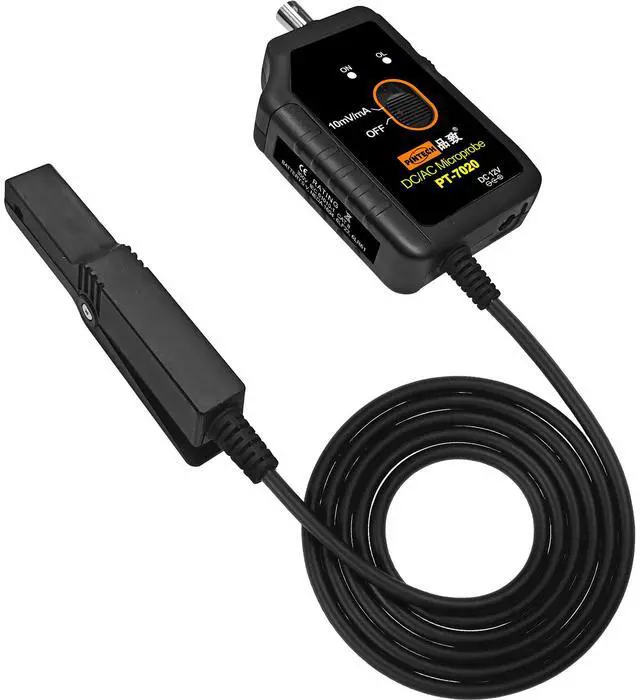
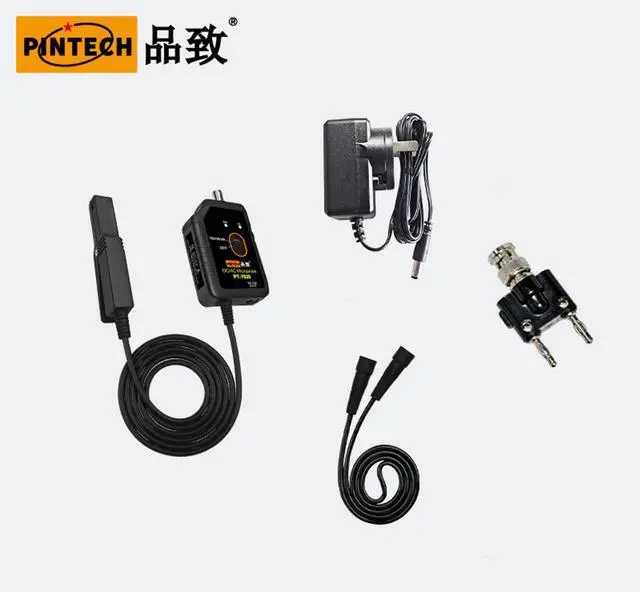



Any questions? Ask CelesteSM will help you find out quickly.
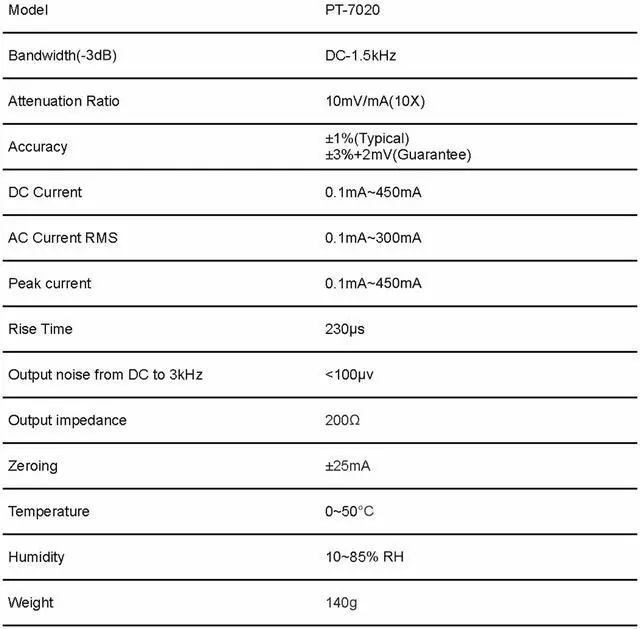
Model: PT-7020
Bandwidth: DC-1.5kHz
DC Current: 0.1mA4.5A
AC Current: 0.1 mA to 3 A rms
Peak current: 0.1mA4.5A
Transformation ratio: 10mV/mA(10:1)
Rise time: 230s
Output noise from DC to 1kHz: <100v
Output Impedance: 200
Zero adjustment: ±25mA
Accuracy: ±1%(Typical); ±3%+2mV(Guaranteed)
Weight: 140g/0.31lb
The PINTECH PT-7020 is a low-current AC/DC probe for oscilloscopes and multimeters, designed for engineers, technicians, and electronics users who need to measure small currents from 0.1 mA up to 4.5 A DC or 3 A RMS AC with ±1% accuracy and a BNC connection.
| Attribute | Value |
|---|---|
| Best For | Measuring small AC and DC currents on oscilloscopes and multimeters — detects down to 0.1 mA and measures up to 4.5 A DC / 3 A RMS; suited for low-current bench debugging and RMS measurements under AC/DC interference |
| Model Identifiers | PINTECH PT-7020; first listed on Newegg March 11, 2026 |
| Product Type | Electrical Testing & Measuring current probe; sold each |
| Accuracy & Standards | ±1% accuracy; CE certified |
Q: Should I choose the PINTECH PT-7020 or a shunt resistor setup for low-current oscilloscope measurements?
A: Choose the PT-7020 when you need non-intrusive current measurement, want to view AC and DC current directly on an oscilloscope, or need isolation from the circuit under test. A shunt resistor setup is usually the better fit when cost matters most and the circuit can tolerate inserting a resistor in series. For small-current debugging, the PT-7020 is the better choice when preserving circuit behavior is more important than minimizing setup cost.
Q: Is the PT-7020 better than a higher-current clamp probe for electronics bench work?
A: For bench work focused on small current signals, the PT-7020 is the more targeted option because its product positioning is for low-current measurement rather than broad high-current coverage. A higher-current clamp probe is the better choice when you regularly measure power rails, motors, inrush current, or other multi-amp waveforms where bandwidth and current range matter more than low-end sensitivity. Choose the PT-7020 when low-current resolution is the priority; choose a higher-current probe when application range is the priority.
Q: Should I buy the PT-7020 for portable field troubleshooting or for detailed bench analysis?
A: The PT-7020 makes more sense for detailed bench analysis than for broad field troubleshooting. Its published positioning emphasizes small-current measurement with a BNC interface for oscilloscopes and multimeters, which aligns with waveform-focused lab work. For field use, technicians often prefer simpler clamp meters or general-purpose current probes when convenience and wider current coverage matter more than low-current waveform detail. Choose the PT-7020 when signal visibility and low-current analysis are more important than portability-first convenience.
Q: Is the PT-7020 a better fit than a Rogowski coil or AC-only current probe?
A: Choose the PT-7020 when you need to observe both DC and low-frequency AC current in small-current circuits. Rogowski coils and AC-only transformer probes are typically better suited to higher-current or higher-frequency AC-only work, but they are not the first choice when DC measurement is required. The PT-7020 is the better fit for mixed AC/DC electronics troubleshooting at low current levels.
Q: Who is the PT-7020 most suitable for?
A: The PT-7020 is best suited to users who need to measure very small AC or DC currents and view them directly on an oscilloscope or compatible meter. Based on its stated 0.1 mA minimum detection, up to 4.5 A DC range, 3 A RMS AC range, and 1.5 kHz bandwidth, it fits bench diagnostics, low-current electronics work, and waveform checking better than high-current power or motor testing.
Q: Can I use the PT-7020 with both an oscilloscope and a multimeter?
A: Yes, if your instrument can accept the probe's BNC-style output and scale the reading correctly. The PT-7020 is described as having a BNC interface and being compatible with oscilloscopes and multimeters, but in practice multimeter use may require a BNC-to-banana adapter or a meter with native BNC input. This is a common buyer question for current probes because physical connector compatibility and scaling often matter as much as the electrical range.
Q: Is the PT-7020 a good choice for automotive, power supply, or motor current testing?
A: Only for lower-current, lower-frequency work. The PT-7020's published range and 1.5 kHz bandwidth make it more appropriate for small-signal current measurement than for large starter, inverter, or motor currents. If your main job is high-current troubleshooting, a higher-range current clamp is usually the better fit, even if it gives up some low-current sensitivity.
Q: What is the main trade-off versus a higher-range current probe like a Hantek or similar clamp probe?
A: The PT-7020 trades maximum current range and bandwidth for better low-current usefulness. Comparable clamp probes commonly target tens of amps, which is better for power electronics, automotive loads, and mains troubleshooting, but those products are not optimized for sub-milliamp to low-amp resolution. If your work is mostly small current measurement, the PT-7020 is the more specialized option; if you need one general-purpose clamp for larger loads, a higher-range model is usually more flexible.
Q: Is the PT-7020 worth buying if I only need a general-purpose current clamp?
A: Usually no. The PT-7020 appears to be a niche probe for low-current AC/DC measurement, not a broad general-purpose clamp. It is worth considering when small-current sensitivity and waveform viewing matter more than high-current capacity. For occasional household, automotive, or mains work, a more common higher-range clamp probe is typically the simpler choice.
Q: Who is the PT-7020 best suited for?
A: The PT-7020 is best suited for users who need to observe small AC or DC currents on a scope or meter, especially in low-current bench work. Its stated strengths are a 0.1 mA minimum detectable value, up to 4.5 A DC / 3 A RMS AC range, BNC connectivity, and ±1% accuracy. Based on Reddit discussion, this kind of low-current probe is most useful when you specifically need current waveforms rather than just a numeric current reading. It is less suitable if your main need is high-speed switching analysis or very low microamp work.
Q: Is the PT-7020 a good choice for measuring switching power supplies or fast current transients?
A: Usually no. The main trade-off is bandwidth: the product data lists only 1.5 kHz. Reddit discussions about current probes repeatedly show that bandwidth matters a lot for switch-mode power supplies and converter waveforms, and that low-bandwidth probes can smooth fast inductor or switching current into a misleading waveform. The PT-7020 is a better fit for slow or low-frequency current measurement than for serious SMPS debugging.
Q: Is the PT-7020 worth buying instead of using a shunt resistor or multimeter?
A: It is worth buying if you need non-intrusive current waveform viewing on an oscilloscope or want BNC-based current measurement without building a shunt setup. It is not the best value if you only need steady DC current readings, because Reddit discussions often recommend a DMM or a shunt resistor for low-frequency or static measurements. In short: buy it for convenience and waveform visibility, not as the cheapest way to measure current.
Q: What are the main trade-offs of the PT-7020?
A: The main trade-offs are clear: it is optimized for small-current measurement and broad instrument compatibility, but not for high bandwidth. The low-current sensitivity and BNC interface make it practical for general bench use with oscilloscopes and some multimeters. The downside is that its 1.5 kHz bandwidth limits usefulness for fast digital power or switching work. It also should not be treated as a replacement for specialized instruments when you need microamp-level precision or high-frequency fidelity.



