




 here!
I’m your shopping assistant for PC builds, upgrades, and everything tech.
Got questions? Ask away!
Start a conversation
here!
I’m your shopping assistant for PC builds, upgrades, and everything tech.
Got questions? Ask away!
Start a conversationShipped by GUANGZHOU PINTECH CO LTD

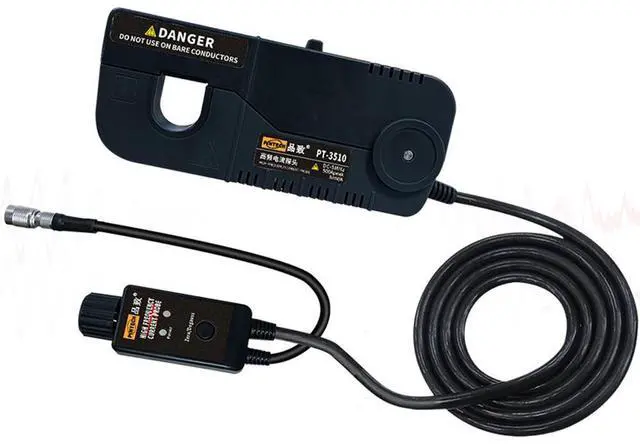
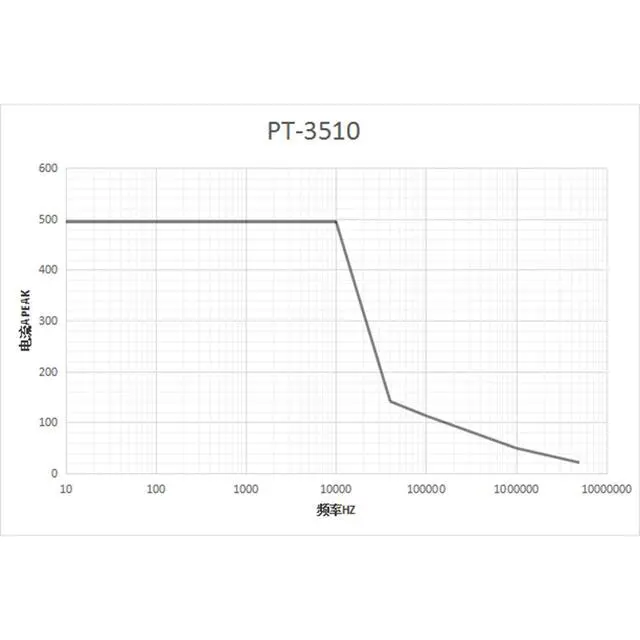



Any questions? Ask CelesteSM will help you find out quickly.
MODEL: PT-3510
Bandwidth (-3dB): DC-5MHz
AC Current:1000Ap-p
DC Current:500A
Maximum Current: 350A rms
Minimum Test Current: 200mA
Accuracy: ±2%
Transformation Ratio: 5mV/A(200:1)
Noise:200mA rms
Rise Time:70ns
Coupling Method:AC/DC
Clamp Dia: 20mm
Weight: 500g/1.1lb
The PINTECH PT-3510 is a high-precision AC/DC current probe for oscilloscopes, designed for engineers, technicians, and lab users who need to measure up to 1000A with 5MHz bandwidth through a standard BNC connection.
| Attribute | Value |
|---|---|
| Best For | Engineers and technicians performing electrical testing and measurement tasks |
| Model Identifiers | PINTECH PT-3510 |
| Product Type | Electrical Testing & Measuring instrument |
| Measurement Performance | ±2% accuracy for measured signals |
| Compliance And Certifications | CE certified for applicable markets |
| Selling Unit | Sold individually |
Q: Should I choose the PINTECH PT-3510 or a 100A current probe like the Micsig CP2100B?
A: Choose the PINTECH PT-3510 when you need to measure much higher current levels, such as inverter, motor drive, or power distribution waveforms, because its product positioning centers on 1000A peak capability with 5MHz bandwidth. Choose a 100A-class probe like the Micsig CP2100B when your work is on lower-current power electronics and you want a smaller-range probe designed around 10A and 100A ranges. The main trade-off is current range versus lower-range focus: PT-3510 is the stronger fit for high-current capture, while a 100A probe is typically the better fit for smaller signals where range selection matters more than maximum current headroom.
Q: Is the PT-3510 a better choice than a low-bandwidth clamp like the Hantek CC-65?
A: Yes, if your goal is oscilloscope waveform analysis rather than general low-frequency current checking. The PT-3510 is positioned as a 5MHz AC/DC current probe, while the Hantek CC-65 is a 20kHz AC/DC clamp. That means the PT-3510 is the more appropriate choice for capturing switching behavior, pulse edges, and higher-frequency current waveforms on an oscilloscope. A lower-bandwidth clamp remains the better fit for slower electrical measurements and simpler troubleshooting where MHz-level waveform detail is not required.
Q: Should I buy the PT-3510 or move up to a higher-end current probe like the Tektronix TCP0030A?
A: Choose the PT-3510 if you need high-current measurement with a standard BNC-connected probe and your use case is centered on current capacity rather than premium lab integration. Choose a higher-end probe like the Tektronix TCP0030A if you need a probe built for lower-current, high-bandwidth bench analysis with tighter ecosystem integration on compatible Tektronix oscilloscopes. The trade-off is clear: PT-3510 emphasizes 1000A and broad oscilloscope compatibility, while the TCP0030A emphasizes 120MHz performance and instrument-specific integration but at a much lower 30A range.
Q: Is a 5MHz, 1000A probe like the PT-3510 better for power electronics than a smaller 800kHz probe?
A: In many power-electronics workflows, yes. A 5MHz, 1000A probe like the PT-3510 is the better choice when you need more bandwidth for switching-current shape and more current headroom for larger converters, drives, or bus measurements. An 800kHz probe is still a practical fit for lower-current SMPS debugging and routine bench work, especially when the measured currents stay well below 100A. The buying decision usually comes down to whether your priority is larger current capability and more waveform bandwidth, or a smaller-range tool matched to lighter-duty measurements.
Q: Is this a good fit if I need to measure both DC and fast-changing AC current on an oscilloscope?
A: Yes, if your job requires one probe for both DC and AC current waveforms, the PT-3510 is a suitable match. Its listed DC to 5 MHz bandwidth means it can capture steady current plus switching and transient behavior that AC-only current clamps cannot show correctly. The main trade-off is that it is a specialized oscilloscope accessory, so it makes more sense for bench diagnostics, power electronics, and waveform analysis than for basic clamp-meter use.
Q: Will this work with my oscilloscope if it has a standard BNC input?
A: Usually yes, but only at a basic connectivity level. The PT-3510 uses a standard BNC connector, so it can connect to many oscilloscopes with BNC inputs. However, buyers should still confirm input impedance, scaling setup, and whether their scope can properly display the probe's output ratio. In short: BNC improves compatibility, but it does not guarantee every scope will support the probe equally well.
Q: Who is this probe best suited for?
A: This probe is best suited for engineers, technicians, and advanced users who need non-intrusive current waveform measurement on an oscilloscope. It is more appropriate for power electronics, motor drives, inverter work, and lab troubleshooting than for casual household electrical checks. The 1000 A peak-class positioning and 5 MHz bandwidth suggest it is intended for serious current analysis rather than entry-level testing.
Q: What are the main trade-offs versus a lower-bandwidth or simpler current clamp?
A: The PT-3510's advantage is that it combines DC measurement, oscilloscope waveform viewing, and higher bandwidth than many simpler clamps. That makes it better for switching signals, transient events, and detailed waveform work. The trade-offs are cost, more setup complexity, and less convenience for quick go/no-go current checks. If you only need rough current readings, a simpler clamp may be enough; if you need waveform detail, this type of probe is the better tool.
Q: Is this a better choice than an AC-only current probe?
A: It is a better choice only if you need to see DC current or mixed DC-plus-AC behavior. An AC-only probe can be simpler and sometimes more economical, but it cannot fully characterize circuits where DC offset or steady current matters. For battery systems, power supplies, motor controllers, and switching converters, an AC/DC probe like the PT-3510 is the safer buying decision.
Q: Is the PT-3510 a good fit if I need to view real current waveforms on an oscilloscope instead of just average current?
A: Yes, if your goal is waveform analysis rather than only average current measurement. Reddit and YouTube discussions repeatedly frame current probes as useful when you need to see dynamic current behavior during debugging, while the PT-3510 product data specifically supports DC and AC measurement up to 5 MHz with a standard BNC oscilloscope connection. It is a better fit for bench diagnostics and switching-current observation than for simple steady-state current checks.
Q: Who is the PT-3510 most suitable for?
A: It is most suitable for users who need an AC/DC clamp-style current probe for oscilloscope-based electronics or power measurement work, especially when they need higher current range and waveform capture rather than a basic meter reading. Based on the product data, it suits users who need up to 1000 A measurement, BNC scope compatibility, and moderate high-frequency coverage up to 5 MHz. It is less clearly aimed at low-current precision work or entry-level hobby use.
Q: Will the PT-3510 work with most oscilloscopes?
A: Usually yes, if your oscilloscope accepts a standard BNC input, because the PT-3510 is described with a standard BNC connector. Community discussions around oscilloscope probe compatibility commonly treat plain-BNC probes as broadly usable across brands. Buyers should still confirm input setup and scaling on the oscilloscope side, because physical connection does not guarantee automatic readout or correct measurement without proper configuration.
Q: What are the main trade-offs of choosing the PT-3510?
A: The main trade-off is that it prioritizes high current capacity and oscilloscope waveform visibility over maximum bandwidth or specialized low-current sensitivity. In Reddit discussions, buyers often compare current probes by bandwidth and intended measurement range, and some applications need either more bandwidth or more sensitivity than a general high-current probe provides. Based on the product data, the PT-3510 offers 1000 A range, 5 MHz bandwidth, and ±2% accuracy, which makes it more practical for many power and general bench tasks than for very fast or very small current measurements.


