




 here!
I’m your shopping assistant for PC builds, upgrades, and everything tech.
Got questions? Ask away!
Start a conversation
here!
I’m your shopping assistant for PC builds, upgrades, and everything tech.
Got questions? Ask away!
Start a conversationShipped by GUANGZHOU PINTECH CO LTD




Any questions? Ask CelesteSM will help you find out quickly.
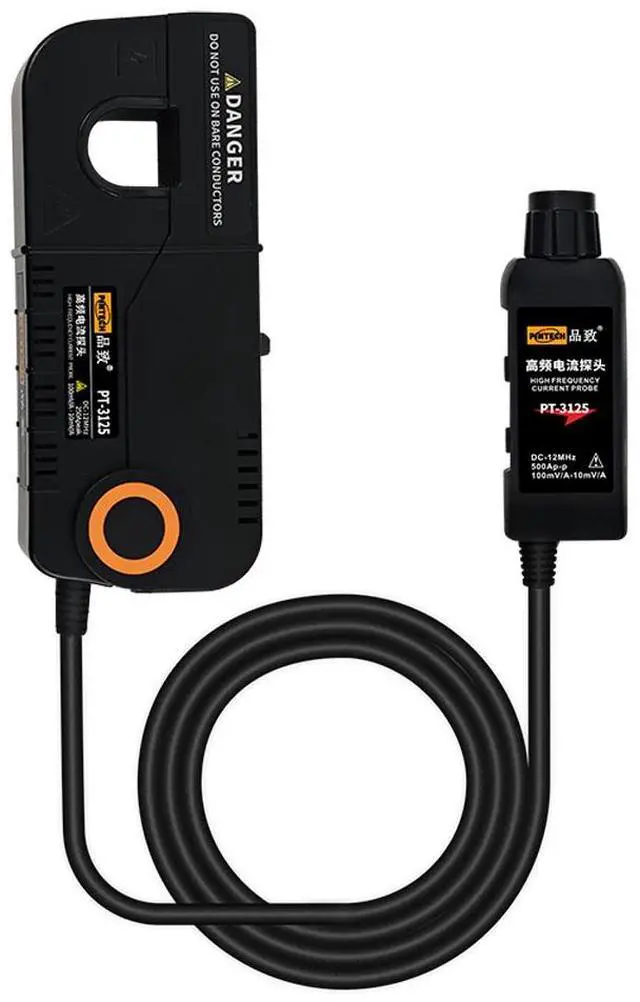
MODEL: PT-3125
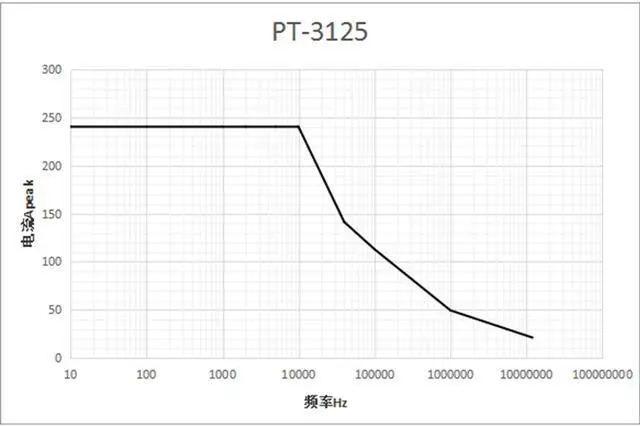
Bandwidth (-3dB): DC-12MHz
AC Current:500Ap-p
DC Current:250A
Maximum Current: 170A rms
Minimum Test Current: 100mA
Accuracy:±2%
Transformation Ratio: 10mV/A(100:1)
Noise:100mA rms
Rise Time:30ns
Coupling Method:AC/DC
Clamp Dia: 20mm
Weight: 500g/1.1lb
The PINTECH PT-3125 is a high-precision AC/DC oscilloscope current probe for measuring up to 500A with DC to 12MHz bandwidth, making it well suited for engineers, technicians, and lab users who need fast, accurate current waveform capture on BNC-equipped oscilloscopes.
| Attribute | Value |
|---|---|
| Best For | Measuring DC and AC currents up to 500 A and signals to 12 MHz with an oscilloscope via a standard BNC connector; suited for waveform capture and general electrical testing requiring ±2% accuracy |
| Measurements & Accuracy | AC/DC current measurement with a 500 A maximum range and accuracy ±2% |
| Bandwidth And Frequency | Bandwidth DC to 12 MHz for high-frequency current waveform capture |
| Connector And Compatibility | Standard BNC connector for direct connection to oscilloscopes and test instruments |
| Physical And Mechanical | Clamp-style jaws with a diameter of 0.79 inches for enclosing conductors during measurement |
| Package Contents | Includes PT-3125 current probe plus adaptors, BNC cable, power cable and user manual |
| Regulatory And Model Info | PINTECH PT-3125 current probe, category: Electrical Testing & Measuring, CE certified, sold individually (each) |
Q: Should I choose the PINTECH PT-3125 or a lower-bandwidth current probe for SMPS and inverter waveform work?
A: Choose the PT-3125 when you need to see faster switching edges, harmonics, and transient current behavior rather than just average or low-frequency current trends. Its official DC to 12 MHz bandwidth and 30 ns rise time place it above lower-bandwidth clamp probes typically discussed for general bench use, where community advice often treats sub-1 MHz to low-MHz probes as sufficient only until bandwidth becomes the limiting factor. A lower-bandwidth probe is the better fit when your work is mostly low-frequency power checks and you want to prioritize simpler, lower-cost measurement.
Q: Is the PT-3125 a better choice than the PINTECH PT-3510 for high-speed current measurements?
A: Yes, if your priority is bandwidth and faster waveform detail. Within PINTECH's own lineup, the PT-3125 moves from 5 MHz on the PT-3510 to 12 MHz, and from 70 ns rise time to 30 ns, which makes it the more suitable option for examining faster switching events. The trade-off is current range: the PT-3510 supports higher current than the PT-3125, so it is the better choice when your measurement target is less bandwidth-sensitive but requires more headroom.
Q: Should I buy the PT-3125 or the PT-3215 if I need more current capacity?
A: Choose the PT-3215 when current capacity matters more than bandwidth. Official PINTECH specs show the PT-3215 supports substantially more current, while the PT-3125 trades that headroom for much higher bandwidth and faster rise time. In practice, the PT-3125 fits lab work where waveform fidelity at higher switching frequencies matters more, while the PT-3215 fits heavier-current applications where the signal is slower or where current range is the main buying constraint.
Q: Is the PT-3125 enough, or should I move up to a higher-end current probe from a premium test brand?
A: The PT-3125 is a practical choice when you need a BNC-output AC/DC current probe with meaningful high-frequency capability and broad oscilloscope compatibility without stepping into premium-brand probe pricing and amplifier ecosystems. Move up to a higher-end platform when you need tighter published accuracy, deeper ecosystem integration, or significantly different bandwidth/current combinations from established premium probe families. The main trade-off is that premium brands typically offer broader documented application support and accessory ecosystems, while the PT-3125 keeps the setup simpler with a standard BNC approach.
Q: Will this probe work with a standard oscilloscope, or does it need a special interface?
A: It is best suited to oscilloscopes with a standard high-impedance BNC input, because the product includes a BNC connection and is described as broadly compatible with oscilloscopes. The main compatibility check is not the brand of scope, but whether your scope accepts a standard BNC signal input and whether the probe’s scaling and power requirements match your setup. In this category, some competing current probes also use standard BNC, while others require a dedicated probe interface or external amplifier, so this model is the simpler choice when you want general BNC-based compatibility.
Q: Who is this 500A current probe suitable for?
A: It is most suitable for users who need to observe both DC and AC current waveforms on an oscilloscope, especially in power electronics, motor drives, inverter work, switching power supplies, and general bench diagnostics. A 500A probe is more appropriate for medium- to high-current measurement than for very small-signal current analysis. If your work is mostly low-current, high-sensitivity debugging, a lower-range probe may be a better fit.
Q: Is 12 MHz enough bandwidth for this kind of current probe?
A: Yes for many power and service tasks, but not for every application. A 12 MHz current probe is generally suitable for viewing DC current, line-frequency AC, switching power supply behavior, motor drive current, and many transient events. The trade-off is that it is not the right choice when you need very high-bandwidth, low-current analysis for fast edges or RF-related work. In practical buying terms, 12 MHz is a midrange decision point: broader capability than low-kHz or low-MHz clamp probes, but below premium high-bandwidth lab probes.
Q: What are the main trade-offs versus a premium brand current probe?
A: The main advantage of this type of probe is broader BNC-based compatibility and likely lower cost relative to premium oscilloscope-brand probes. The trade-offs are that premium probes may offer tighter integration with specific oscilloscopes, more automated scaling, dedicated probe interfaces, and in some cases stronger performance at either very high bandwidth or specialized current ranges. This PINTECH model is the better fit when you want a general-purpose AC/DC current probe for standard scopes rather than brand-locked ecosystem features.
Q: Is this a good choice if I need to measure very small currents accurately?
A: Usually no. This model is better matched to higher-current work because its headline range is 500A and its stated accuracy is ±2%. It is useful when current capacity and waveform capture matter more than very fine low-current sensitivity. If your main job is measuring small currents with maximum detail, a lower-range and often higher-sensitivity current probe is typically the better buying decision.
Q: Is the PT-3125 a good fit for switching power supply and power-electronics current waveform work?
A: Yes, if you need to view both DC and AC current on an oscilloscope and your work falls within a 12 MHz probe bandwidth and 500 A maximum range. Reddit discussions around oscilloscope current probes repeatedly focus on SMPS and injector-waveform work, where users care most about bandwidth for seeing waveform shape and edges. Based on the product data, the PT-3125 is better suited to that kind of work than low-bandwidth hobby probes, but it is still a specialized tool rather than a general clamp meter.
Q: Who is the PT-3125 most suitable for?
A: It is most suitable for users who already have an oscilloscope with a BNC input and need non-contact current waveform measurement for bench diagnostics, repair, or design work. It makes more sense for electronics troubleshooting, converter development, motor-drive or injector analysis, and similar lab tasks than for casual household electrical checks. Its value depends on whether you specifically need to see current waveforms, not just current magnitude.
Q: What are the main trade-offs of buying the PT-3125?
A: The main trade-off is that you are paying for waveform visibility and bandwidth, not portability or simplicity. Community discussions repeatedly treat current probes as application-specific purchases: higher bandwidth helps with fast edges and switching behavior, but it only matters if your measurements actually require it. For buyers who only need approximate current readings, a simpler clamp meter may be more practical. For buyers who need oscilloscope-grade current waveforms, a probe like this is the more appropriate tool.
Q: Will the PT-3125 work with most oscilloscopes?
A: Usually yes, if the oscilloscope accepts a standard BNC-connected probe and you can configure the scope scaling correctly. The product data says it uses a standard BNC connector and is intended to be compatible with oscilloscopes broadly. In buying discussions, compatibility is usually less about physical connection and more about whether the scope and workflow support the probe properly for accurate reading and interpretation.


