

Your Browsing History

Meet Your Seller

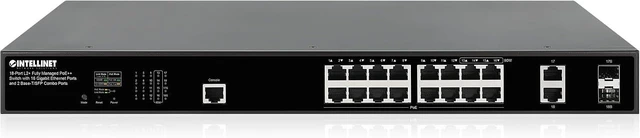


Intellinet 18-Port Managed PoE++ Switch, 518W Budget, 2 SFP Ports
- IEEE 802.3bt/at/af, 4x90W and 12x30W ports, PoE Self healing, PD Alive Check, two 1G combo uplinks, 19" Rackmount | 562065
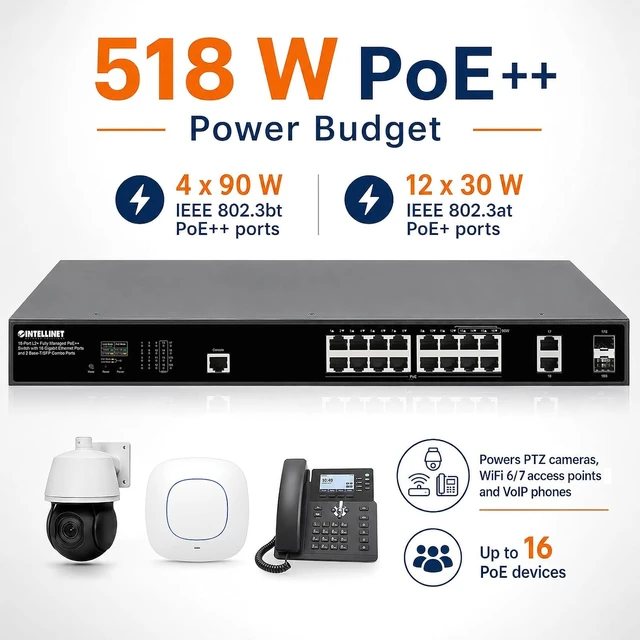
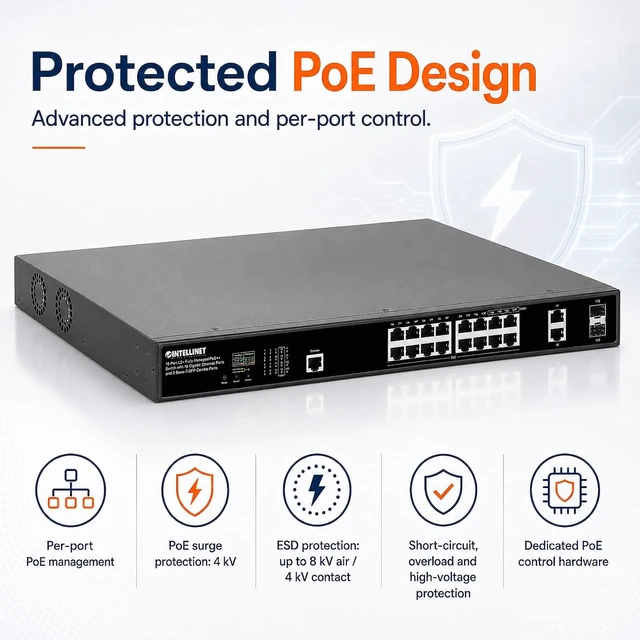
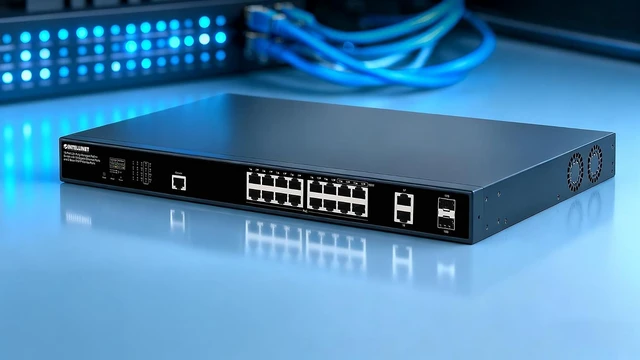
- 16 Gigabit RJ45 PoE ports deliver a 518W total power budget, with ports 1-12 supplying up to 30W PoE+ and ports 13-16 supplying up to 90W PoE++ for higher-draw devices.
- Two 1G combo uplink ports support either copper Base-T or SFP connections, giving you flexible uplink options for fiber or copper runs without changing the 16-port access layout.
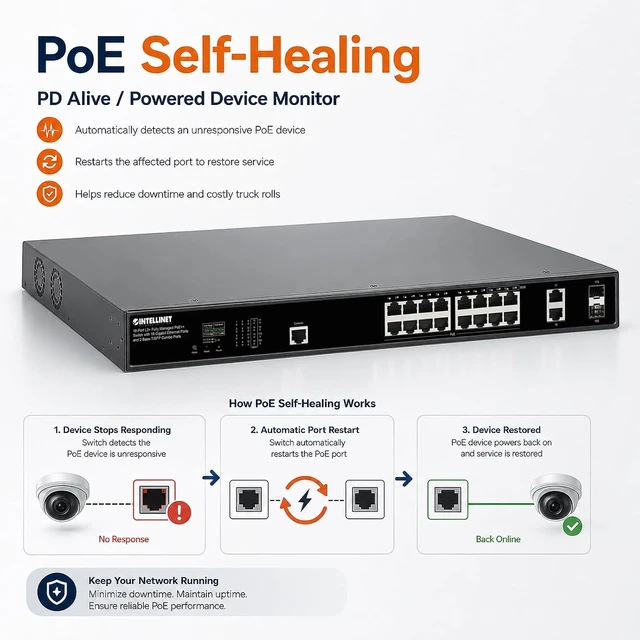
- Built-in PD Alive Check monitors connected PoE devices and can automatically restart a device that stops responding or stops sending traffic to help reduce network interruptions.
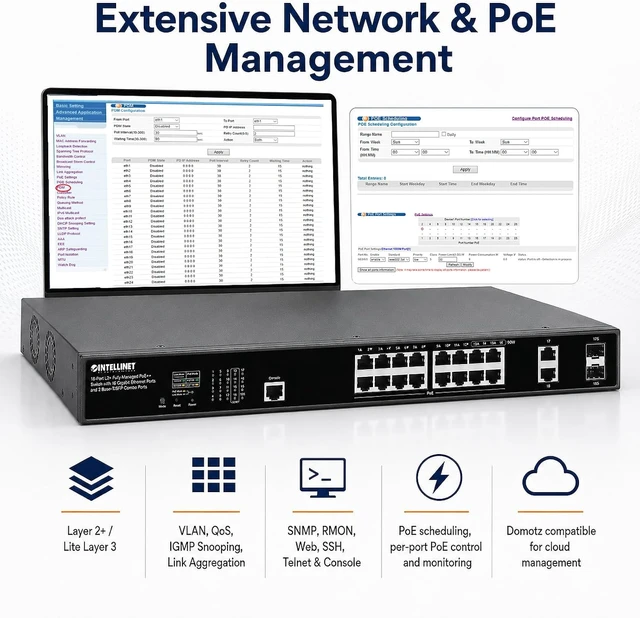
- Managed L2+ features include 802.1Q VLANs, QoS with CoS and DSCP, link aggregation, IGMP snooping, bandwidth control, port mirroring, and broadcast storm control.
- Configure and monitor through web UI, SSH, Telnet, or RJ45 console, with SNMP v1/v2c/v3, RMON, LLDP, ping, traceroute, and dual-stack IPv4/IPv6 support.
+
+
Overview
Specs
Reviews

Any questions? Our AI mode will help you find out quickly.
Try me now
The 24 Port model provides PoE++ output up to 90 watts on ports 1 through 8 and PoE+ output up to 30 watts on ports 9 through 24. The 16 port model provides PoE++ output up to 90 watts on ports 13 through 16 and PoE+ output up to 30 watts on ports 1 through 12.
1 2 What is the difference between the 18-port and 26-port models?
The 18-port model has 16 Gigabit PoE ports; the 26-port model has 24. Both add two 1G Base-T/SFP combo uplinks, a 518W PoE budget and L2+ management.
How much PoE power is available?
Both switches provide a 518W total PoE budget. The 18-port model has four 90W PoE++ ports; the 26-port model has eight. Remaining PoE ports support up to 30W each.
Which PoE standards do these switches support?
Both support IEEE 802.3af, 802.3at and 802.3bt. That means they can power standard PoE, PoE+ and high-power PoE++ devices from the same managed switch.
Can these switches handle advanced network management?
Yes. Both support VLANs, QoS, link aggregation, IGMP snooping, bandwidth control, port mirroring, SNMP/RMON and IPv4/IPv6 for managed business networks.
What are the two combo uplink ports used for?
Each switch includes two 1G Base-T/SFP combo uplinks, giving installers copper or fiber uplink flexibility for connecting to servers, IDF/MDF closets or the network core.
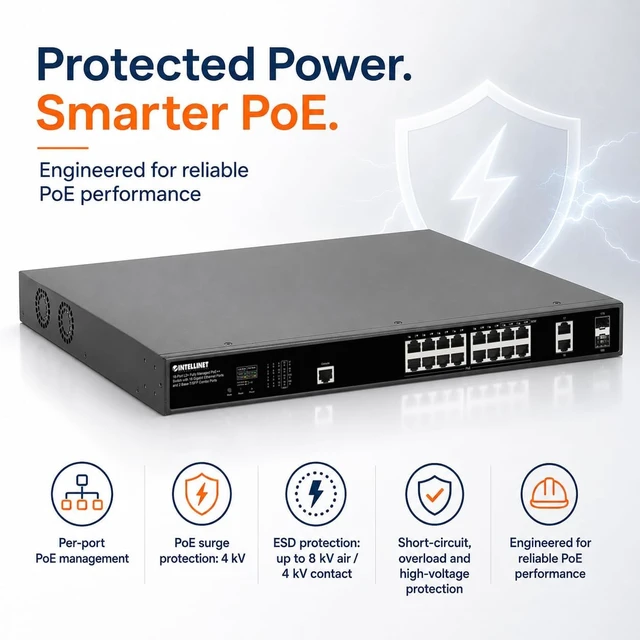
PoE Gigabit Ports 16 × 10/100/1000 Mbps | 24 × 10/100/1000 Mbps High-Power PoE++ Ports 4 × up to 90 W | 8 × up to 90 W PoE+ Ports 12 × up to 30 W | 16 × up to 30 W Total PoE Budget 518 W PoE Standards IEEE 802.3af / 802.3at / 802.3bt Uplink Ports 2 × 1G Base-T/SFP Combo Switching Capacity 36 Gbps | 52 Gbps Management Layer 2+ / Layer 3 Lite Network Management Web, SSH, Telnet, Console, SNMP/RMON Managed Features VLAN, QoS, LACP, IGMP Snooping, Port Mirroring Self-Healing PoE PDM / PD Alive Check Jumbo Frame Support Up to 9,216 Bytes MAC Address Table 8K entries PoE Surge Protection 4 kV on RJ45 ports Dimensions 17.32 × 12.99 × 1.73 in. (19" Rackmount, 1U) Compliance FCC, CE, RoHS, UKCA, NDAA IEEE 802.3bt 4PPoE Output Ports What is the difference between the 18-port and 26-port models?
How much PoE power is available?
Which PoE standards do these switches support?
Can these switches handle advanced network management?
What are the two combo uplink ports used for?
Technical Specifications 18-Port Model 562065 | 26-Port Model 562072
1 2 What is the difference between the 18-port and 26-port models?
The 18-port model has 16 Gigabit PoE ports; the 26-port model has 24. Both add two 1G Base-T/SFP combo uplinks, a 518W PoE budget and L2+ management.
How much PoE power is available?
Both switches provide a 518W total PoE budget. The 18-port model has four 90W PoE++ ports; the 26-port model has eight. Remaining PoE ports support up to 30W each.
Which PoE standards do these switches support?
Both support IEEE 802.3af, 802.3at and 802.3bt. That means they can power standard PoE, PoE+ and high-power PoE++ devices from the same managed switch.
Can these switches handle advanced network management?
Yes. Both support VLANs, QoS, link aggregation, IGMP snooping, bandwidth control, port mirroring, SNMP/RMON and IPv4/IPv6 for managed business networks.
What are the two combo uplink ports used for?
Each switch includes two 1G Base-T/SFP combo uplinks, giving installers copper or fiber uplink flexibility for connecting to servers, IDF/MDF closets or the network core.
PoE Gigabit Ports 16 × 10/100/1000 Mbps | 24 × 10/100/1000 Mbps High-Power PoE++ Ports 4 × up to 90 W | 8 × up to 90 W PoE+ Ports 12 × up to 30 W | 16 × up to 30 W Total PoE Budget 518 W PoE Standards IEEE 802.3af / 802.3at / 802.3bt Uplink Ports 2 × 1G Base-T/SFP Combo Switching Capacity 36 Gbps | 52 Gbps Management Layer 2+ / Layer 3 Lite Network Management Web, SSH, Telnet, Console, SNMP/RMON Managed Features VLAN, QoS, LACP, IGMP Snooping, Port Mirroring Self-Healing PoE PDM / PD Alive Check Jumbo Frame Support Up to 9,216 Bytes MAC Address Table 8K entries PoE Surge Protection 4 kV on RJ45 ports Dimensions 17.32 × 12.99 × 1.73 in. (19" Rackmount, 1U) Compliance FCC, CE, RoHS, UKCA, NDAA IEEE 802.3bt 4PPoE Output Ports What is the difference between the 18-port and 26-port models?
How much PoE power is available?
Which PoE standards do these switches support?
Can these switches handle advanced network management?
What are the two combo uplink ports used for?
Technical Specifications 18-Port Model 562065 | 26-Port Model 562072
Warranty & Returns
Warranty, Returns, And Additional Information
Warranty
- Please contact the Seller directly for warranty information. Warranty information may also be found on the Manufacturer's website.
- Read full details
- CONTACT
Return Policies
- Return for refund within: 30 days
- Return for replacement within: 30 days
- This item is covered by Solides Home Return Policy
Manufacturer Contact Info
- For a directory of all our manufacturers, please click below.
- Manufacturers Directory
LOADING...