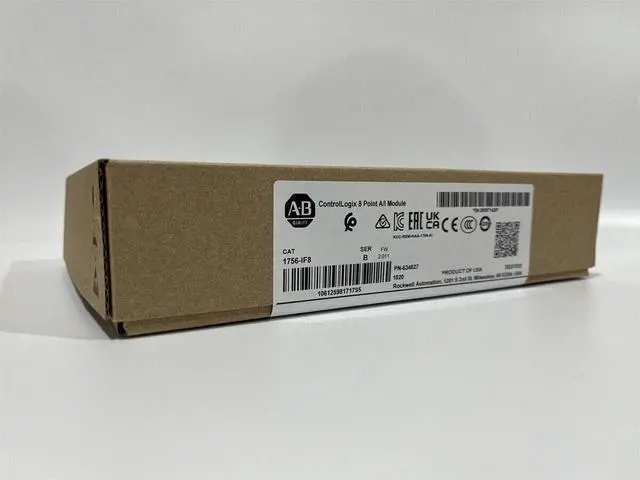
The 1756-IF8 is an analog module. This module comes with several key safety features. Using these features users can establish connections with actuators and I/O sensors. It comes with a finger-safe cover and one built-in removable terminal block. At +/-10 volts direct current, the resolution rating on this module is 15 bits. For other signal types, the supported resolution is 16 bits. This module needs to be supplied with 1.73 watts of power. It comes with overvoltage protection that can withstand 30 volts direct current and 8 volts direct current.
The 1756-IF8 is an analog controller module. It is a module with single slots. It supports conversion between varying resolutions within the range of 15-bit to 16-bit. Specific module resolutions are 160 µV/count for 0-10 volts direct current, 320 µV/count for +/-10 volts direct current, 0.32 µA/count for 0-20 milliampere signals, and finally 80 µ/V counts for 0-5 volts direct current and 0 to 20.5 milliamperes. This particular controller can only accommodate 4000 analog I/O signals. This module can be housed inside a local chassis. Other than that, this module can be placed inside any I/O rack.
Furthermore, it comes preinstalled with the Sigma-Delta conversion method. Any signal that it receives is first stored in an integer mode. This controller should be utilized with an IEEE floating-point 32-bit register. It supports both the 1756-TBCH and 1756-TBSH for user-defined keying. Depending on the type of hard wiring, the scan time may vary. The rated scan time is 16 to 488 milliseconds for single wiring. When the point differential mode is activated, the scan time is 8-244 milliseconds. For point differential inputs, the scan time is 5-122 milliseconds.
This controller comes with many advanced features such as the digital filter, rate alarms, multiple input ranges, process alarms, real-time sampling, module filter, wire off detection, and under-range/over-range detection. This controller can be used with three different types of wiring. The single-ended wiring must be used to accommodate the maximum number of useable modules.





 here!
here!