




 here!
I’m your shopping assistant for PC builds, upgrades, and everything tech.
Got questions? Ask away!
Start a conversation
here!
I’m your shopping assistant for PC builds, upgrades, and everything tech.
Got questions? Ask away!
Start a conversation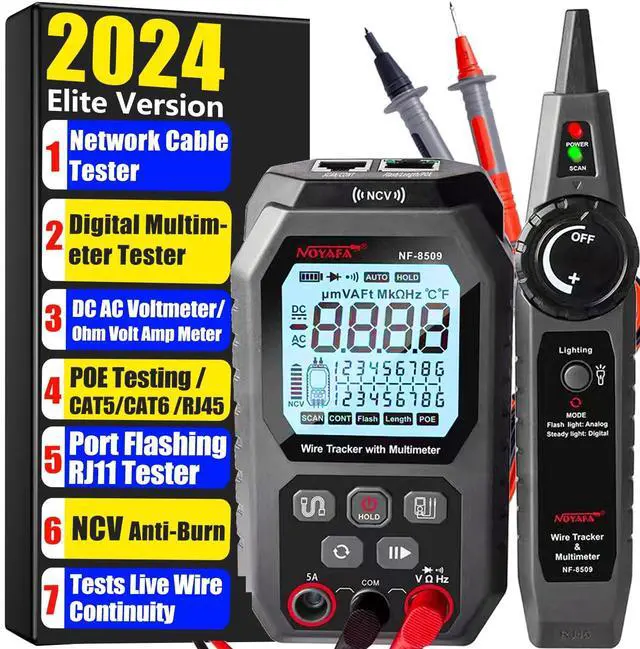
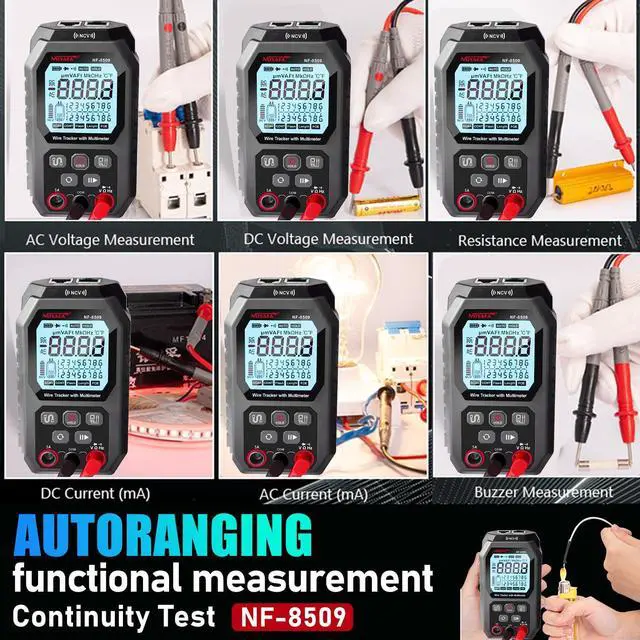
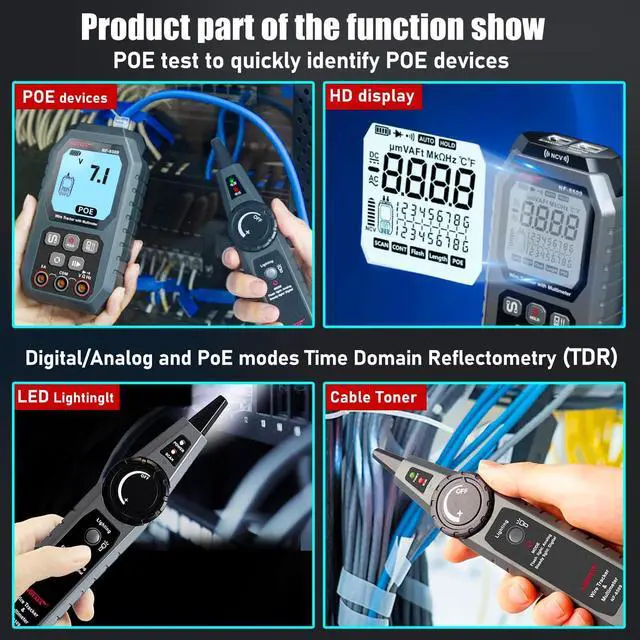
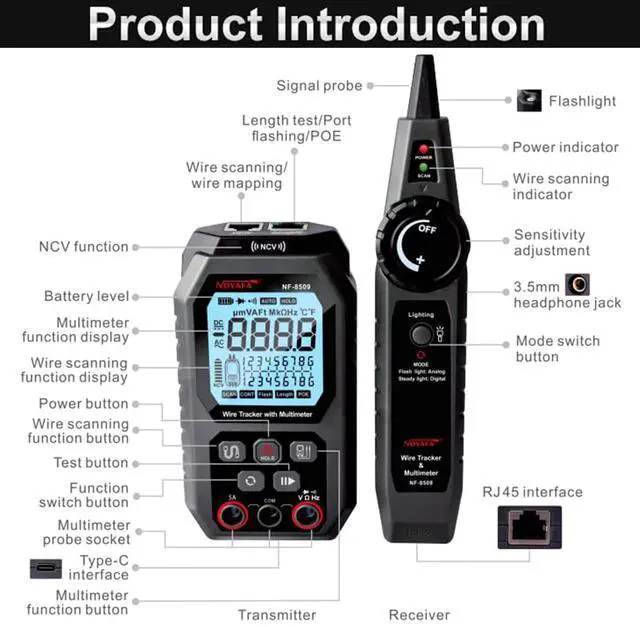



Any questions? Ask CelesteSM will help you find out quickly.


| Wire mapping test | Max. distance of 2,000m |
|---|---|
| Wire scanning | RJ45 600m |
| Wire length test | 5 - 200m (±3m) |
| Port flashing test | 10M/100M/1,000M |
| POE | 4-core/8-core powersupply detection ,POE voltage detection |
| Continuity test | DetectThe connectivity performance ofofwires andvarious conductors,The buzzewillsound when resistance is below 50O,Identify the polarity and forward voltagedrop ofdiodes(0-3.3V) |
| Resistance measurement | 600O-60MO ( accuracy: ±1.0% +5 ) |
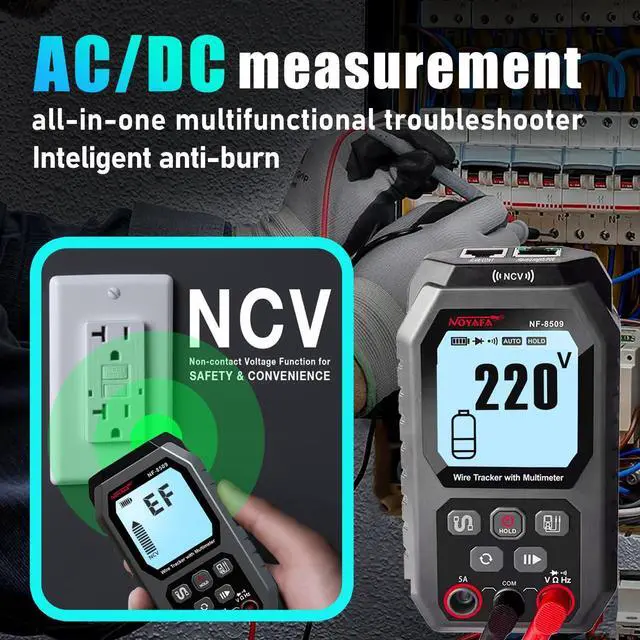
| NCV function | Inductive voltage detector (0-4 levels) |
| AC/DC voltage measurement | 600mV-610V ( DC accuracy: ±0.5%+3: AC accuracy: ±0.5%+3 ) |
| AC/DC measurement | 1mA - 3A DC ( accuracy: ±0.8%+3 ) |
| Frequency | 0-10MHz ( accuracy: ±1.0%+3 ) |
| Power | 3.7V / 1,500mA lithium battery |
| Ambient temperature display | v |
| Telephone function | v |
| Power | DC 9V (exclusive) |
| Maximum working current | =150mA |
NF-8509 Network Cable Tester (with Multimeter Tester), POE/RJ45 RJ11 CAT5 CAT6 LAN/Ethernet Port Flashing, Anti-Interference TDR Network Tester/NCV Anti-Burnout AC DC Voltmeter Network Tool
| Measurement Type | Multimeter |
| Included Components | NO |
| Item Weight | 0.65 pounds |
| Specification Met | FCC |
| Item Package Quantity | 1 |
| Item Dimensions | 6 L x 2.5 W x 2 H inches |
| Brand Name | NOYAFA |
| Number of Items | 1 |
| Item Package Dimensions | 5.588 L x 16.51 W x 26.8986 H centimeters |
| Size | NF-8509 |
| Style Name | Industrial |
| Color | Black |
| Measurement Accuracy | 0.003m |
| Package Weight | 0.608 kilograms |
| Manufacturer | NOYAFA |
| Model | NF-8509 |
| Are batteries required? | false |
| Power Source | No |
| Unit Count Type | Count |
| Unit Count | 1 |
| Are batteries included? | false |
The NOYAFA NF-8509 is a multifunction network cable tester and digital multimeter for technicians, network installers, electricians, and advanced DIY users. It tests RJ45, RJ11, CAT5, and CAT6 cabling, measures AC/DC voltage, current, resistance, continuity, diodes, and temperature, and supports PoE detection, port flashing, NCV, and TDR cable-length testing from 5 to 200 meters.
| Attribute | Value |
|---|---|
| Best For | Network cable testing and electrical troubleshooting in a portable, battery-powered cable tester format |
| Product Type | Cable tester kit in a rectangular housing |
| Power And Electrical Rating | Battery powered with a listed 66 V DC rating |
| Physical Specifications | 1.12 pounds; 6.9 L x 3.2 W x 1.5 H inches |
| Model Identifiers | NOYAFA NF-8509 |
Q: Should I buy the NOYAFA NF-8509 or the NF-8209 Pro?
A: Choose the NF-8509 when you need one handheld tool for RJ45/RJ11 testing plus electrical measurements such as AC/DC voltage, current, resistance, continuity, diode testing, temperature, and NCV detection. Choose the NF-8209 Pro when cable installation is the priority and you need stronger cable-tracing features, integrated wire mapping, RJ45 crimp testing, rechargeable USB-C batteries, and cable-length testing up to 350 meters. The NF-8509 is the more versatile electrical troubleshooting tool, while the NF-8209 Pro is more focused on structured-cabling work.
Q: Is the NOYAFA NF-8509 or NF-8601S better for locating cable faults?
A: Choose the NF-8601S for performance-first cable troubleshooting. It supports TDR testing up to 500 meters, distance-to-fault reporting, RJ45/RJ11/coaxial and power-cable testing, ping testing, color display, and data export. Choose the NF-8509 for a more compact mixed-use tool when basic RJ45 testing up to 200 meters, PoE checks, port flashing, cable tracing, and multimeter functions are more important than maximum cable range and detailed fault analysis.
Q: Should I choose the NF-8509 or a Klein Tools Scout Pro 3 for network installation?
A: Choose the Klein Scout Pro 3 when you need structured-wiring features such as RJ45, RJ11/12, and coax testing, multiple remote identifiers, and efficient cable mapping across many installed runs. Choose the NF-8509 when electrical troubleshooting is also part of the job because it combines network testing with AC/DC voltage, current, resistance, continuity, diode, temperature, and NCV functions. The Klein is better suited to multi-cable installation workflows, while the NF-8509 reduces the need to carry a separate multimeter.
Q: Is the NOYAFA NF-8509 a practical alternative to the Fluke Networks MicroScanner PoE?
A: Choose the NF-8509 when you want network cable testing combined with general electrical measurements in one tool. Choose the MicroScanner PoE when professional Ethernet diagnostics are the main requirement, especially PoE class reporting, network-speed identification through 10GBASE-T, detailed wiremap results, and distance-to-fault testing. The NF-8509 covers more general electrical functions, while the MicroScanner PoE provides deeper Ethernet and PoE verification.
Q: Who is the NOYAFA NF-8509 suitable for?
A: The NF-8509 is suitable for home-network installers, IT technicians, electricians, security-camera installers, and advanced DIY users who need one handheld tool for Ethernet cable testing, PoE checks, port identification, cable-length measurement, and basic electrical measurements.
Q: Can it test both Ethernet and telephone cables?
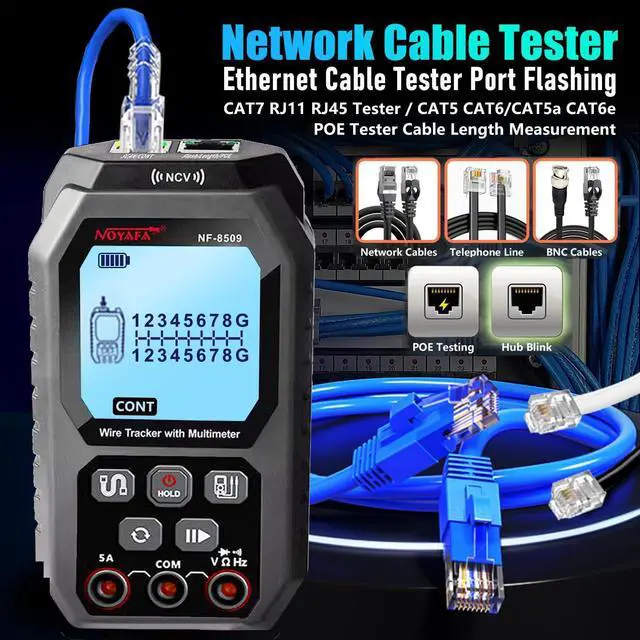
A: Yes. The NF-8509 supports RJ45 Ethernet testing for CAT5 and CAT6 network cables and RJ11 testing for telephone-style cables. It is designed for continuity checks, cable identification, port flashing, and related wiring diagnostics rather than network-speed certification.
Q: Can the NF-8509 test PoE equipment and identify the correct network port?
A: Yes. Its PoE function can identify supported PoE information, including voltage, polarity, power-supply mode, and whether the source is based on 802.3af or 802.3at. Its port-flashing function helps locate the matching switch or hub port. It is intended for PoE identification and troubleshooting, not for full PoE network certification.
Q: Is the cable-length measurement useful for troubleshooting installed network runs?
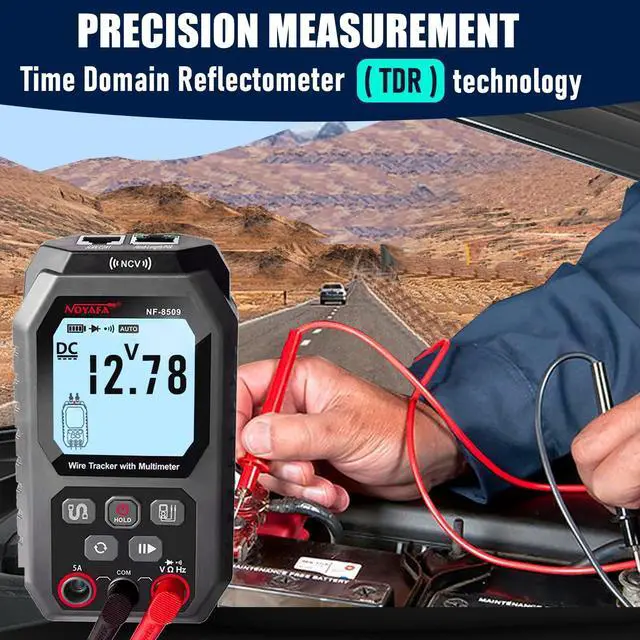
A: Yes. The NF-8509 measures cable length from 5 to 200 meters using TDR and allows VoP calibration. This is useful for estimating installed-run length and locating wiring issues, but the result depends on the cable type and VoP setting, so it should not be treated as a substitute for professional cable certification.
Q: Can it replace a dedicated multimeter or professional network certifier?
A: It can cover basic multimeter tasks such as AC/DC voltage, DC current, resistance, continuity, diode, temperature, and NCV testing, while also handling common network-cable checks. However, it should not be considered a replacement for a professional cable certifier or a specialized electrical meter when formal certification, advanced signal analysis, high-voltage work, or strict measurement accuracy is required.
Q: Is the NOYAFA NF-8509 worth buying for routine network and cable troubleshooting?
A: It can be a practical value choice for routine troubleshooting because it combines cable continuity, TDR length measurement, cable tracing, port flashing, PoE checks, and basic multimeter functions. It is better suited to maintenance and fault finding than to formal cable certification.
Q: Can the NF-8509 replace a professional cable certifier or advanced network analyzer?
A: No. The NF-8509 is intended for basic cable testing, tracing, length estimation, PoE checks, and electrical measurements. It should not be treated as a replacement for certification equipment or advanced tools that provide detailed network diagnostics, reporting, or certification results.
Q: Is the NF-8509 suitable for locating cables, identifying switch ports, and checking PoE?
A: Yes, it is suitable for basic field identification and troubleshooting. Its feature set includes cable toning, RJ45/RJ11 testing, port flashing, and PoE information checks. Results are intended to help locate and diagnose connections, not to provide full switch-level network analysis.
Q: Who is the NF-8509 best suited for?
A: It is best suited for home network troubleshooting, installers, electricians, low-voltage technicians, and maintenance workers who need several basic testing functions in one portable tool. It may be less suitable for users who need formal certification, detailed link diagnostics, or highly polished professional documentation.
Q: What are the main trade-offs of choosing the NF-8509?
A: The main trade-off is breadth versus specialization: one device combines networking and multimeter functions, but users may need to learn multiple test modes and should not expect the precision, durability, instructions, or certification capabilities of higher-end dedicated tools. Community discussions also mention that some NOYAFA models can have confusing model differences or less helpful documentation.





