




 here!
I’m your shopping assistant for PC builds, upgrades, and everything tech.
Got questions? Ask away!
Start a conversation
here!
I’m your shopping assistant for PC builds, upgrades, and everything tech.
Got questions? Ask away!
Start a conversationShipped by GUANGZHOU PINTECH CO LTD

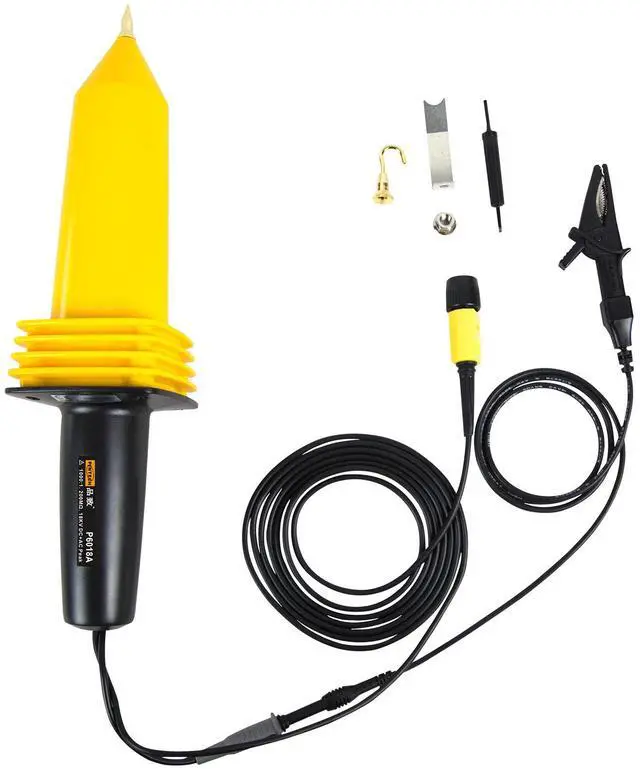



Any questions? Ask CelesteSM will help you find out quickly.
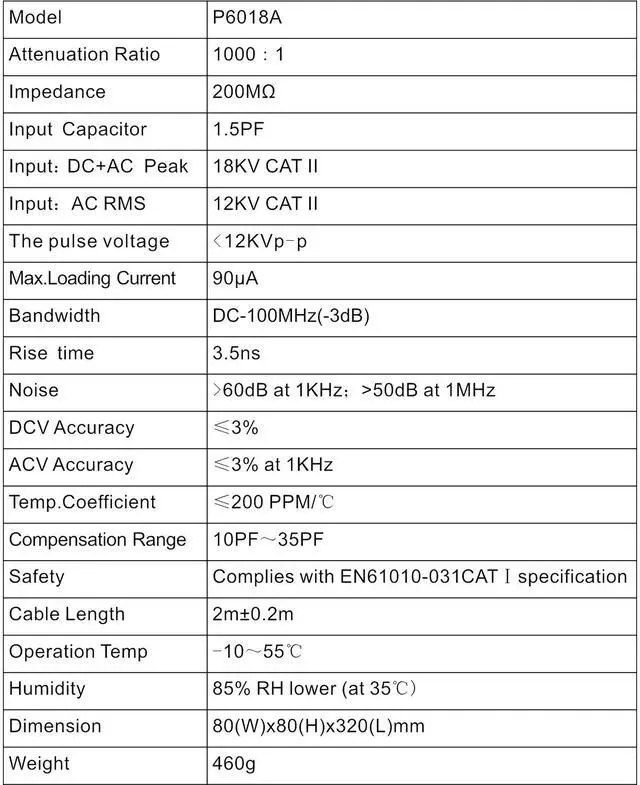
MODEL: P6018A
Input Impedance: 200M
Input Capacitance: 1.7pF
Attenuation Rate: 1000:1
Bandwidth: DC-100MHz(-3dB)
Max.DC+AC peak: 18kV/30 sec
Max.AC RMS: 12kV/30 sec
Rise Time: 3.5ns
DCV Accuracy: 3%
ACV Accuracy: 3% at 60Hz(0-10kV rms), 5% at 60Hz(10-20kV rms)
Max. Loading Current: 56A
Noise: >60dB at 1kHz; >50dB at 1MHz
Size: 80 x 80 x 320 mm
Weight: 460g/1lb
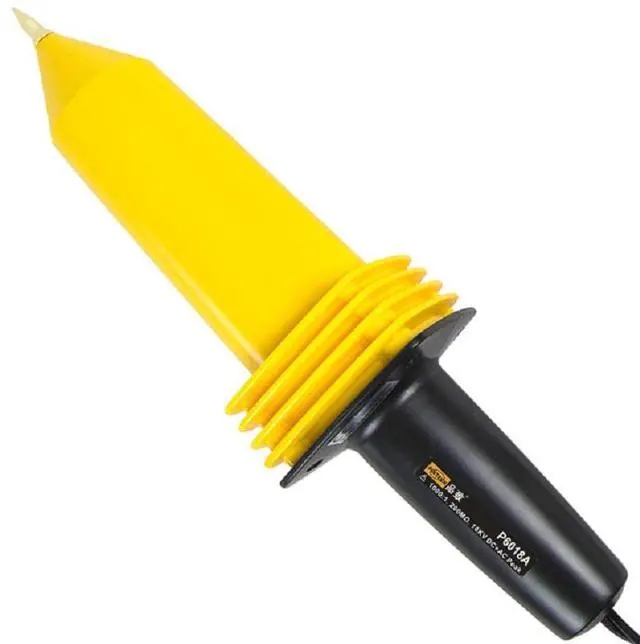
The PINTECH P6018A is a high-voltage oscilloscope probe with 1000:1 attenuation, designed for engineers, technicians, and electronics labs that need to measure high-voltage waveforms up to 18kV DC or 12kV AC on standard BNC-equipped oscilloscopes.
| Attribute | Value |
|---|---|
| Best For | Measuring high-voltage signals on oscilloscopes (up to 18 kV DC / 12 kV AC) where a 1000:1 attenuated input and standard BNC connection are required |
| Electrical Characteristics | Maximum ratings 18 kV DC and 12 kV AC with 1000:1 attenuation, input impedance 200 MΩ, accuracy ±3% (DC); AC accuracy 3% at 60Hz for 0–10 kV rms and 5% at 60Hz for 10–20 kV rms — attenuation reduces the voltage presented to the oscilloscope input for safer measurement |
| Frequency/Response | Bandwidth 100 MHz, suitable for measuring signals up to 100 MHz |
| Connector And Compatibility | Standard BNC connector for direct connection to oscilloscopes; described as compatible with oscilloscopes |
| Physical | Dimensions 80 x 80 x 320 mm; sold individually (Each) |
| Standards And Compliance | CE certified |
| Model Identifiers | PINTECH P6018A (type: Electrical Testing & Measuring) |
Q: Should I choose the PINTECH P6018A or a standard 10:1 oscilloscope probe?
A: Choose the PINTECH P6018A when you need to measure high-voltage signals that are far beyond the safe working range of a standard passive probe. The P6018A is positioned as a 1000:1 high-voltage probe with up to 18 kV DC, 12 kV AC, 100 MHz bandwidth, and 200 MΩ input impedance, making it suitable for high-voltage waveform measurement on a grounded oscilloscope. A standard 10:1 probe is the better fit for routine low-voltage bench work because it preserves more on-screen sensitivity and is easier to use for small signals. The trade-off is that the 1000:1 attenuation that makes the P6018A appropriate for high voltage also makes low-level signals appear much smaller on the scope. ([pintech.com.cn](https://www.pintech.com.cn/en/sys-pd/103.html?utm_source=openai))
Q: Is the PINTECH P6018A a better choice than a 100:1 high-voltage probe?
A: The P6018A is the better choice when your measurements can exceed the range of a 100:1 probe or when you want much higher attenuation to protect the oscilloscope input during high-voltage testing. Its 1000:1 ratio and 18 kV DC rating place it in a different use case from common 100:1 probes that are often discussed for roughly 1 kV-class work. A 100:1 probe is usually the more practical option for lower high-voltage ranges because it gives a larger displayed signal and can be easier to use when voltage headroom is not the main concern. In short: choose the P6018A for true high-voltage measurement margin; choose 100:1 when the voltage is lower and display sensitivity matters more. ([pintech.com.cn](https://www.pintech.com.cn/en/sys-pd/103.html?utm_source=openai))
Q: How does the PINTECH P6018A compare with the Tektronix P6015A?
A: The P6018A is the better fit if you want a modern high-voltage probe with higher stated bandwidth, since PINTECH positions it at 100 MHz, 18 kV DC, 1000:1, and 200 MΩ input impedance. The Tektronix P6015A remains a common reference option in the category, with a 1000:1 ratio and about 20 kV capability, and third-party selection guides list it at 75 MHz bandwidth. That means the practical trade-off is bandwidth versus voltage headroom: the P6018A is aimed more at faster waveform viewing, while the P6015A keeps an edge in maximum voltage rating. Choose based on whether your priority is extra bandwidth or extra rated voltage margin. ([pintech.com.cn](https://www.pintech.com.cn/en/sys-pd/103.html?utm_source=openai))
Q: Should I step up from the PINTECH P6018A to a higher-bandwidth high-voltage probe?
A: Step up from the P6018A if your main goal is capturing faster edges or preserving more waveform detail at higher frequencies. PINTECH's own high-voltage probe lineup and third-party listings show higher-tier models in this class with bandwidth above 100 MHz, including 150 MHz, 200 MHz, and beyond. The P6018A remains the more balanced choice when 18 kV-class measurement and 100 MHz bandwidth already cover the application, because it avoids paying for bandwidth you may not use. Choose a higher-tier probe for faster switching waveforms; choose the P6018A for general high-voltage oscilloscope work where its voltage range and bandwidth are already sufficient. ([pintek.com.tw](https://www.pintek.com.tw/customer/pintek/upload/High-Voltage-Probe-guide-HVP-08.pdf?utm_source=openai))
Q: Will this probe work with my oscilloscope?
A: Usually yes if your oscilloscope has a standard BNC input and 1 MΩ input impedance. The P6018A uses a BNC connector and a 1000:1 attenuation ratio, so it is intended to scale high voltage down for a normal scope channel. The main check is not just connector fit: your scope also needs to support proper probe compensation and enough bandwidth for the signal you want to view.
Q: Is this a good choice for measuring power supplies, CRT, inverter, or other high-voltage circuits?
A: Yes for grounded, high-voltage measurements within its rating; not for every high-voltage job. The P6018A is suited to reading up to 18 kV DC or 12 kV AC with 1000:1 attenuation, which matches common buyer questions about whether a probe is appropriate for HV electronics work. But high-voltage probes are not automatically suitable for floating or line-side power measurements, so application type matters as much as voltage range.
Q: Can I use this probe for floating measurements or mains/power-distribution work?
A: Not by default. A single-ended high-voltage probe like this is ground-referenced, so it is better suited to grounded measurements. For floating nodes, half-bridge high-side switching, or power-distribution environments, a high-voltage differential or isolated probe is usually the safer and more appropriate choice.
Q: What are the main trade-offs of a 1000:1 high-voltage probe versus a standard 10:1 or 100:1 probe?
A: The advantage is safe measurement of much higher voltage. The trade-offs are lower signal amplitude at the scope input, potentially more noise on small signals, and less suitability for low-voltage troubleshooting. In practice, a 1000:1 probe is the right tool when voltage rating is the priority, not when you need maximum sensitivity on small signals.
Q: Who is this probe best suited for?
A: It is best suited for technicians, repair specialists, and lab users who specifically need to observe high-voltage waveforms on an oscilloscope. It is less suitable as a general-purpose first probe, because its 1000:1 attenuation and high-voltage focus are specialized for HV electronics rather than everyday low-voltage bench work.
Q: Who is the PINTECH P6018A suitable for?
A: The P6018A is best suited to users who need to view high-voltage waveforms on a standard oscilloscope, such as tube amp, CRT, power supply, ignition, or other HV electronics work. Its 1000:1 attenuation, BNC output, and 18 kV DC / 12 kV AC rating make it more appropriate for specialized bench diagnostics than for general low-voltage hobby use.
Q: Is the P6018A a good choice if I need to measure several hundred volts to kilovolts on a regular oscilloscope?
A: Yes, if your main need is safely attenuating high voltage into a scope with a BNC input. The P6018A is designed for that use case: 1000:1 attenuation reduces the signal seen by the oscilloscope, and the published ratings are far above the range discussed in many tube-amp and CRT troubleshooting scenarios. It is a better fit for high-voltage measurement than a standard 10x probe, but users still need a scope and setup that are appropriate for the grounding and reference conditions of the circuit.
Q: What are the main trade-offs of the P6018A?
A: The main trade-off is specialization. The P6018A is useful when voltage rating matters more than convenience or sensitivity. Because it is a 1000:1 high-voltage probe, small signals become very small at the oscilloscope input, so it is less convenient for low-voltage work. It also does not solve every safety problem by itself: bench-scope grounding, reference-to-ground limits, and the type of circuit being measured still matter.
Q: Can the P6018A replace a normal oscilloscope probe for everyday low-voltage measurements?
A: Usually no. It can measure lower voltages, but it is not the most practical choice for everyday signal work because the 1000:1 attenuation greatly reduces displayed signal amplitude. For routine low-voltage electronics, a standard 10x probe is typically more usable. The P6018A makes more sense when high-voltage capability is the deciding requirement.



