




 here!
I’m your shopping assistant for PC builds, upgrades, and everything tech.
Got questions? Ask away!
Start a conversation
here!
I’m your shopping assistant for PC builds, upgrades, and everything tech.
Got questions? Ask away!
Start a conversationShipped by GUANGZHOU PINTECH CO LTD




Any questions? Ask CelesteSM will help you find out quickly.


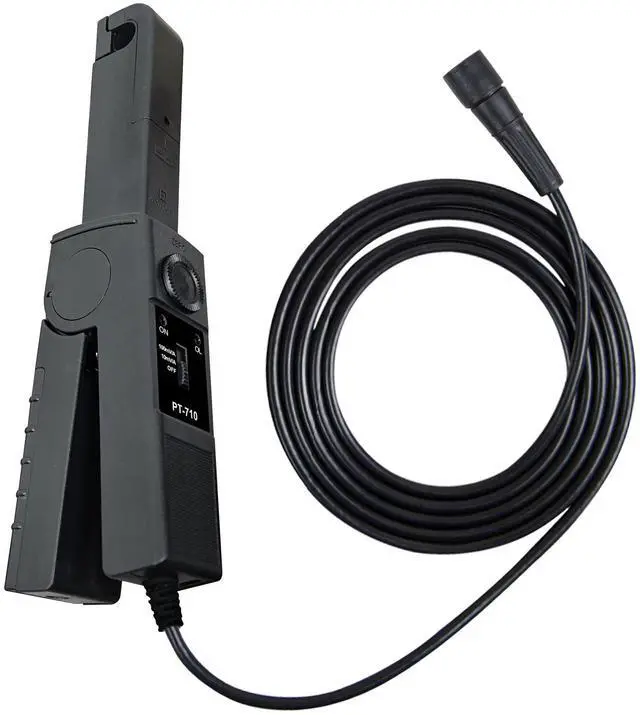
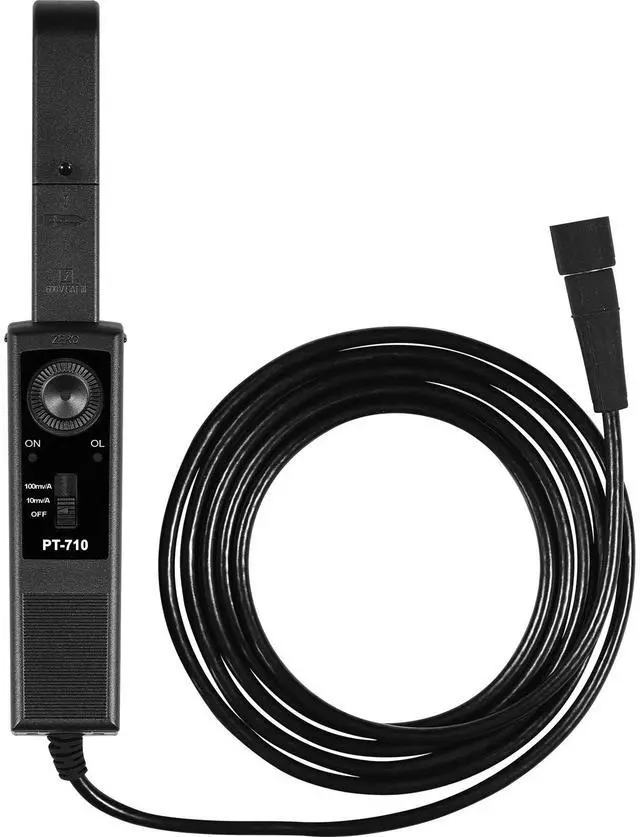
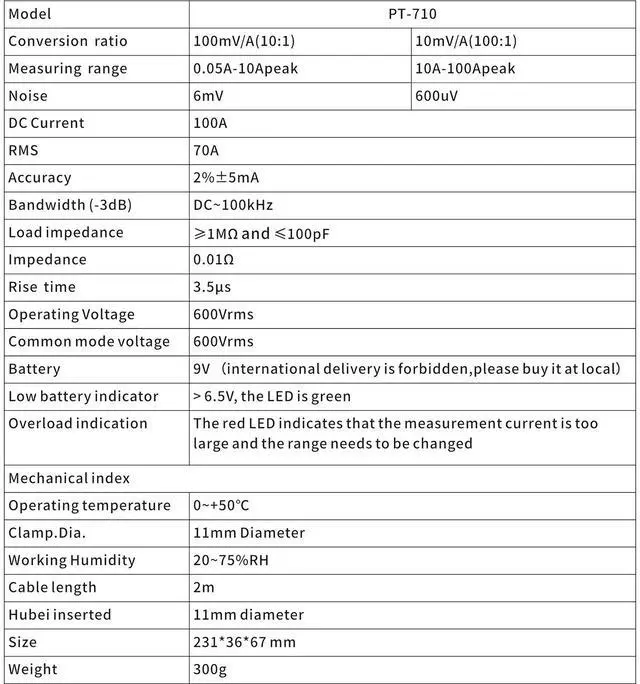
The PINTECH PT-710 is an AC/DC current clamp probe for oscilloscopes, built for technicians, engineers, and electronics users who need to measure 0.05A to 100A current signals with up to 100kHz bandwidth through a standard BNC connection.
| Attribute | Value |
|---|---|
| Best For | Technicians and engineers who need a handheld current clamp probe for electrical testing and troubleshooting with oscilloscopes and multimeters (with adapter), suitable for lab and field use |
| Measurement Accuracy | ±2% + 5mV accuracy for measured signals, suitable for diagnostic and routine test work |
| Physical Dimensions | 232 x 33 x 66 mm compact clamp-body size, handheld form factor for bench or field use |
| Product Type | Electrical Testing & Measuring device intended for current measurement applications |
| Brand | PINTECH |
| Selling Unit | Each |
Q: Should I buy the PINTECH PT-710 or a standard clamp meter for current testing?
A: Choose the PINTECH PT-710 if you need to see current waveforms on an oscilloscope, measure AC and DC current without opening the circuit, and work on switching supplies, inverters, motor drives, or transient behavior. Choose a standard clamp meter if you mainly need a numeric current reading for field service or routine electrical checks. The PT-710 is more suitable when waveform visibility and oscilloscope compatibility matter; a clamp meter is more suitable when portability and one-hand standalone measurement matter.
Q: Is the PINTECH PT-710 a better fit than a high-current low-bandwidth clamp probe?
A: Choose the PT-710 if your priority is measuring lower-current signals with oscilloscope-friendly sensitivity and up to 100 kHz bandwidth. A high-current clamp probe is a better fit when your main job is measuring much larger current ranges and bandwidth is less important. In practice, the PT-710 is the better choice for electronics bench work, power-supply debugging, and inverter analysis up to 100 A, while higher-current probes are better for heavy-load electrical systems.
Q: How does the PINTECH PT-710 compare with Tektronix A622 or Keysight 1146C style 100 A, 100 kHz probes?
A: The PT-710 is the closer match when you want the same core class of probe: AC/DC measurement, 100 A range, BNC output, and 100 kHz bandwidth. Tektronix A622 and Keysight 1146C are established alternatives with similar positioning and documented compatibility for oscilloscope-based current measurement. The PT-710 makes sense when you want that general measurement envelope for bench diagnostics; premium-brand alternatives make more sense when brand ecosystem, documentation depth, calibration workflow, or procurement standards are the bigger priority.
Q: Should I choose a lower-bandwidth current probe or the PINTECH PT-710 for oscilloscope work?
A: Choose the PT-710 if you need to capture faster current events, switching behavior, or waveform detail beyond basic power-frequency measurements. A lower-bandwidth probe is sufficient for slower AC/DC trend checks and general utility measurements. The PT-710 is the better fit when current shape matters, not just current magnitude.
Q: Is the PINTECH PT-710 better for bench testing or for portable field use?
A: The PT-710 is better suited to bench testing because it is designed around oscilloscope use, BNC connectivity, and waveform measurement. For portable field use, a standalone clamp meter is usually the more convenient option because it does not depend on an oscilloscope. Choose the PT-710 when diagnostic detail is more important than grab-and-go convenience.
Q: Is the PT-710 a good fit for oscilloscope current measurements in low-power electronics and power-supply debugging?
A: Yes. The PT-710 is best suited for bench troubleshooting where you need to view AC and DC current on an oscilloscope without breaking the circuit, especially in power supplies, motor drives, and inverter work. Its 0.05A to 100A range and 100kHz bandwidth make it more appropriate for low-frequency and switching-power diagnostics than for high-speed waveform analysis.
Q: Can the PT-710 measure both AC and DC current, or is it only for AC?
A: It is designed for both AC and DC current measurement. That makes it more versatile than AC-only clamp probes, because it can capture DC draw, ripple riding on DC rails, and mixed current behavior that appears in power electronics and automotive-style troubleshooting.
Q: Will the PT-710 work with any oscilloscope that has a BNC input?
A: Usually yes for basic connection, because it uses a standard BNC interface. In practice, buyers should still confirm the oscilloscope can display the probe's output scaling correctly and has enough vertical sensitivity for low-current readings. If you want to use it with a multimeter instead of a scope, the product description says that requires the MT-246N adapter.
Q: What are the main trade-offs versus a higher-end current probe?
A: The main trade-off is bandwidth and likely measurement headroom. A 100kHz probe like the PT-710 is adequate for general power and inverter diagnostics, but it is not the right choice when you need to analyze fast edges, RF content, or higher-frequency switching behavior. Higher-end probes also commonly offer wider bandwidth, better low-current resolution, and tighter integration with premium oscilloscopes, but they cost much more.
Q: Who should buy the PT-710, and who should skip it?
A: Buy it if you need an AC/DC clamp probe for general oscilloscope-based current measurement up to 100A and your work is centered on power electronics, motor drive, inverter, or bench service tasks. Skip it if your main need is very low-current precision, very high bandwidth, or advanced probe-to-scope auto-detection features, because those use cases are usually better served by more specialized and more expensive probes.
Q: Who is the PINTECH PT-710 best suited for?
A: The PT-710 is best suited for bench diagnostics where you need to view AC and DC current waveforms directly on an oscilloscope, especially in power supplies, motor drives, inverters, and general electronics troubleshooting. It is a better fit for users who already have a scope with BNC input than for someone who only needs a basic clamp meter reading.
Q: Is the PT-710 a good choice if I only need to measure current occasionally?
A: Usually no. If you only need occasional current checks, a standard clamp meter or shunt-based measurement setup is often more practical and lower cost. The PT-710 makes more sense when waveform visibility on an oscilloscope matters, not just the current value.
Q: What are the main trade-offs of the PT-710?
A: The main trade-off is capability versus range and bandwidth. The PT-710 covers both AC and DC current and works directly with an oscilloscope, which is useful for waveform analysis. The trade-off is that its 100 kHz bandwidth and 0.05 A to 100 A range make it more suitable for low-to-mid frequency power electronics work than for very fast switching analysis or very small current measurements.
Q: Is the PT-710 worth buying instead of a higher-bandwidth current probe?
A: It depends on the job. The PT-710 is a reasonable choice for general-purpose current waveform checks where 100 kHz bandwidth is enough. If you need to inspect faster switching edges, high-frequency ripple, or more demanding power-electronics behavior, users discussing oscilloscope current probes often lean toward higher-bandwidth models, which usually cost more.
Q: Can the PT-710 replace a clamp meter?
A: Not fully. The PT-710 can measure current non-invasively and is useful when connected to an oscilloscope, but it is primarily a probe for waveform observation. A clamp meter is still the simpler choice for quick standalone current checks, while the PT-710 is the better tool when you need time-domain behavior, transients, or ripple on a scope.



