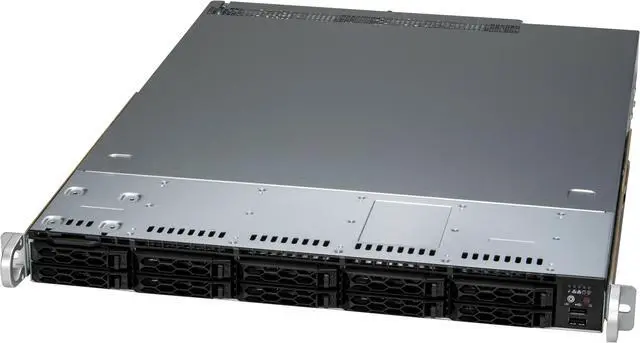
The Supermicro AS-1115CS-TNR is a single-socket SP5 server barebone for AMD EPYC 9004 processors, designed for data centers running cloud computing, value IaaS, web servers, or CDN and edge workloads. It combines 12 DDR5-4800 DIMM slots, PCIe 5.0 expansion, and 10 hot-swap 2.5-inch hybrid drive bays.
Recommended For
- Data-center teams building compact virtualization or cloud nodes can use the single-socket EPYC platform, 12 DIMM slots, and rack-focused 1U design for dense server deployments.
- Web, CDN, and edge-service operators who need a rack server with hot-swap 2.5-inch storage and flexible networking options can match the system to those deployments.
- Infrastructure teams deploying DNS, gateway, or firewall appliances can use the compact rack format, EPYC processor support, and OCP 3.0-compatible networking slots.
- Storage teams building dense 2.5-inch NVMe systems can use the 10 hot-swap bays; a SPEC-published test also evaluated this server with 10 local NVMe drives in a storage workload.
Real-World Use Scenarios
- Hosting web applications or APIs in a data center: the server can handle application workloads in a compact 1U rack space, with the actual capacity depending on the chosen processor, memory, and software.
- Running virtual machines or private-cloud services: an IT team can use the single-socket platform to consolidate multiple services on one rack server; the number and size of workloads it can support depend on the CPU, memory, and configuration.
- Deploying a firewall, gateway, or DNS server: network teams can use it as a rack-mounted infrastructure node for traffic-handling services, with network connectivity determined by the installed networking options and software.
- Placing compute or caching services closer to users at an edge site: its 1U form can suit compact deployments that support CDN or other edge workloads, provided the site has suitable rack, power, cooling, and network infrastructure.
- Building a local high-throughput storage server: in a published SPEC storage test, an AS-1115CS-TNR configuration used nine NVMe drives for the test data and one for the operating system, showing how the platform can be configured for storage-focused workloads.
Spec Summary
| Attribute | Value |
|---|
| Best For | Barebone server for web, DNS, gateway, and firewall roles, as well as cloud computing, CDN, and edge-node deployments |
|---|




 here!