
Your Browsing History
 Holiday Shipping Details & Extended Holiday Returns Holiday Shipping Details & Extended Holiday Returns

Joined on 06/21/13
Maybe not the upgrade you think
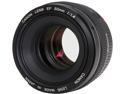
Pros: Good build quality, much quieter than 1.8, nice bokeh.
Cons: Sluggish autofocus system, surprisingly bad color fringing.
Overall Review: The Canon 50mm 1.8 was the first prime lens I ever owned, and I think it spoiled me a little bit. Not in it's build quality, obviously as I think it's made out of the same plastic cracker jacks use, but in it's value for money. I still, to this day, with a bag full of L series glass, call the 1.8 the best buy lens you can get. Hands down. So when money started to come in a little more, I looked at an upgrade from my little 1.8. Because spending more means better right? 1.4 or even 1.2 are better! Well, I'm here to tell you no. The 1.2 is an amazing piece of glass at an amazingly high price. If you can afford the 1.2, buy it.. buy it several times so you can have a family of 1.2 lenses.. it's that good. But the 1.4? I simply don't get it. At close to $400, it's 4 times the price of the glorious plastic nifty 50 (1. but as best as I can tell, isn't even twice as good. The extra depth is nice SOMETIMES, but it's auto focus is nowhere near that of the 1.2 so you'll have a hard time putting it to use without a tripod or exceptionally steady hands. Realistically, how often to you shoot at 1.4 anyway? I seldom go below 1.8. Sure, it has more blades than a 1.8, but outside of photographers, don't assume anyone is trying to count the edges on your bokeh. As ridiculous as it sounds, the upgrade from your awesome $100 50mm 1.8 is the $1600 50mm 1.2. The 1.4 has the right ingredients on paper, but in the real world it will simply frustrate your wallet to the tune of $349
Lots of lens slip, but still Canon
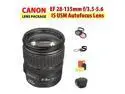
Pros: Good build quality, nice results that are consistent with the rest of this range. Decent image stabilization.
Cons: Bad lens slip (focal length zooming due to loose gearing), noisy image stabilization motor
Overall Review: This is part of Canon's middle of the pack EF series. I have found it's build quality to be good, not great (on par with other EF lenses), reliable performance, and predictable results. It's image stabilization works well, but is rather noisy if things like that are important to you. It doesn't have a fixed aperture so not the "best" lens for video work. My biggest issue with this lens, and I have read that other people have had this issue, is it's lens or zoom slip. If I hold this lens upside down (with the lens end down), it will zoom all the way to it's 135mm length. It is not meant to do this and has proven annoying at times. Mostly, it adds wear to the zoom system and will reduce the life of your lens slightly. It's a good walk around lens, but I'd definitely look closer at some other products like Tamron if I were going to purchase again.
Buy this flash.. do it.
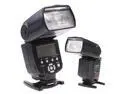
Pros: Surprising build quality, excellent recycle time, very easy to use.
Cons: No ETTL, doesn't say "Canon" across the front.
Overall Review: Let me start this review off simply. BUY THIS. Is it as good as the more expensive alternative? It very, very, very nearly is. It's the right price, it has surprisingly good build quality, excellent recycle time (better than my Canon), and consistent results. This is my second Yongnuo unit (I have the 2 also) and unless I end up having more money than I care to count, I may never buy another Canon unit. Don't get me wrong, the Canon IS better, but $300 better? Absolutely not. My first Yongnuo was bought as a cheap second unit for a specific job that I didn't want to invest too much in. It has, since then, become my primary unit. I have two 430 EXII units that I use as backups now. My concern with most low price alternatives from China are usually quality related. This flash has taken several spills already (see my upcoming review of my new sandbags to avoid that) and hasn't skipped a beat. It's build quality is EXCELLENT. I can't say that part enough. So what do you give up from the Canon? For starters, ETTL. I don't use it, so I don't miss it. Canon 600EX zooms to 200mm, Yongnuo zooms only to 105mm. Canon 600EX has the really nice radio triggering built in, but that limits you to using only canon units. At the end of the day, this flash can be delivered to your door for $85, versus $400 for the Canon equivalent. Imagine what you could use the extra $325 for. For me? I'll buy three more of these and take my girlfriend out for a nice steak dinner.. all for the same price as one Canon.
Amazing lens
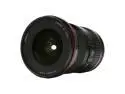
Pros: top notch build quality, great low light performance, very sharp considering it's focal length, perfect for landscapes
Cons: slight clarity drop at 20mm, not good for portraits
Overall Review: A lot has been said about this lens and a lot will be said to come. So keep in mind where I'm coming from while you read this. I use a crop sensor camera, primarily commercial portraiture and performance. Firstly, this is one of the more expensive L series lenses. It's build quality is exactly what you'd expect from Canon.. top of the line. The fixed 2.8 is fantastic for low light shots though I go find that 2.8 on my 16-35 vs 2.8 on my 70-200 is about a 1/3rd stop darker. Not entirely sure why, just something I have noticed in the year I've been using it. I DO experience the slight drop in clarity around the 20mm mark. That being said, it's only noticeable to me when I'm using this lens for things it's not designed for. This is not the lens you want to shoot portraits with, even at 35mm. It simply isn't flattering to the shape of faces, it's color compression isn't ideal for it, and it isn't tack sharp. If you are shooting a lot of landscapes however, this is the lens for you. I upgraded from a Ronikon 14mm fixed 2.8 and the difference is night and day. I absolutely adore this lens, but that said, it is exceptionally expensive. For my uses, and given a redo, I would be more likely to save a few bucks and get the 24mm 1.4L.
For the price, a great product
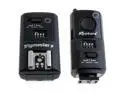
Pros: good fire rate, light, durable (even though the cheap plastic is prone to breaking)
Cons: cheap plastic cold shoe wings tend to break, finicky power switch, less than ideal battery performance.
Overall Review: Let me start this review by saying that if you're looking at triggers CHEAPER than this, be very careful. I moved up the ranks through wireless triggers and found that these are about as cheap as you want to go. In a perfect world, we'd all have pocket wizards, but we live in the real world! I've been using these triggers for about a year and they have proved to be very reliable at the price. I would say that realistically, they have a 95% fire rate. They are light, well built, well packaged, and come with all the accessories you will need. That being said, they do suffer from a couple of small issues.. but what can you expect for $50ish? Firstly, the battery performance in the receivers is "ok". I am not sure if this is a radio strain issue or if thats just how it is, but end up replacing the AAA batteries roughly every 8 hours of shooting. Not too bad. The hot shoe MALE part of the receivers (so the part that will go into your cold shoe) is quite weak. I had a light stand go down and the plastic wings broke on a first fall. I had a similar fall with the other receiver from a lower height and it was the same result. I now just use them with sync cables and strap them to my flashes with rubber bands. The other minor issue I have is that the three-way switch on the receivers sometimes are a little finicky to turn off. Not that it's difficult, but you will definitely want to take a second look to make sure that they are, in fact, in the off position. Like I said at the start of this review, you can definitely save money on triggers.. I think I've seen them starting around $20.. but you absolutely don't want to. This is as low as you'll want to go in trying to save some money. A nice purchase at this price point.
For the price, absolutely
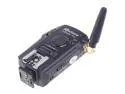
Pros: Good fire rate, light, well built
Cons: battery life, locking into hot shoe
Overall Review: Let me start this review by saying that if you're looking at triggers CHEAPER than this, be very careful. I moved up the ranks through wireless triggers and found that these are about as cheap as you want to go. In a perfect world, we'd all have pocket wizards, but we live in the real world! I've been using these triggers for about a year and they have proved to be very reliable at the price. I would say that realistically, they have a 95% fire rate. They are light, well built, well packaged, and come with all the accessories you will need. That being said, they do suffer from a couple of small issues.. but what can you expect for $50ish? Firstly, the battery performance is "ok". I am not sure if this is a radio strain issue or if thats just how it is, but end up replacing the batteries roughly every 8 hours of shooting. Not too bad. On the transmitter, I have lost it a couple of times from my hot shoe. It slides snugly onto the camera, but there is no locking mechanism to hold it there. Just keep that in mind if you are leaving it on and throwing the camera over your shoulder. Like I said at the start of this review, you can definitely save money on triggers.. I think I've seen them starting around $20.. but you absolutely don't want to. This is as low as you'll want to go in trying to save some money. A nice purchase at this price point.