



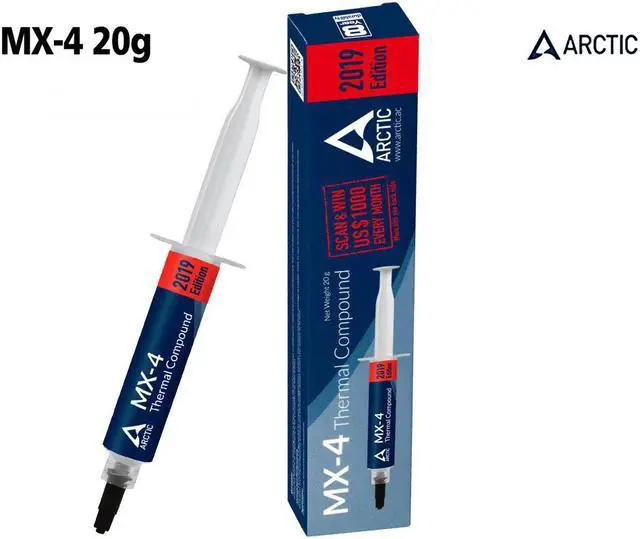
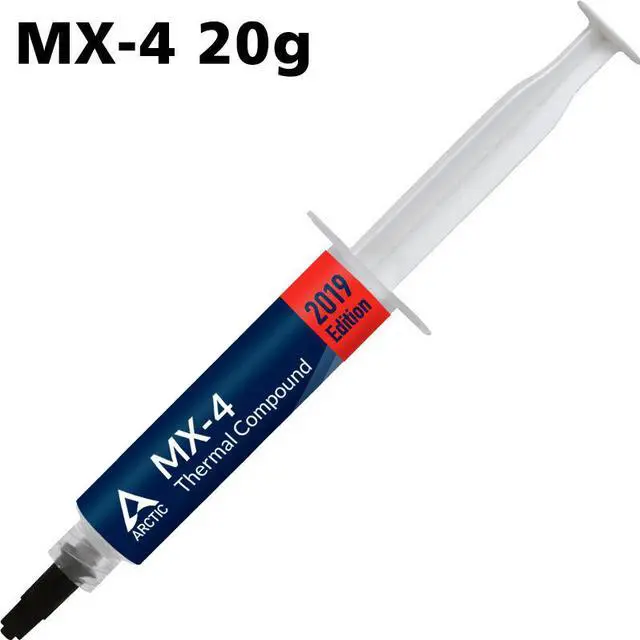
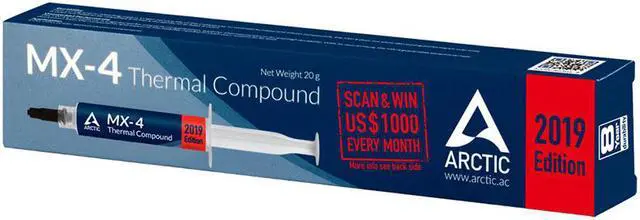


Arctic MX-4
Well-proven and award-winning thermal compound that helps optimize heat transfer from the CPU/GPU to cooler. It is specially formulated, and contains no metallic particle for safety. Plus, the MX-4 lasts longer than the service life of your gaming rig, so apply it once, and the MX-4 maintains its hallmark performance till retirement of your system.
Award Winning Thermal Paste
The performance of our ARCTIC MX-4 Thermal Compound has been tested and honored by numerous independent magazines.
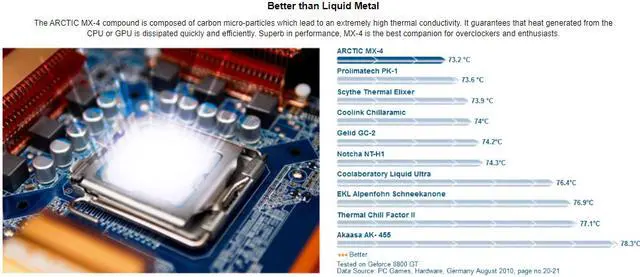
Better than Liquid Metal
The ARCTIC MX-4 compound is composed of carbon micro-particles which lead to an extremely high thermal conductivity. It guarantees that heat generated from the CPU or GPU is dissipated quickly and efficiently. Superb in performance, MX-4 is the best companion for overclockers and enthusiasts.

Easy to Apply
With an ideal consistency, the MX-4 is very easy to use, even for beginners.
Safe Application
It does not contain any metallic particles so electrical conductivity would not be an issue. Unlike silver and copper compound, it ensures that contact with any electrical pins would not result in damage of any sort.
High Durability
In contrast to metal and silicon thermal compound, the performance of MX-4 does not compromise over time. Once applied, you do not need to apply it a second time as it will last at least for 8 years.
Value for Money
A high performance thermal compound perfect for system builders, there's no surprise that the MX-4 exceeds your expectations for its low price tag.

Highest thermal conductivity
The surfaces of processor chips and cooler floors are covered with microscopic dents; ARCTIC's MX-4 thermal paste is composed of carbon microparticles which fill these cavities. This leads to extremely high thermal conductivity, guaranteeing that heat is dissipated quickly and efficiently from the CPU or GPU. With its outstanding performance, the MX-4 is not only an excellent choice for overclockers and enthusiasts, but also for other sapplications that require thermal transmission.

Easy application
Thanks to its consistency, MX-4 is easy to apply, even for beginners. The video in the picture gallery demonstrates the application technique to avoid air pockets between processors and coolers.

Proven quality
While the packaging of our thermal paste has changed several times over the years, the composition of the formula has remained the same. Our MX pastes have long stood for high performance and quality, and with our new, recyclable packaging, we aim to reduce CO2 emissions and thus make a contribution to the environment.

Secure usage
In contrast to pastes based on metal oxides or liquid metal, ARCTIC's MX-4 is metal-free and not electrically conductive. This eliminates the risk of short circuiting, and eliminates the need to worry about corrosion damage to the radiator floor caused by liquid metal.

Technical Specifications:
- Electrical conductivity: 0 pS/m
- Ideal Applications: CPU / GPU Thermal
- Thermal Conductivity: 8.5 Wm / K
- Viscosity: 870 poise
- Specific gravity: 2.50g/cm³
- Operating temperature: -50 °C / 230°C
- Content: 20g

Must see before installing CPU:
1. Remove the original CPU, clean up the dust on the fan and heat sink, and clean up the original silicone grease remaining on the heat sink, especially the hardened silicone grease. This is very important!
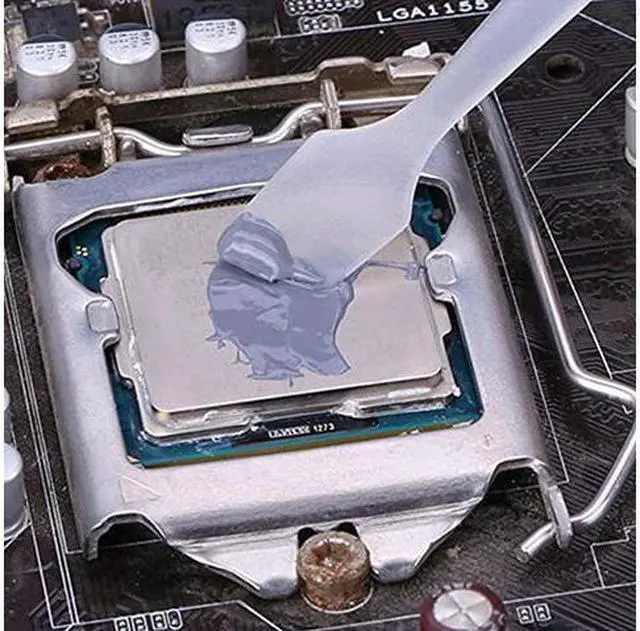
2. Insert the newly bought CPU in the correct direction and apply a layer of silicone grease on the top of the CPU. Take the small sticks of silicone grease in the needle tube as an example, squeeze 2-3 small grids of silicone grease on it.)
3. Reinstall the heat sink, first press the heat sink with your fingers and move it up and down, left and right, let the silicone grease inside spread out evenly and exhaust air, and then follow the numerical order marked on the fixing screw on the heat sink (or diagonally) Tighten the screws one by one, turn a few times each time, and then unscrew one screw. Don't screw one screw to the end, rotate one by one until the balance is fixed.

Since the mere thermal conductivity value cannot provide any information about the actual performance, we put our thermal grease up against a broad field of competitors under laboratory conditions. The temperature difference between CPU and cooler base was measured.
