

  • $7.99
  • Free 30-day Returns
  • Price alert
    Add to Wish List(Found on 2 wish lists)
    Shop it at NeweggBusiness.

    Meet Your Seller

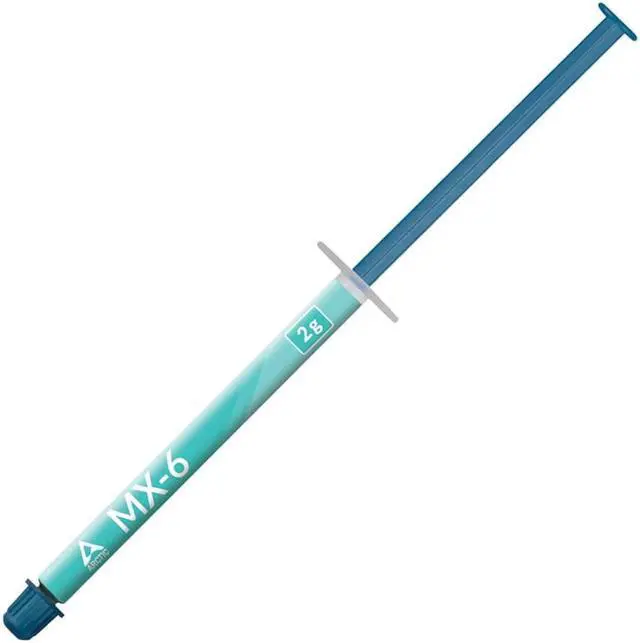
    Arctic ACTCP00079A MX-6 (2 g) Thermal Compound Paste for CPU, Consoles, Graphics Cards, laptops, Very high Thermal Conductivity, Long Durability

    • 4g
    • 8g
    • 2 g
    • 20% BETTER PERFORMANCE: With its improved composition, the ARCTIC MX-6 has a measurably lower thermal resistance than the MX-4
    • PROVEN QUALITY: With over 20 years of experience in the PC cooling market, our focus was on improved performance, versatile application possibilities and an easy-to-use consistency
    • RISK-FREE APPLICATION: MX-6 is neither electrically conductive nor capacitive. This eliminates the risk of short circuits or discharges
    • VERSATILE APPLICATION: With its new composition, the MX-6 is suitable for many application scenarios. Thanks to its viscosity, it is also suitable for direct-die cooling scenarios for GPUs of graphics cards or console processors
    • 100 % ORIGINAL DUE TO AUTHENTICITY CHECK: Due to our Authenticity Check, the authenticity of each individual product can be verified
    +
    +
    Overview
    Specs
    Reviews (44)
    See all Q & A

    Any questions? Ask CelesteSM will help you find out quickly.
    arctic-mx-6-thermal-compounds-paste.jpg
    SIMPLY THE PASTE


    The ARCTIC MX-6 is a carbon filler-based thermal paste and reaches its maximum performance without burn-in, directly after application and distribution. It achieves all of this without any reputed ingredients, such as expensive diamond dust or various precious metal particles. The silicone gel used as a carrier enables optimal distribution, which is achieved through even contact pressure, for example when mounting the heat sink.


    20 % BETTER PERFORMANCE


    With its improved composition, the ARCTIC MX-6 has a measurably lower thermal resistance than the MX-4. The basis for calculation is the temperature difference between the cooler base and the heat source (in C) in relation to the applied heat load (in W), which also results in the unit C/W. The higher the thermal resistance, the worse the heat can be transferred through the TIM layer. Thermal insulators, as an example, therefore always have a particularly high thermal resistance, while thermal interface materials usually have a particularly low one.


    PROVEN QUALITY


    We are proud of our thermal pastes. With over 20 years of experience in the PC cooling market the MX-6 was developed with the goal to offer a first-class product. The optimized formula is based on the proven MX-4, one of the best-selling thermal pastes in the world. The focus was on versatile application possibilities and an easy-to-use consistency.


    VERSATILE RANGE OF APPLICATIONS


    With its new composition, MX-6 is the suitable thermal compound for many application scenarios. Excellent non-drying and non-bleeding properties ensure consistent long-term performance. Its viscosity prevents leakage due to the pump-out effect. It's also suitable for direct-die cooling scenarios which occur, for example, with graphics cards or console processor GPUs.


    OFTEN COPIED, BUT NEVER EQUALED


    ARCTIC's thermal pastes have always been one of the most popular products on the TIM market. To be able to ensure that a paste has been produced and filled under ARCTIC regulations and thus meets our high quality standards, we have the ARCTIC Authenticity Check. This means that every product can be reliably verified so that our customers are always on the safe side.


    EASY APPLICATION


    MX-6 is neither electrically conductive nor capacitive. This eliminates the risk of short circuits or discharges, which can cause serious damage to components if care is not taken. The thermal paste is also free of liquid metal components, which can often lead to discoloration, abrasion or corrosion damage to the radiator bottom.


    AVAILABLE IN SEVERAL VERSIONS


    ARCTIC MX-6 is available in package sizes from 2 to 8 grams. Resealable syringes prevent the paste from drying out and facilitate dispensing. Alternatively, the variants with MX Cleaner are available. These enable simple and residue-free cleaning of the contact surfaces. The cleaner consists of 100% Limonene, a natural substance obtained from citrus essential oil.

    Warranty & Returns

    Warranty, Returns, And Additional Information

    Warranty

    • Please contact the Seller directly for warranty information. Warranty information may also be found on the Manufacturer's website.
    • CONTACT

    Return Policies

    Manufacturer Contact Info

    LOADING...
    LOADING...

    ARCTIC MX-6 (2 g) is a non-electrically conductive thermal paste for PC builders and repairers cooling CPUs, graphics cards, laptops, or console processors; its viscosity also suits direct-die applications.

    Recommended For

    • DIY desktop builders and PC maintainers repasting a CPU for everyday gaming or sustained workloads who want a well-benchmarked conventional paste and can let cooler pressure spread it.
    • GPU owners servicing a bare graphics-card die who need a non-electrically-conductive paste intended for direct-die cooling.
    • Console repairers replacing compound between a processor die and its cooler, where the cooler’s mounting pressure can distribute the paste.
    • PC users who prioritize repeatable thermal performance and long-term consistency for a standard CPU or GPU cooler interface over a paste that can be manually spread with a spatula.

    Real-World Use Scenarios

    • When reinstalling a desktop CPU cooler or replacing old paste, apply MX-6 between the processor and heatsink; if the previous paste or contact was poor, the refreshed interface may improve temperatures, though the result depends on the cooler and installation.
    • During a new PC build or cooler swap, a first-time builder can apply MX-6 to the CPU before mounting the cooler; ARCTIC demonstrates application patterns and says cooler pressure spreads the paste across the contact area.
    • When servicing a graphics card with a bare GPU die, use MX-6 at the die-to-cooler interface; ARCTIC identifies direct-die GPU cooling as a suitable use, while temperature changes depend on the card and how it is reassembled.
    • When repairing or maintaining a console with an exposed processor die, MX-6 can be applied between the die and its heatsink; it is intended for this direct-die scenario, but it does not replace thermal pads used on other components.
    • For a laptop repaste, MX-6 is an option when the CPU or GPU uses conventional thermal paste; check the device’s cooling materials first, since some laptop designs use different interface materials and repasting results vary.

    Spec Summary

    AttributeValue
    Best ForApplying thermal compound to CPUs, graphics cards, consoles, and laptops
    Product IdentificationARCTIC MX-6 thermal compound, 2 g; part number ACTCP00079A
    Package And Physical Details1 item in 1 box; package dimensions are 1.2 × 2.3 × 14.9 cm; item weight is 4 g and package weight is 0.01 kg

    Reference Q&A

    Q: ARCTIC MX-6 vs MX-4: which should I choose?

    A: Choose MX-6 if you want ARCTIC’s newer formula and lower thermal resistance, which ARCTIC reports compared with MX-4. In one CPU test, MX-6 also ran only a few tenths of a degree cooler than MX-4, so the practical difference in that test was small. MX-4 is a straightforward choice if you prefer to stay with the established model.

    Q: ARCTIC MX-6 vs MX-7: which is the newer performance option?

    A: Choose MX-7 if you want ARCTIC’s newer paste and prioritize the recent independent comparison: Igor’sLAB found MX-7 ran slightly cooler than MX-6 New Formula across the bond-line thicknesses most relevant to typical applications. MX-6 remains a suitable choice for users who want the specific 2 g product configuration.

    Q: Should I choose ARCTIC MX-6 or MX-5 for a CPU repaste?

    A: Choose MX-6 when selecting between the two for a new CPU repaste. In OCinside’s Ryzen 5 7600X test, MX-6 recorded slightly lower maximum core temperatures than MX-5 under the same test conditions. Treat that result as a comparison from that specific test setup rather than a guaranteed temperature difference on every system.

    Q: Is MX-6 safe to use around CPU or GPU components?

    A: MX-6 is neither electrically conductive nor capacitive, reducing the risk of short circuits if a small amount reaches nearby components. Follow the device or cooler’s service instructions when applying it.

    Q: Can I use MX-6 on a CPU, GPU, laptop, or game console?

    A: MX-6 is intended for CPU, graphics-card, laptop, and console cooling applications, including direct-die use. Check the device’s service instructions first: some locations require thermal pads or another interface material rather than paste.

    Q: Is 2 g enough for more than one application?

    A: The 2 g syringe may be suitable for multiple applications, but the number depends on the size of each chip and how much paste is used. It is a small quantity, so it may not suit frequent servicing or larger dies.

    Q: Do I need to spread MX-6 manually before installing the cooler?

    A: Application requirements depend on the chip and cooling assembly. Follow the device or cooler’s instructions for the amount and pattern; make sure old compound is removed before applying new paste.

    Q: Is MX-6 worth choosing over MX-4?

    A: MX-6 may offer a small temperature improvement, but the difference is not necessarily large enough to justify replacing MX-4 that you already have. A YouTube comparison found only a modest average difference in its test, with MX-6 performing better at higher loads; it was also less fluid and harder to spread.

    Q: Is MX-6 suitable for a laptop or GPU repaste?

    A: It is discussed for laptop and GPU repasting, including direct-die use. Reddit experiences differ on how well it resists pump-out over time, so MX-6 should not be treated as a guarantee against recurring temperature issues; application and cooler contact also matter.

    Q: Is MX-6 harder to apply than MX-4?

    A: It can be. In a side-by-side comparison, MX-6 was more viscous and did not spread as easily as MX-4. If ease of spreading is your priority, MX-4 may be simpler to work with; MX-6 is the less fluid option.