




 here!
I’m your shopping assistant for PC builds, upgrades, and everything tech.
Got questions? Ask away!
Start a conversation
here!
I’m your shopping assistant for PC builds, upgrades, and everything tech.
Got questions? Ask away!
Start a conversation




Any questions? Ask CelesteSM will help you find out quickly.
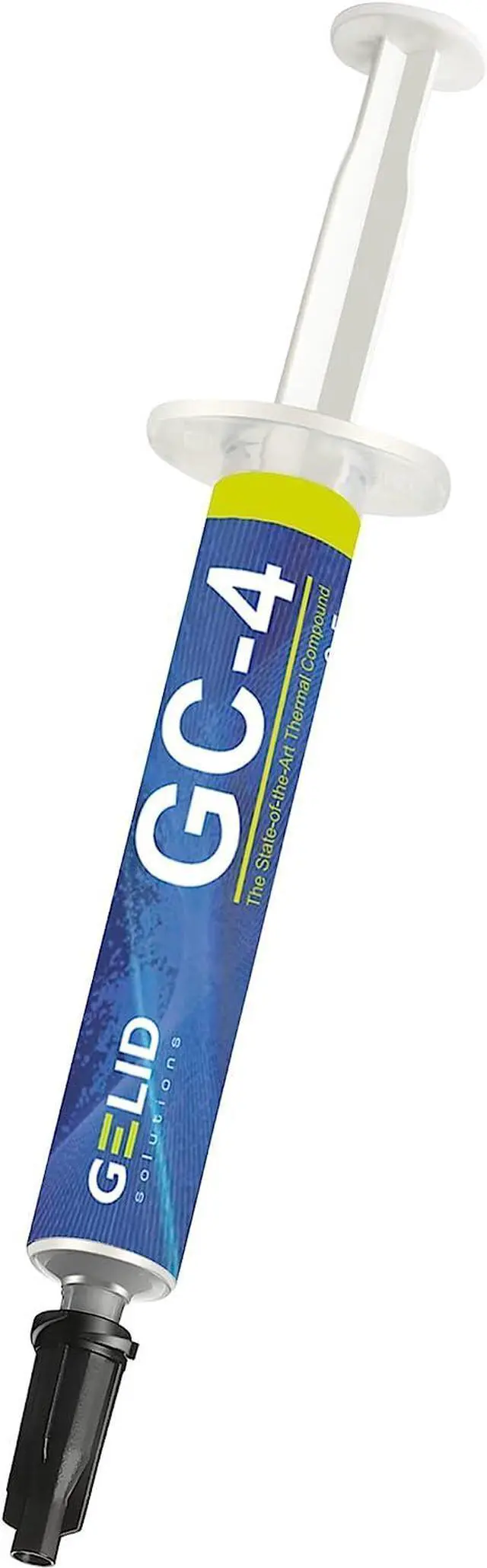
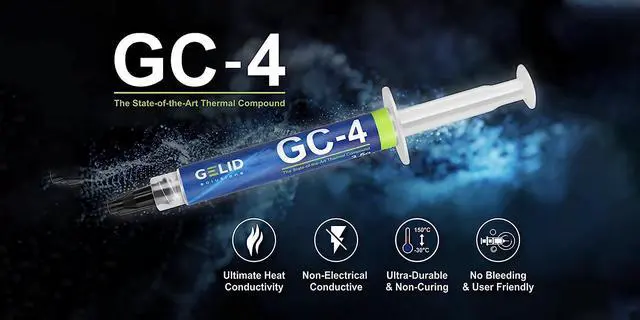
GELID Solutions GC-4 is a 3.5g thermal compound for transferring heat between a CPU, GPU, or chipset and its heatsink, suited to PC builders and maintainers seeking a non-electrically conductive paste with an included applicator.
| Attribute | Value |
|---|---|
| Best For | Thermal-interface use between heat sinks and CPU, GPU, or chipset components, with an included applicator for placement |
| Net Weight | 3.5 g |
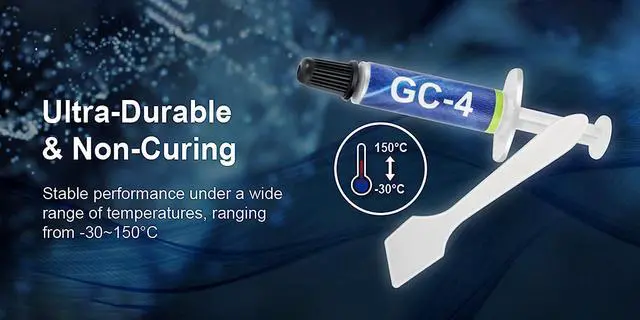
| Operating Temperature | -30 to 150 °C |
| Composition And Application | Micron-particle synthetic thermal filler in a polymer matrix; non-electrically conductive, with gap-filling properties and an included applicator |
| Model Identifiers | GELID Solutions GC-4, model TC-GC-04-A |
Q: GELID GC-4 vs. GC-Extreme (2024): which should I choose?
A: Choose GC-4 if you are comparing the two by measured thermal conductivity: Igor’s LAB reported 3.5 W/m·K for GC-4 and 2.9 W/m·K for GC-Extreme (2024) in its tests. These are material-test figures, not a direct prediction of temperatures in every computer.
Q: Should I get the 3.5g or 10g GELID GC-4?
A: Choose the 3.5g syringe for a smaller quantity; choose the 10g syringe if you want more of the same GC-4 compound for repeated applications or multiple systems. The two sizes are listed as GC-4 variants by GELID.
Q: Is the 3.5g GELID GC-4 different from the 1g version?
A: Both are GC-4; the difference is the amount supplied. Choose 3.5g for more compound on hand, or 1g when you prefer the smaller quantity. GELID lists both sizes for the same GC-4 compound.
Q: Can I use GC-4 on a CPU or GPU?
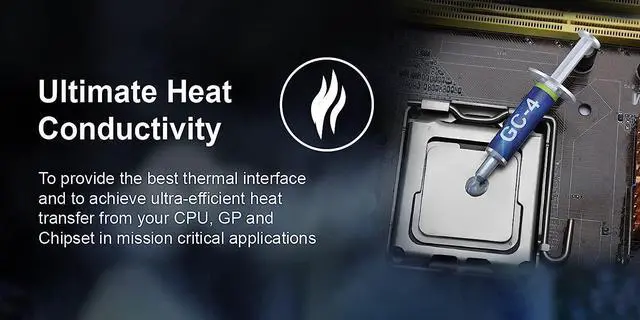
A: Yes. GC-4 is intended for heat transfer between a CPU, GPU, or chipset and its heatsink. Check the device’s service instructions first, since some components require a different thermal interface material.
Q: Is GC-4 electrically conductive?
A: No. The supplied product specifications state that GC-4 is electrically non-conductive. Apply it only to the intended chip-to-heatsink contact surface and follow the device’s service instructions.
Q: How many applications can I get from the 3.5g tube?
A: The tube contains 3.5g, but the number of applications depends on the chip’s contact area and how much compound is applied. The product information does not specify an application count.
Q: Does GC-4 include an applicator, and is it suitable for first-time use?
A: GC-4 includes an applicator, and its listed features describe the compound as easy to apply. Application still requires access to the component and heatsink; follow the device or cooler instructions for the correct amount and placement.
Q: What operating temperatures is GC-4 rated for?
A: GC-4’s listed long-term operating temperature range is −30°C to 150°C. This is the compound’s stated operating range, not a temperature target for the CPU or GPU.
Q: Is GC-4 worth switching to from Arctic MX-4?
A: It may be worth considering for a high-load GPU repaste, but user reports are mixed: one user reported a lower GPU temperature after switching from MX-4, while others reported no improvement or worse CPU temperatures. These individual results do not guarantee a benefit for your system.
Q: Is GC-4 suitable for repasting a GPU?
A: Users have tried it on GPUs, but reported outcomes vary: one reported lower temperatures on a high-power GPU, while others saw little or no improvement. Treat it as a conventional thermal paste option, not a guaranteed fix for high temperatures; cooler contact, thermal pads, and other system factors can also matter.
Q: Is GC-4 easy to apply?
A: One user described its consistency as reasonably easy to spread and reported applying it with the dot method. Application can still affect results, so use a consistent method and check cooler contact if temperatures do not improve.
Q: Is GC-4 a reasonable choice for a laptop repaste?
A: A laptop owner reported using GC-4 on a CPU heatsink and comparing it favorably with MX-4, but that is a single user experience. The same discussion raised concerns about paste pump-out in laptops, so it does not establish long-term performance for every laptop.


