
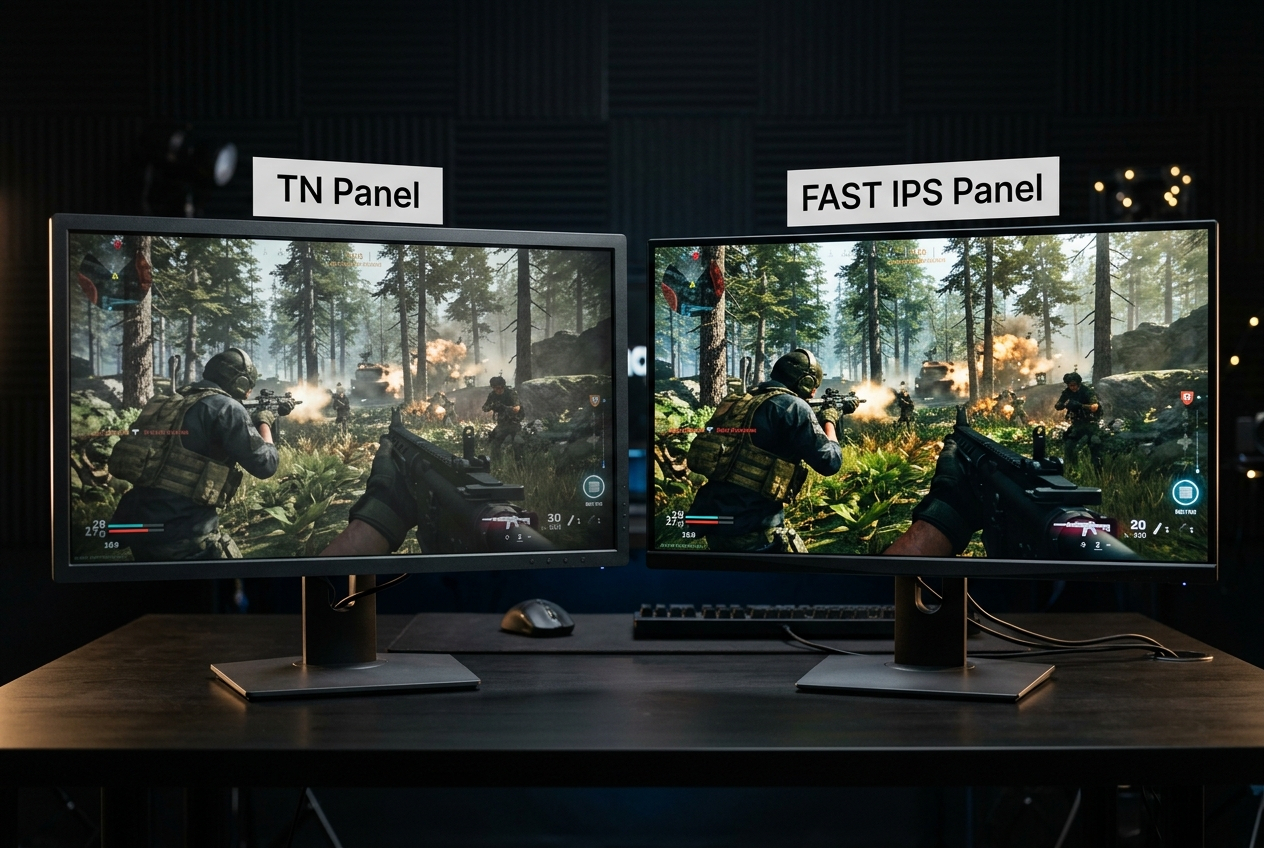
It’s one of the most common purchase dilemmas for gaming monitor buyers: Should I prioritize an IPS panel for color and image quality, or a TN/Fast IPS panel for speed? The answer used to be straightforward — competitive players picked TN for speed, everyone else picked IPS for quality. In 2026, that divide has largely dissolved. But the nuance still matters, and getting it right for your specific use case is worth understanding clearly.
What’s Actually Different: Color Quality vs. Speed
Before comparing panel choices, it helps to understand what “speed” and “color quality” actually mean in monitor specs.
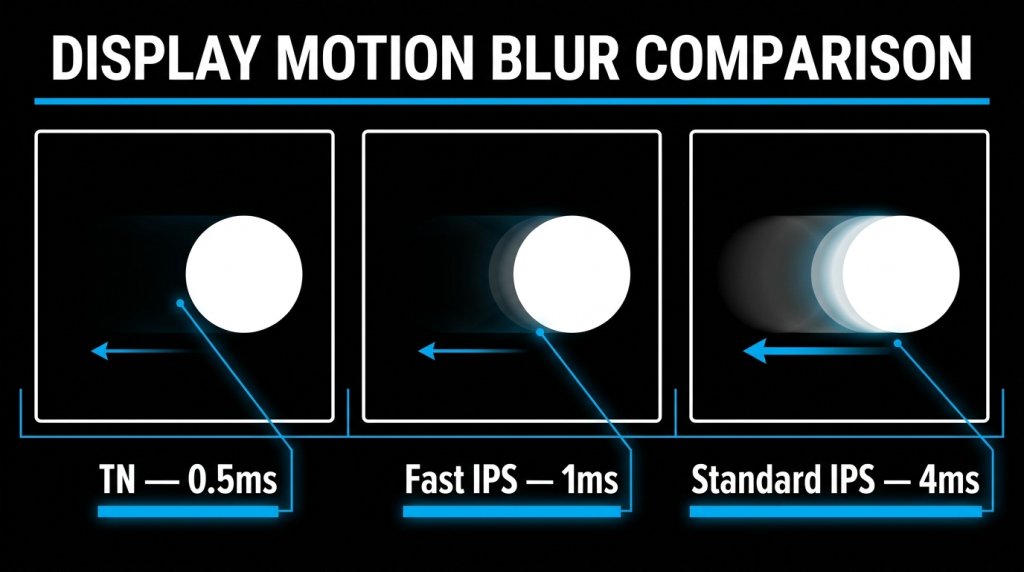
Panel speed refers to how quickly individual pixels can transition between colors — measured in milliseconds (ms) of gray-to-gray (GTG) response time. Slow pixel transitions create a visible motion artifact called “ghosting” — a trailing smear that follows fast-moving objects on screen. In fast-paced competitive games, this affects target clarity and visual precision.
Color quality refers to how accurately and richly a panel reproduces colors — measured in color gamut coverage (sRGB, DCI-P3), bit depth (6-bit vs. 8-bit vs. 10-bit), and viewing angle consistency. Better color quality means more immersive game worlds, more accurate content creation, and less eye fatigue from washed-out or inaccurate colors.
The question is: in 2026, do you really have to choose?
TN Panels: The Speed Heritage
TN (Twisted Nematic) panels built their reputation on one thing: raw pixel response time. Top TN monitors achieve GTG response as low as 0.5ms — the fastest among LCD technologies — and support refresh rates of 360Hz and beyond on 24–26 inch competitive displays.
Where TN still wins:
- Sub-millisecond response times at the absolute floor of LCD technology
- 360Hz+ refresh rates on compact competitive panels
- Lower input lag baseline than IPS in some configurations
Where TN falls short:
- Color accuracy is noticeably poor — typically 6-bit + dithering rather than true 8-bit
- Narrow vertical viewing angles mean image shifts when viewed even slightly off-center
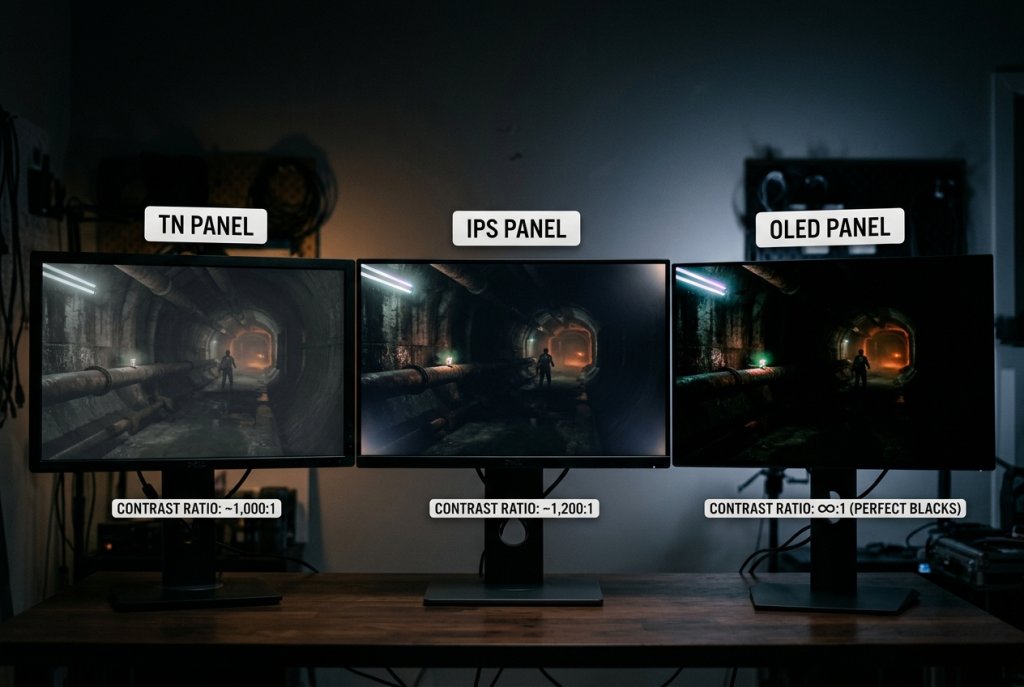
- Black levels and contrast ratios are weak compared to IPS, VA, and especially OLED
The honest assessment in 2026: TN’s color and viewing angle weaknesses have become harder to justify. For most buyers — even competitive players — the visual trade-off is larger than the performance benefit.
Fast IPS: The Technology That Changed the Equation
Fast IPS (including Nano IPS, IPS Black, and AHVA variants) has made the TN-vs-IPS trade-off largely obsolete. These panels achieve GTG response times of 1ms — barely distinguishable from TN’s 0.5ms in real gameplay — while delivering the wide color gamut, 8-bit depth, and 178° viewing angles that IPS is known for.
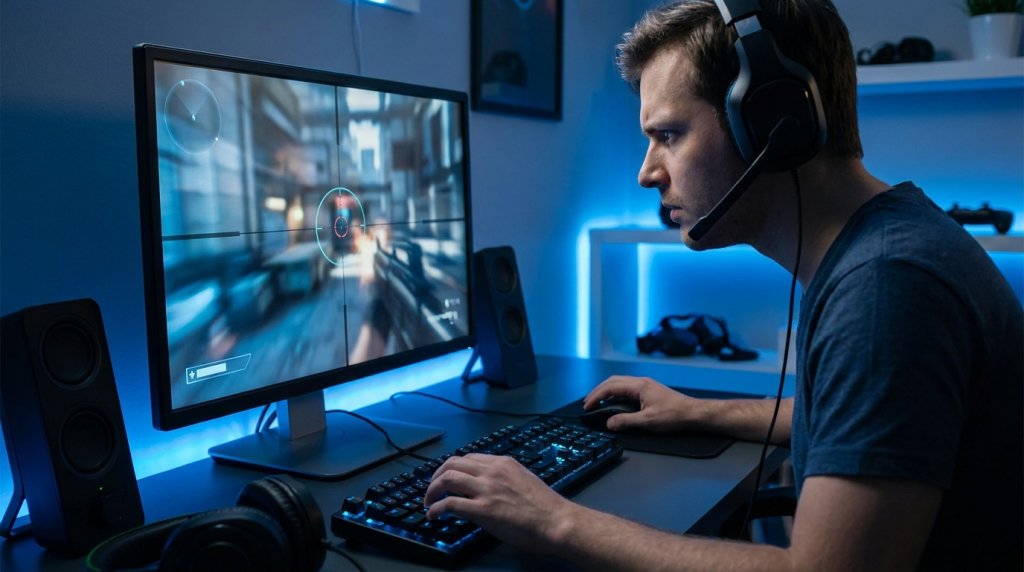
Where Fast IPS wins in 2026:
- 1ms GTG response: competitive performance without TN’s visual compromise
- 8-bit true color + wide color gamut (typically 95–98% DCI-P3 on premium models)
- 178° horizontal and vertical viewing angles with minimal shift
- Broad support for HDR with Mini-LED backlight implementations
- Available with G-Sync and FreeSync variable refresh rate
The one remaining weakness: IPS glow — a characteristic backlight bleed visible in dark room corners at high brightness. IPS Black panels have reduced this significantly in 2026, achieving contrast ratios around 2,000:1 compared to the 1,000:1 typical of standard IPS.
OLED: The Third Option Disrupting Both
Any conversation about IPS vs. TN in 2026 is incomplete without acknowledging OLED. OLED and QD-OLED gaming monitors have entered the mainstream premium segment and offer something neither IPS nor TN can match: both superior speed and superior color quality simultaneously.
| Feature | TN | Standard IPS | Fast IPS | OLED |
|---|---|---|---|---|
| GTG Response | 0.5ms | 3–5ms | 1ms | <0.1ms |
| Color Accuracy | Poor | Excellent | Excellent | Excellent |
| Contrast Ratio | ~1,000:1 | ~1,000:1 | ~2,000:1 (IPS Black) | Infinite |
| Viewing Angles | Poor | 178° | 178° | 178° |
| Max Refresh Rate | 360Hz+ | 240Hz | 360Hz+ | 240–480Hz |
| HDR Quality | Poor | Good | Good–Very Good | Excellent |
| Burn-in Risk | None | None | None | Manageable |
For buyers who can invest in an OLED display, the IPS-vs-TN debate is essentially bypassed. OLED’s sub-0.1ms response time makes TN’s speed advantage irrelevant, while its color gamut and contrast ratio exceed both.
The Real-World Impact of Response Time
Here’s a perspective that often gets lost in spec comparisons: the difference between 0.5ms (TN) and 1ms (Fast IPS) response time is functionally imperceptible in gameplay for the overwhelming majority of players.
At 240Hz, a single frame lasts approximately 4.16ms. At 360Hz, approximately 2.77ms. A 0.5ms difference in pixel transition time represents 12% of a single frame at 240Hz — a margin that scientific studies have found difficult or impossible for humans to perceive under normal gaming conditions.
The much more impactful number is the refresh rate itself. Going from 60Hz to 144Hz is dramatically visible to nearly all players. Going from 144Hz to 240Hz is noticeable to most competitive players. Going from 240Hz to 360Hz is detectable primarily by professional-tier esports athletes under controlled conditions.
Matching Your Choice to Your Actual Priorities
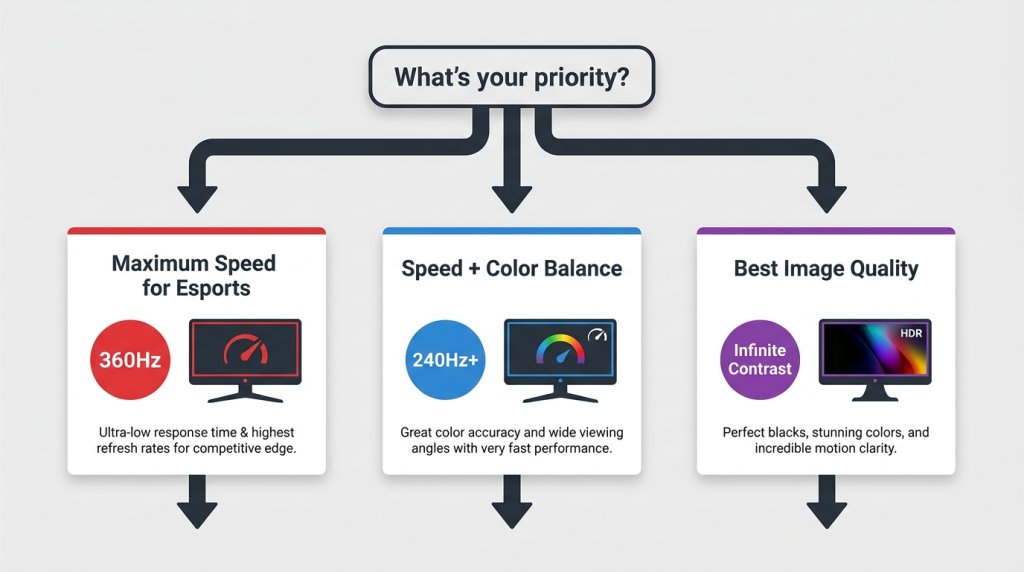
If your primary game is competitive multiplayer (CS2, Valorant, Apex, Overwatch):
A Fast IPS monitor at 240Hz or higher on a 24–26 inch 1080p display gives you competitive-grade speed without TN’s color compromise. Pair with a capable GPU from NVIDIA or AMD that can sustain high frame rates consistently.
If you play a mix of competitive and single-player games:
Fast IPS is the definitive recommendation. You get the speed for competitive play and the color quality for immersive single-player experiences — without compromise.
If you play immersive single-player games primarily:
Standard IPS or OLED/QD-OLED will deliver the best visual experience. HDR-enabled monitors in the 33-inch and larger category transform cinematic games into genuinely stunning experiences.
If you’re a professional esports competitor:
TN at 360Hz remains a defensible choice for the fraction of performance you can actually leverage at the highest tiers. For everyone else, Fast IPS at 240Hz+ gives you everything you need.
The 2026 Verdict
The question of IPS color quality vs. TN/Fast IPS speed has largely resolved itself in 2026. Fast IPS panels have achieved response times close enough to TN that the practical performance difference is negligible for the vast majority of players. Meanwhile, TN’s color and viewing angle limitations remain unchanged.
For most buyers — casual, enthusiast, or semi-competitive — Fast IPS is the right answer. It delivers competitive speed without sacrificing the visual quality that makes gaming enjoyable. And if you want to eliminate the trade-off entirely, OLED gaming monitors now offer both simultaneously at an increasingly accessible tier.