

The gaming monitor market in 2026 presents more resolution choices than ever before, from budget-friendly 1080p to ultra-premium 8K displays. Amid this expanding landscape, 1440p Quad HD has solidified its position as the most popular gaming resolution, but does “most popular” equal “best”? This comprehensive analysis explores whether 1440p truly deserves its reputation as the optimal gaming resolution or if alternatives better serve specific gaming needs.
Understanding the 1440p Sweet Spot
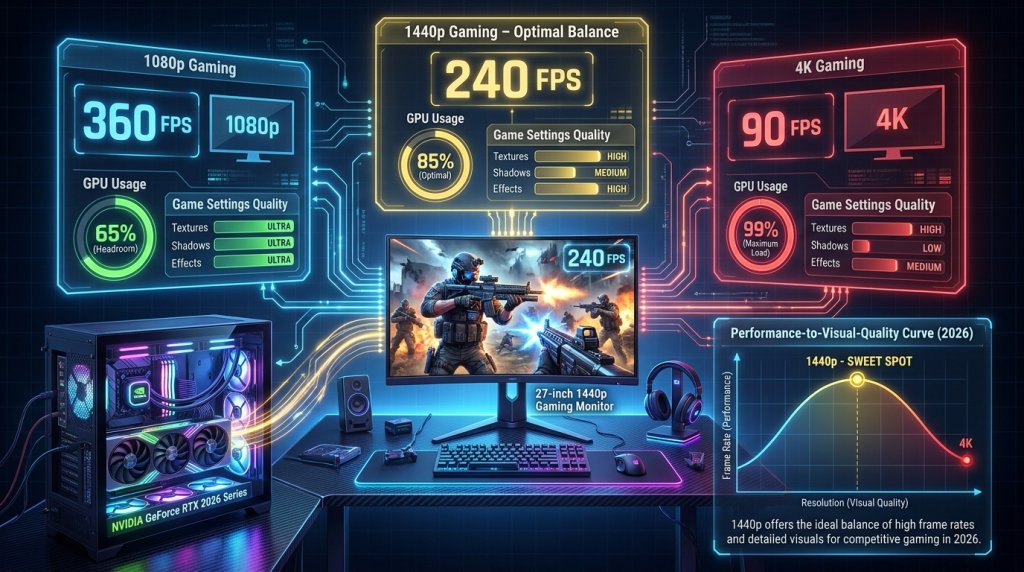
At 2560×1440 pixels, 1440p delivers 3.6 million pixels—78% more than 1080p’s 2 million pixels, yet significantly fewer than 4K’s 8.3 million pixels. This middle-ground positioning creates a unique balance between visual fidelity and performance demands that has captured the gaming community’s attention.
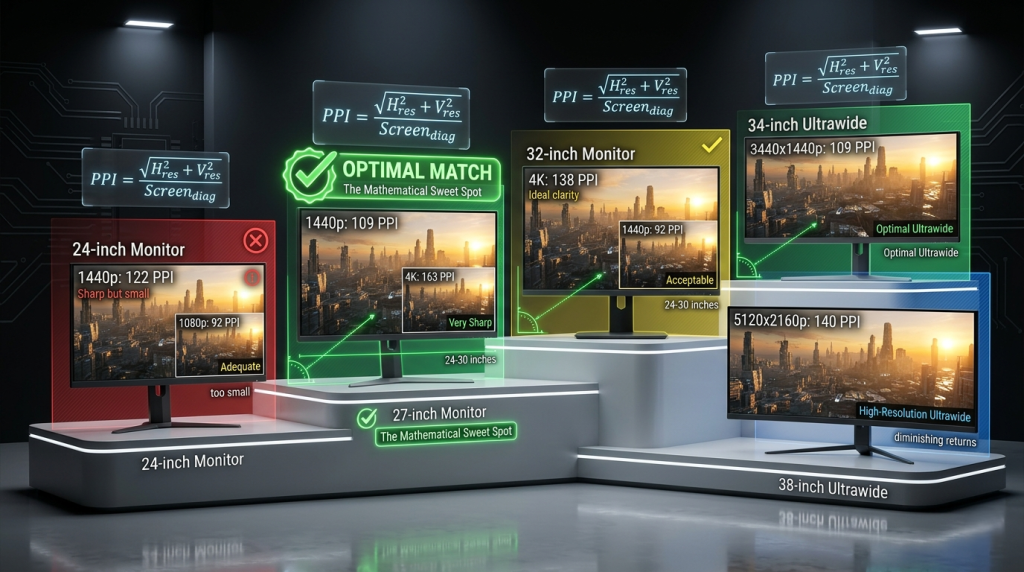
The pixel density at typical screen sizes creates noticeably sharper images than 1080p without the extreme GPU requirements of 4K gaming. At 27 inches, 1440p provides approximately 109 pixels per inch, delivering crisp clarity without requiring operating system scaling that can complicate some applications and games.
The Performance Equation in 2026
One of 1440p’s strongest arguments lies in its performance characteristics with current gaming hardware. Modern graphics cards from both NVIDIA and AMD handle 1440p gaming exceptionally well, enabling high frame rates even in demanding AAA titles.
The GPU overhead required for 1440p compared to 4K allows gamers to maximize visual settings while maintaining frame rates suitable for high refresh rate displays. 1440p gaming monitors commonly offer 165Hz to 240Hz refresh rates, creating smooth, responsive experiences that 4K struggles to match without flagship-tier hardware.
AI Upscaling Technologies Transform the Landscape
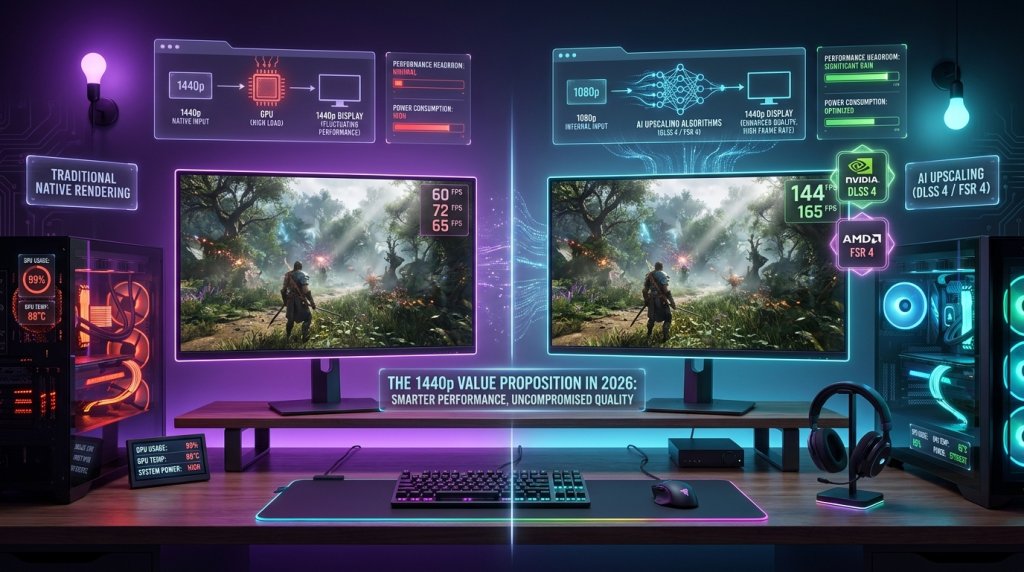
2026’s breakthrough AI upscaling technologies have significantly impacted resolution considerations. DLSS 4 and FSR 4 can render games at lower internal resolutions while delivering image quality approaching native resolution output. This technology particularly benefits 1440p, as upscaling from 1080p to 1440p produces excellent results while providing substantial performance headroom.
These AI-driven solutions effectively extend the usable lifespan of mid-range GPUs, allowing them to deliver high-quality 1440p experiences in titles that might otherwise struggle at native resolution. The combination of 1440p displays with advanced upscaling represents a powerful value proposition.
When 1440p Excels: The Ideal Use Cases
Several gaming scenarios position 1440p as the objectively optimal choice, regardless of budget considerations.
Competitive Gaming Balance
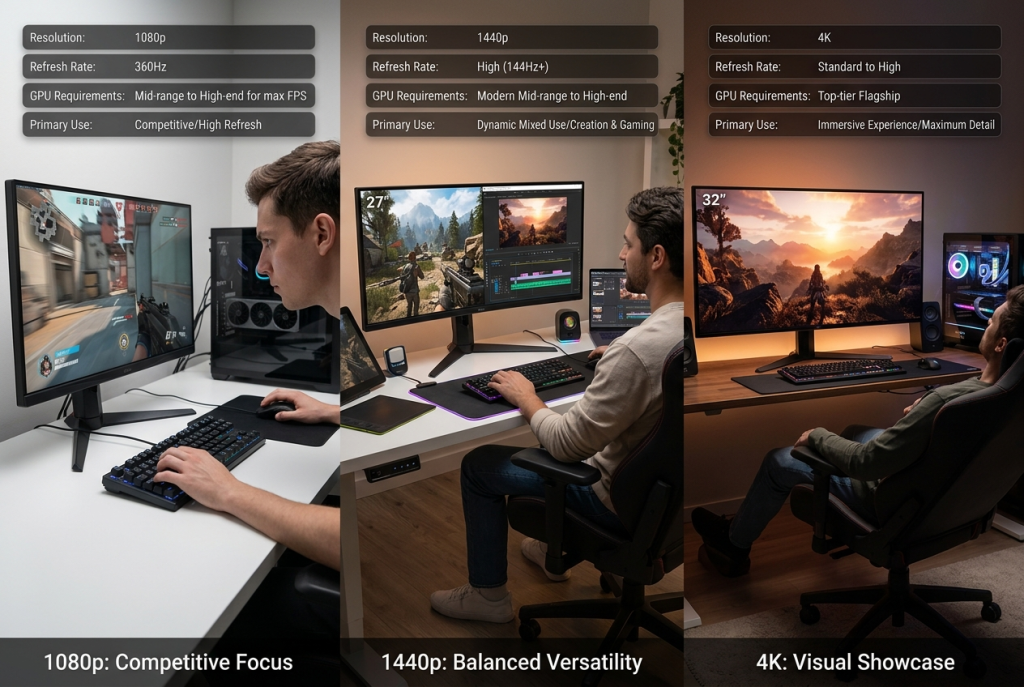
For competitive multiplayer gaming, 1440p strikes an excellent balance between visual clarity and frame rate potential. Unlike 1080p, which can appear noticeably soft at typical viewing distances, 1440p provides the detail needed to spot distant enemies while allowing high refresh rate displays to operate at their maximum potential.
The resolution provides enough pixel density that UI elements and text remain sharp without scaling, important for competitive titles where screen real estate matters. Integration with G-Sync and FreeSync technologies ensures tear-free gaming across varying frame rates.
Multi-Purpose Computing
Beyond gaming, 1440p excels as a productivity resolution. The increased desktop real estate compared to 1080p makes multitasking more comfortable without requiring display scaling. For gamers who also stream, create content, or work from their gaming setups, 1440p provides functional workspace advantages that purely gaming-focused 1080p lacks.
The 27-Inch Perfect Pairing
1440p’s pixel density mathematically optimizes for 27-inch displays, creating ideal clarity without scaling requirements. This 27-inch form factor dominates gaming monitor sales, and the resolution-size pairing explains much of this popularity.
When 1440p Isn’t the Answer
Despite its strengths, 1440p doesn’t represent the universal best choice for all gaming scenarios.
Competitive Esports: 1080p’s Continued Relevance
Professional esports players frequently choose 1080p displays for their lower GPU overhead and ability to sustain extreme frame rates. In competitive Counter-Strike 2, Valorant, or League of Legends, maximizing frame rates to 360Hz or 500Hz takes priority over resolution.
The pixel count advantage of 1440p becomes less meaningful in competitive scenarios where visual settings are minimized for clarity and performance. For dedicated competitive players, 1080p at 24-26 inches remains the pragmatic choice.
Single-Player Showcase Titles: 4K’s Visual Superiority
For gamers prioritizing visual fidelity in story-driven single-player experiences, 4K gaming monitors deliver noticeably superior image quality. The 2.25x pixel increase over 1440p creates stunning clarity in games designed to showcase cutting-edge graphics.
Modern OLED 4K displays combine ultra-high resolution with perfect blacks and HDR performance, creating unmatched visual experiences for atmospheric games. When frame rates above 60-90fps aren’t critical, 4K’s visual advantages become compelling.
Ultra-Wide Immersion: Beyond Traditional Resolutions
Ultra-wide displays at 33+ inches and 39+ inches often use 3440×1440 or 5120×2160 resolutions, offering immersive experiences that transcend traditional resolution comparisons. These curved ultra-wide monitors create wraparound viewing experiences ideal for simulation gaming and immersive single-player titles.
Resolution Comparison Matrix
| Resolution | Pixel Count | GPU Demand | Best Screen Size | Frame Rate Potential | Ideal Gaming Type |
|---|---|---|---|---|---|
| 1080p | 2,073,600 | Low | 24″ | 240-500Hz | Competitive Esports |
| 1440p | 3,686,400 | Moderate | 27″ | 165-240Hz | Balanced/Multi-Genre |
| 4K | 8,294,400 | High | 27-32″ | 120-144Hz | Visual Showcase |
| 1440p UW | 4,953,600 | Moderate-High | 34-38″ | 144-175Hz | Immersive Gaming |
| 5K UW | 11,059,200 | Very High | 49″ | 120-144Hz | Premium Immersion |
The HDR Factor
HDR-capable gaming monitors have become increasingly common in 2026, and resolution interacts with HDR implementation in meaningful ways. 1440p HDR displays offer excellent visual impact while maintaining the performance characteristics that make the resolution attractive.
However, 4K displays better leverage HDR’s capabilities due to higher pixel density allowing more nuanced brightness gradations. For HDR-focused gaming, this represents a point in 4K’s favor, though 1440p HDR still delivers impressive results.
Cost-Benefit Analysis in 2026
Beyond performance considerations, 1440p offers compelling value propositions. The combination of moderate GPU requirements and mature manufacturing processes means 1440p displays typically offer more features per dollar than 4K alternatives.
High refresh rate 1440p monitors with fast response times, excellent color accuracy, and adaptive sync technologies are widely available across various price points. This accessibility democratizes high-quality gaming experiences without requiring top-tier hardware budgets.
Future-Proofing Considerations
The question of future-proofing adds complexity to resolution decisions. While 8K displays exist, mainstream gaming won’t target 8K for years due to extreme performance demands. This suggests 1440p’s relevance will persist throughout current GPU generations.
AI upscaling technologies continue improving, potentially extending 1440p’s viability even as game fidelity advances. Rendering internally at 1080p or dynamic resolutions while displaying at 1440p may become standard practice, making the output resolution choice somewhat independent from rendering resolution.
The Verdict: Context-Dependent Excellence
Is 1440p the best resolution for gaming in 2026? The answer depends entirely on your gaming priorities, hardware, and use cases.
1440p excels when:
- You play diverse game genres requiring different optimization priorities
- You have mid-to-high-end GPU hardware
- You want high refresh rates with excellent visual quality
- You use your display for gaming and productivity
- You prefer 27-inch displays
Consider alternatives when:
- Competitive esports is your exclusive focus (1080p)
- Visual fidelity trumps all other concerns (4K)
- You have flagship GPU hardware to leverage
- You prioritize immersive ultra-wide experiences
- You game primarily at 24-inch or smaller sizes
For the majority of gamers seeking the best overall balance of performance, visual quality, and practical usability, 1440p remains the optimal choice in 2026. However, the “best” resolution ultimately depends on your specific gaming priorities and willingness to optimize for particular use cases over versatility.