
The ASUS UGen300 Hailo-10H AI accelerator gives developers, makers, and small businesses a way to run AI models on their own hardware instead of a cloud API. It ships in two forms, a plug-and-play USB stick and an M.2 module for system integrators, and both use the same Hailo-10H AI accelerator chip to deliver 40 TOPS at INT4 precision while drawing just 2.5 watts. That combination of local processing and low power draw is the entire point of this product: privacy-sensitive inference without a data-center power bill.
This article breaks down what the Hailo-10H AI accelerator chip actually does, how the USB accelerator differs from the M.2 module, which workloads it fits, and where it hits a hard ceiling compared with a discrete GPU. It also covers the software stack ASUS supports, since a chip is only as useful as the frameworks that can talk to it.
Most buyers researching edge AI hardware start from the wrong question. They ask “how fast is it” before asking “what does my model actually need.” A speech-to-text pipeline, a security camera doing object detection, and a chatbot running a quantized 7B model all have wildly different memory and latency requirements. As a result, the UGen300’s fixed 8 GB memory pool and 2.5 W power envelope make sense for some of those jobs and not others. Working through the specs with that framing first avoids the most common buyer’s remorse with any dedicated accelerator, which is discovering after purchase that the target model simply does not fit.
What Is the ASUS UGen300 Hailo-10H AI Accelerator?
The ASUS UGen300 is a dedicated AI inference accelerator built around Hailo’s Hailo-10H AI accelerator chip, designed specifically for running pre-trained neural networks rather than general computing. Unlike a CPU or GPU, it does not run an operating system or handle graphics. Instead, it accepts a model and a set of inputs, then returns predictions. In practice, that means far less power draw than a general-purpose processor would need for the same job.
Both UGen300 variants carry 8 GB of onboard LPDDR4 memory clocked at 4266 MT/s. That capacity is enough headroom for most vision models, speech-to-text pipelines, and small-to-midsize language models without leaning on the host system’s RAM. In addition, ASUS rates the chip at 40 TOPS (trillion operations per second) at INT4 precision and 20 TOPS at INT8, numbers that describe raw throughput for quantized inference rather than training workloads.
For context, a modern discrete GPU or a professional workstation-class GPU delivers TOPS figures an order of magnitude higher, but it also draws 200 to 450 watts under load. The UGen300’s entire pitch is efficiency and locality, not raw horsepower.
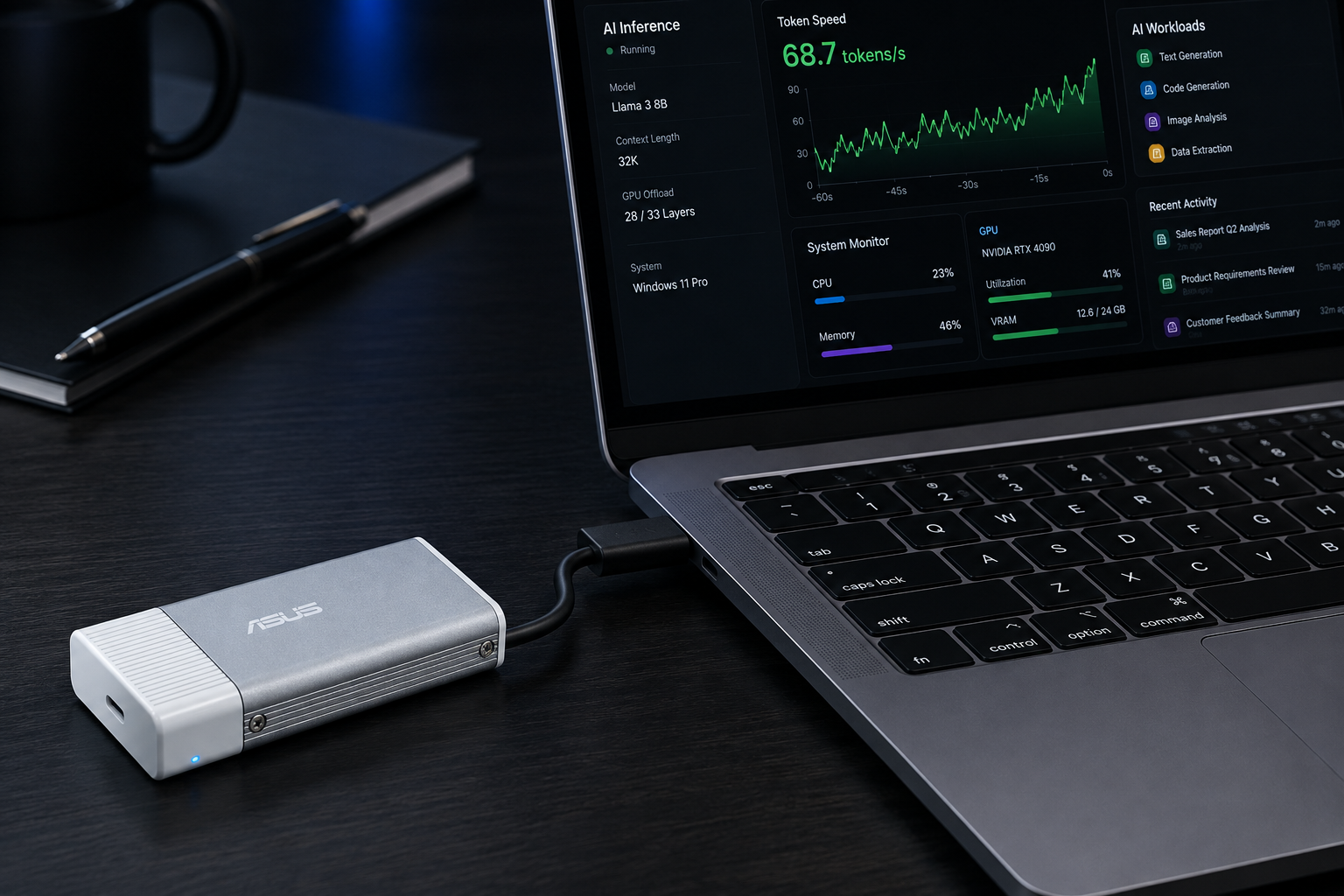
That framing matters because “AI accelerator” has become a loose marketing term applied to everything from data-center cards to phone chips. Instead, the Hailo-10H sits firmly in the edge-inference category: small, efficient, and purpose-built for running models that have already been trained elsewhere, not for building them from scratch.
Two Form Factors: USB Accelerator vs. M.2 AI Module
ASUS sells the Hailo-10H AI accelerator in two physical packages, and picking the right one depends entirely on how the hardware will be deployed.
The ASUS UGen300 USB AI Accelerator is a compact external unit measuring 4.1 by 2.0 by 0.7 inches and weighing 0.32 pounds. It connects over USB 3.1 Gen2 Type-C at up to 10 Gbps using the included 20 cm cable, so it works with almost any desktop, laptop, or single-board computer that has a free Type-C port. No case has to come open, no warranty seal has to break. That makes it the practical choice for retrofitting an existing machine or for anyone who needs to move the accelerator between systems.
Where the M.2 Module Fits
The ASUS UGen300 M.2 AI Module uses an M.2 Key-M 2280 form factor and connects over PCIe 3.0 x4 instead of USB. It is meant for system builders and OEMs who are designing a device from scratch, such as a kiosk, an industrial controller, or a compact edge AI mini PC. An internal connection like this is simply cleaner than a cable hanging out of the case. Both modules use the identical Hailo-10H AI accelerator chip, the same 8 GB of LPDDR4 memory, and the same 2.5 W typical power draw, so performance is the same either way. Instead, the decision comes down to installation, not capability.
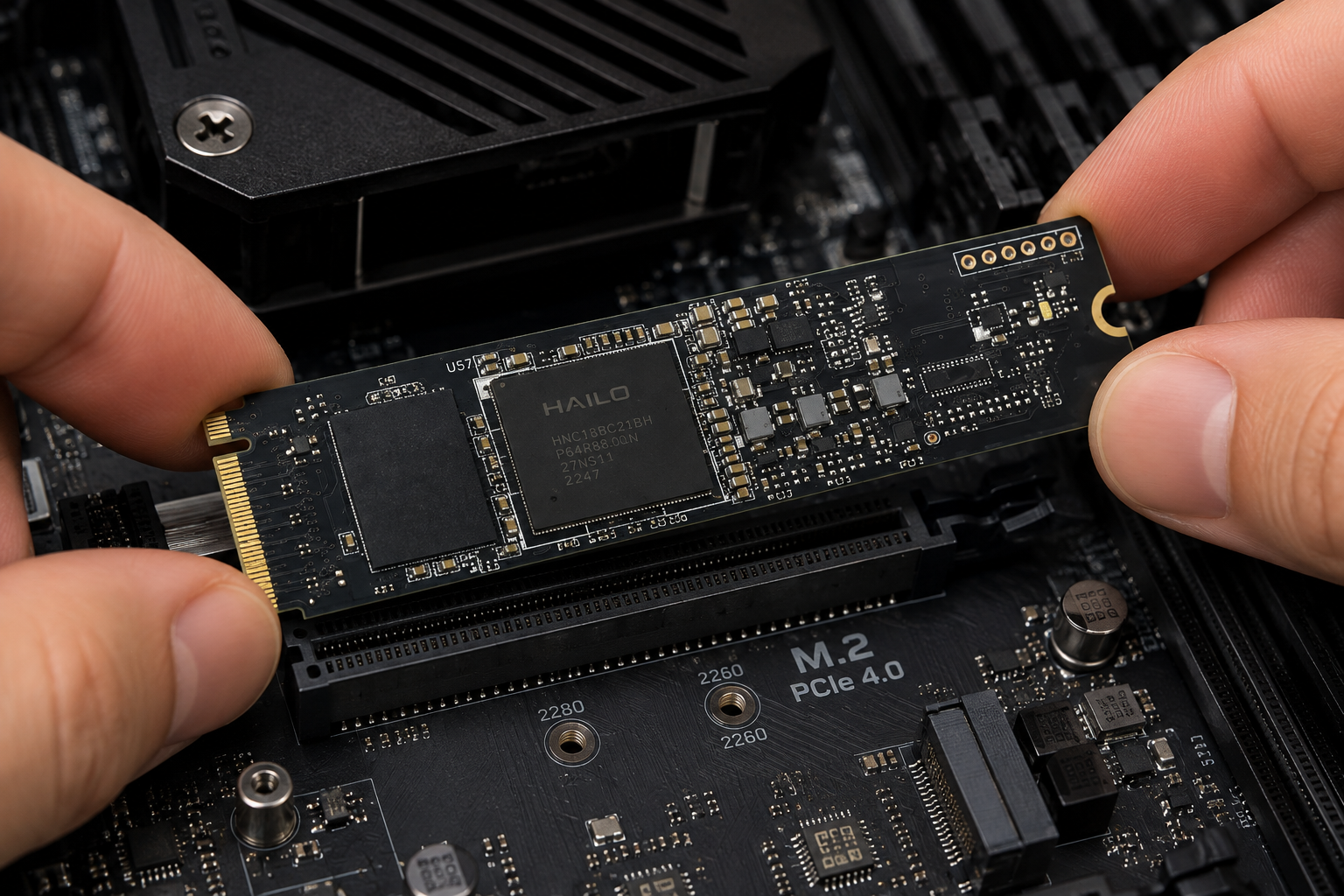
Price reflects that distinction too. The USB accelerator lists at $299.99, while the M.2 module comes in at $259.99, a modest discount that likely reflects the simpler bill of materials on the internal card versus a finished external enclosure, cable, and housing. Neither price includes a host computer, so buyers should budget for whatever desktop PC, laptop, or single-board computer will actually run the software stack.
Inside the Hailo-10H: TOPS, Memory, and Power Draw
Every spec on the UGen300’s sheet exists to answer one question: what can this chip actually run? The 40 TOPS INT4 rating is the headline number, but it only tells part of the story without memory and power context.
Eight gigabytes of LPDDR4 at 4266 MT/s is the ceiling for how large a model can live on the accelerator at once. In practice, that capacity comfortably fits most computer-vision models, OCR pipelines, and speech models like Whisper, along with smaller quantized language models. It will not hold a 70-billion-parameter language model, and ASUS is not marketing it for that use case.
Power draw is where the UGen300 actually differentiates itself. At 2.5 W typical, it draws less than most USB-connected peripherals, let alone a GPU. That number matters for two practical reasons: first, it can run continuously without meaningful heat buildup, and second, ASUS rates it for more than 72 hours of continuous operation across a 0°C to 40°C range. For an always-on kiosk, sensor node, or classroom device, that reliability profile matters more than raw speed.
| Spec | ASUS UGen300 (both variants) |
|---|---|
| AI chip | Hailo-10H |
| Performance | 40 TOPS @ INT4, 20 TOPS @ INT8 |
| Memory | 8 GB LPDDR4 @ 4266 MT/s |
| Power draw | 2.5 W typical |
| Operating temperature | 0°C to 40°C |
| Continuous operation | 72+ hours rated |
Software Stack and Framework Support
A neural accelerator is only useful if the frameworks a developer already uses can target it, and this is where the UGen300 avoids a common pitfall of niche AI hardware. ASUS lists support for TensorFlow, TensorFlow Lite, Keras, PyTorch, and ONNX, which covers the vast majority of models a hobbyist or SMB developer would already have on hand.
Both variants run on Windows, Linux, and Android, and they support both x86 and ARM architectures. As a result, the same accelerator can sit behind a Windows desktop, a Linux edge server, or an ARM-based single-board computer without a different driver stack for each. In addition, developers who would rather not build a model from scratch can pull from more than 150 pre-trained models in Hailo’s model zoo, spanning large language models, vision-language models, Whisper-based transcription, and standard computer-vision networks.
That said, ASUS has not published token-per-second benchmarks for specific language models on this hardware, so treat the TOPS figures as a starting point for capacity planning rather than a guaranteed real-world speed. Anyone with a specific latency requirement should test their exact model on the hardware before committing to a deployment.
Real-World Use Cases: Local LLMs, Vision, and Edge AI
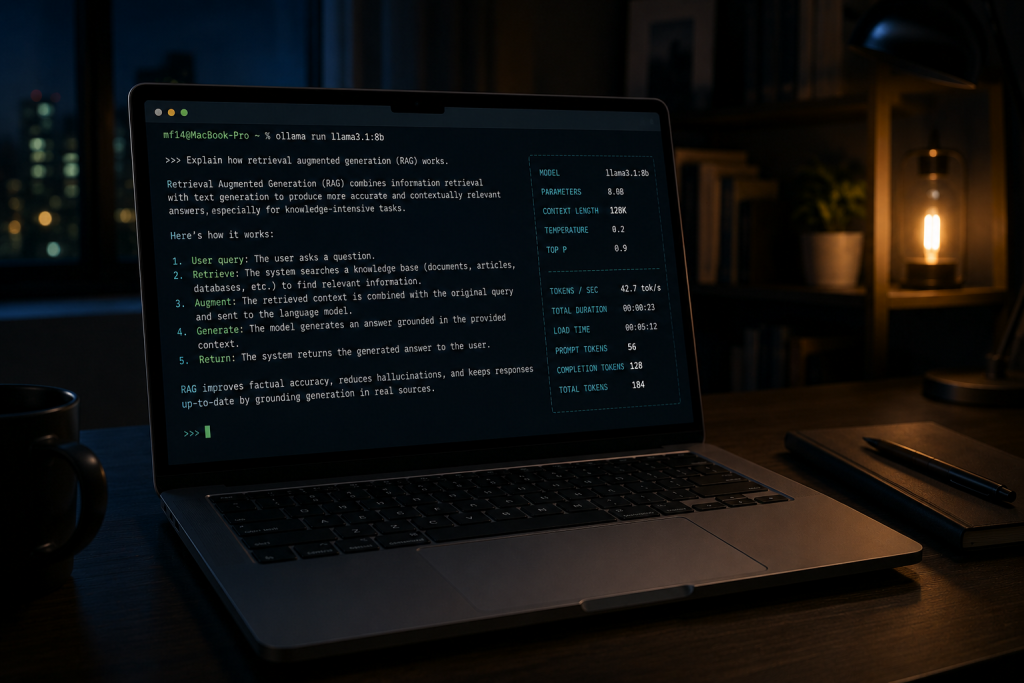
The UGen300’s target use cases line up closely with what “local, offline AI” actually means for a small team. In practice, running inference entirely on-device means a security camera can classify people and objects without uploading footage anywhere. Likewise, a small business kiosk can transcribe customer speech without an API bill per request, and a lab prototype can run a language model without a network dependency at all.
ASUS specifically calls out developers, makers, educators, and industrial or SMB applications as the target market. For example, a classroom teaching computer vision could hand students a $259.99 M.2 module rather than a $1,500 GPU, since the lesson is about model behavior, not training speed. Similarly, an industrial line could embed the M.2 variant directly into an inspection camera housing, where the 2.5 W draw and 72-hour continuous rating matter more than peak throughput.
Compared with the NPU built into a Copilot+ AI PC, the UGen300 offers a narrower but more portable option. After all, a laptop’s NPU is fixed to that one machine, while a USB accelerator can move between a desktop, a laptop, and a single-board computer as a project’s hardware changes.
How It Compares to a Discrete GPU for AI Inference
This is the honest tradeoff section, and it matters more than any single spec. A discrete GPU with dedicated VRAM will outrun the UGen300 on raw throughput for nearly every workload, particularly for training or for running large, unquantized language models. For instance, if the goal is fine-tuning a 7B or 13B parameter model, a modern GPU with 16 GB or more of VRAM remains the better tool, full stop.
Where the UGen300 wins is efficiency, footprint, and predictability. A GPU capable of the UGen300’s INT8 workloads will draw anywhere from 80 to 450 watts depending on the card. It also requires a compatible PCIe slot, adequate case airflow, and a power supply with headroom to spare. By contrast, the UGen300 needs only a free USB port or a single M.2 slot and effectively no cooling plan. For a battery-powered device, a fanless enclosure, or an always-on edge deployment, that difference is the deciding factor, not an afterthought.
It is also worth being direct about what this device is not. It is not a gaming GPU, and it will not accelerate a graphics pipeline. Nor is it a training accelerator for anything beyond small fine-tuning jobs. Buyers expecting GPU-class throughput at GPU prices will be disappointed; on the other hand, buyers who need low-power, always-on inference at the edge are the actual target customer.
Setting Up: What You Need to Get Started
Getting either UGen300 variant running does not require specialized tools, but the two form factors have different prerequisites. The USB-connected accelerator needs only a free USB 3.1 Gen2 Type-C port. ASUS includes the 20 cm Type-C to Type-C cable in the box, so no separate purchase is required for a typical desktop or laptop setup.
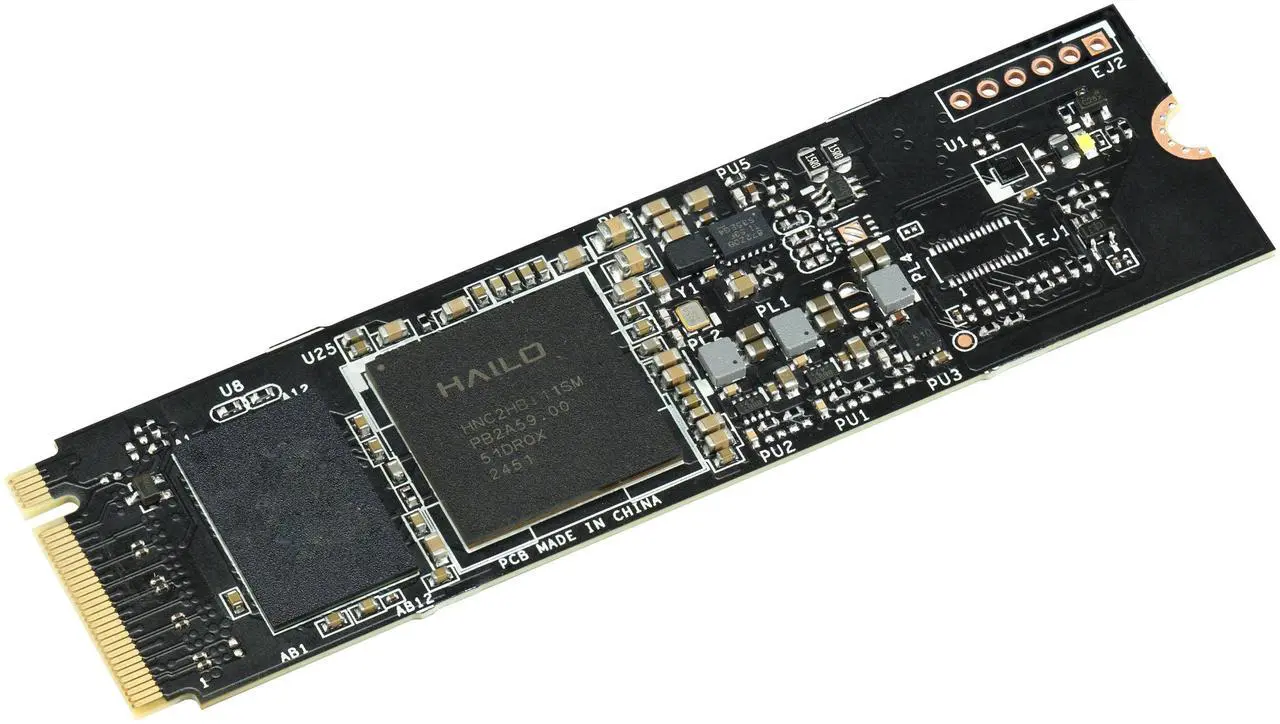
The M.2 module needs an available M.2 Key-M slot wired for PCIe 3.0 x4 or better. That slot type is common on desktop motherboards and many single-board computers, but it is worth double-checking before ordering. For instance, if the only open M.2 slot on a build is already earmarked for an NVMe SSD, plan the module placement before finalizing a parts list, since most consumer boards only offer two or three M.2 slots total.
Once physically connected, installation follows the standard driver-and-SDK pattern common to edge AI hardware. First, install Hailo’s runtime and drivers for the target OS. Next, point an existing PyTorch, TensorFlow, or ONNX pipeline at the device through Hailo’s software layer. Developers who would rather skip custom model conversion can instead start from one of the 150-plus pre-trained models in the model zoo and modify from there.
Which UGen300 Fits Your Project?
| If you need… | Choose | Why |
|---|---|---|
| A quick add-on for an existing desktop or laptop | USB AI Accelerator | No case opening, works across multiple machines |
| A permanent build for a kiosk, camera, or embedded device | M.2 AI Module | Internal mounting, no external cable |
| To prototype on one machine before mass-producing a product | USB AI Accelerator first, M.2 for production | Same chip and performance, easier iteration |
| Maximum throughput for training or large LLM inference | A discrete GPU instead | Neither UGen300 variant targets this workload |
For most individual developers and small teams, the USB accelerator is the lower-friction starting point. Companies building a physical product around the chip will eventually want the M.2 AI accelerator module for the final design, since it avoids a dangling cable and does not consume an external port.

Conclusion: Is the Hailo-10H AI Accelerator Worth It?
The Hailo-10H AI accelerator in the ASUS UGen300 is not trying to replace a GPU, and that is exactly why it works for its target audience. At 2.5 W and 40 TOPS INT4, it turns local, offline AI inference into something that fits in a USB port or an M.2 slot instead of a full tower case. If a project needs to fine-tune large models or push maximum throughput, a discrete GPU is still the right call. On the other hand, if the goal is privacy-respecting, always-on inference for vision, speech, or smaller language models on a tight power budget, the UGen300 fills a gap that most AI workstation builds do not address well.
Instead, developers evaluating either variant should start with the workload, not the spec sheet, and match the model size and latency needs to the 8 GB memory ceiling before ordering. Browse the full lineup of GPUs for anything beyond that ceiling, or start prototyping directly with the UGen300 accelerator for everything within it.
Related Posts
- Back-to-School Monitors Under $160: Your Questions, Answered
- Best CPU for the RTX 5070: Four Contenders, One Clear Winner
- How to Choose the Right Business Desktop for Work on Newegg
- Back to School 2026: Which Laptop Should You Actually Buy?
- Ryzen 7 7700X3D Motherboard and BIOS Guide: Official Support, Step by Step
Frequently Asked Questions
Answers to the most common questions about the ASUS UGen300 Hailo-10H AI accelerator.