
Every console generation produces the same moment. A landmark open-world game ships, PC players run it on hardware that handled everything before it, and suddenly the frame rate graph looks like a heart monitor. It happened with Grand Theft Auto V in 2015 and with Red Dead Redemption 2 in 2019, and it will happen again.
Grand Theft Auto VI is dated for 19 November 2026 on PlayStation 5 and Xbox Series X and Series S. Rockstar has not announced a PC version, so nobody has real system requirements. What we do have is a decade of evidence about which parts of a machine large open-world games actually stress, and that is enough to shop with.
Who This Is For
People buying a machine they expect to keep through the next two or three years of big releases, at settings they will not resent. If you mostly play competitive titles or your library is older, this is more machine than you need and you should buy for what you actually play.
About ABS
Three machines, one badge, so here is what sits behind it. ABS was founded in 1990 by Fred Chang as Always Better Service, a direct-mail computer company in Southern California. It is now a Newegg subsidiary headquartered in Diamond Bar, California, and Newegg relaunched the brand on 1 October 2020 as Advanced Battlestations, pointed squarely at gaming.
For a machine you intend to keep through several release cycles, the useful detail is that ABS assembles in-house using name-brand retail components and works with Intel, AMD, NVIDIA and Microsoft. That means one warranty covering the finished system, and ordinary parts underneath when you eventually want to change something — which, on a machine bought for games that have not shipped yet, you almost certainly will. Whatever is in stock at the moment is in the ABS brand store on Newegg.
The Three Things That Age Badly
Video memory. This is the one you cannot fix later. The PlayStation 5 and Xbox Series X each have 16GB of unified memory shared between CPU and GPU, and ports tend to reflect that budget. An 8GB card starts making decisions for you; 16GB does not.
CPU cache. Dense traffic, large crowds and long draw distances are cache-sensitive workloads, and they show up in 1% lows rather than average frame rates. This is the part people underspend on when they are excited about a graphics card.
Storage. Rockstar’s last two open worlds were enormous installs. A 1TB drive shared with an operating system and a few current games will not fit another one.
Scenario One: 4K, Single Player, Settings Up
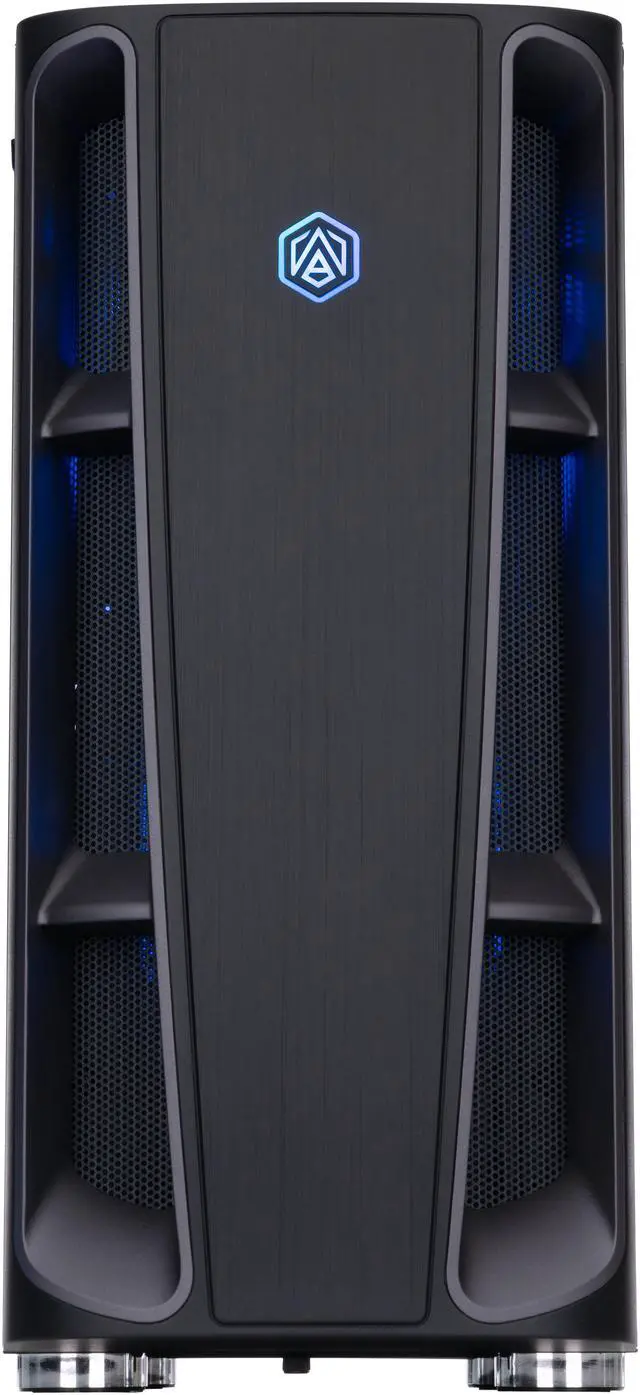
The ABS Kaze II Ruby with the Ryzen 7 9800X3D and RTX 5080 is the machine for the person who plays big games slowly and wants them to look it. The 5080 is 10,752 CUDA cores and 16GB of GDDR7 on a 256-bit bus at 360W. The 9800X3D contributes eight cores, sixteen threads and 96MB of L3 at 120W on Socket AM5.
The supporting parts are what make it a four-year machine rather than a two-year one: a 1000W 80+ Gold supply, a 360mm all-in-one cooler, 32GB of DDR5-6400 and 2TB of NVMe storage on a GIGABYTE B850 board. Nothing here is the part that fails first.
Scenario Two: 1440p, High Refresh, Mixed Library
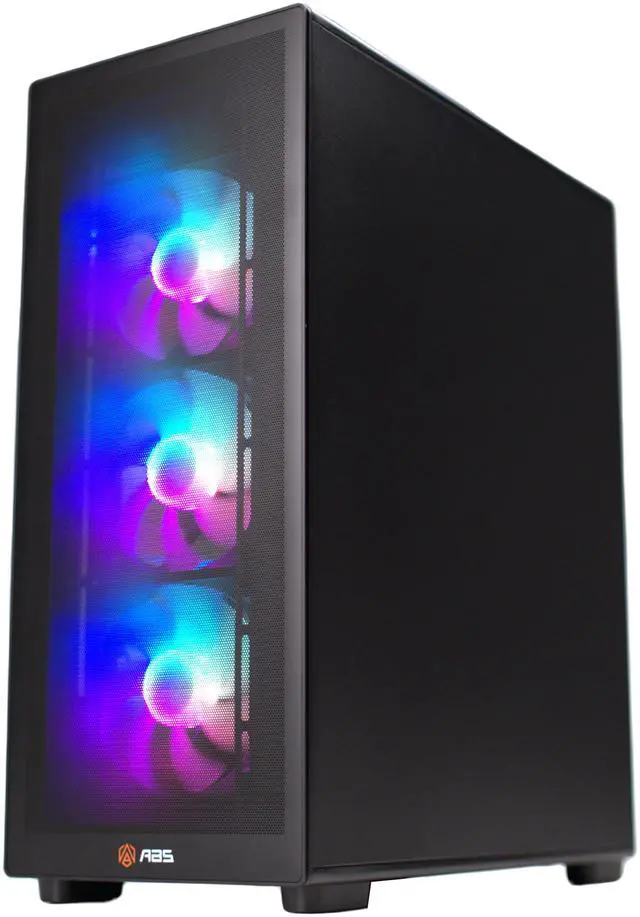
The ABS Stratos II Ruby with the Ryzen 7 9800X3D and RTX 5070 Ti is the configuration I would pick if my library is split between demanding single-player releases and games I want running very fast. The 5070 Ti is 8,960 CUDA cores with 16GB of GDDR7 on a 256-bit bus at 300W — enough for 1440p at high settings and capable at 4K with upscaling.
The same 96MB-cache processor sits behind it, with DDR5-6000, 2TB of M.2 storage, an 850W supply and a 240mm liquid cooler on an ASRock B850M board. The memory speed is the detail worth noticing: DDR5-6000 is the range this platform tends to run well, rather than the highest number available.
Scenario Three: Playing and Making Things
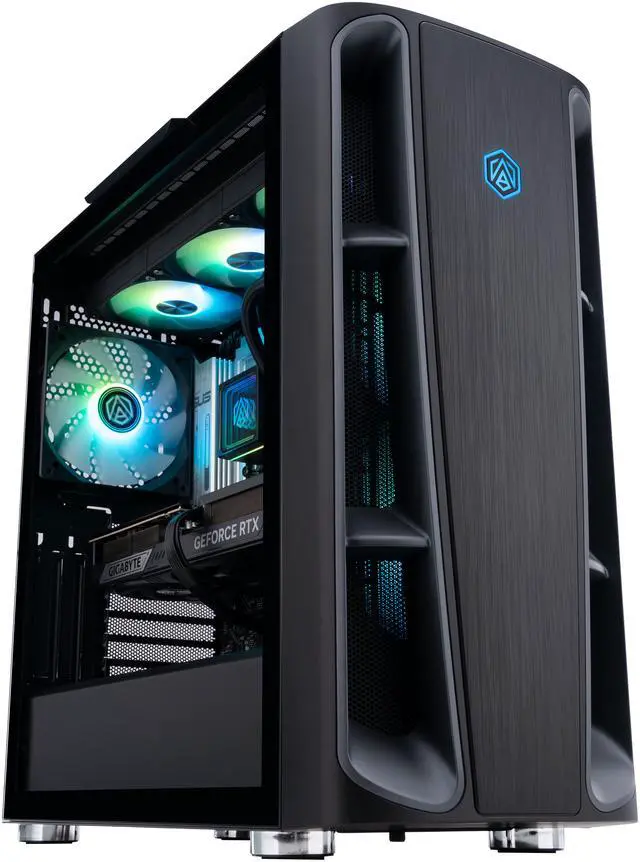
The ABS Kaze II Aqua with the Core Ultra 7 270K Plus and RTX 5070 Ti takes a different position. Instead of eight cores with a huge cache, it gives you twenty-four cores at up to 5.5GHz with 36MB of L3 on Socket FCLGA1851, cooled by a 360mm all-in-one and fed by an 850W supply, with 32GB of DDR5-6400 and 2TB of NVMe storage on a GIGABYTE Z890 board.
For gaming alone, I would take the 9800X3D. For a machine that also renders, encodes, compiles or runs a stream while you play, the wide core count and the newer platform are the better long-term bet. This is a genuine fork in the road rather than a better-and-worse comparison.
What I Would Actually Buy
For most people reading this, the 5070 Ti build is the right answer. It has the 16GB of video memory and the large cache that matter for this kind of game, 2TB of storage so the install fits, and it does not spend heavily on 4K headroom that a 1440p monitor cannot use. Move up to the 5080 machine if you already game at 4K. Move sideways to the 24-core build if the PC does real work as well as play.
And there is no rush. The PC version is not announced, let alone dated, and hardware bought early is simply older when the game arrives. Buy for what is on your drive today. The rest of the range is on Newegg’s ABS gaming desktop listings.
Frequently Asked Questions
How much video memory should a PC have for upcoming AAA games? 16GB is what I would aim for on a 1440p or 4K machine. The PlayStation 5 and Xbox Series X each carry 16GB of unified memory shared between CPU and GPU, and large ports tend to reflect the memory budget developers had. 12GB is workable at 1440p, and 8GB is where compromises start showing up first.
Does a large CPU cache help in open-world games? It tends to, because dense traffic, crowds and long draw distances repeatedly touch a large working set. Processors with AMD’s 3D V-Cache carry 96MB of L3 against roughly 30MB to 36MB on comparable parts, and the benefit usually appears in frame consistency rather than in the average figure.
Is a Ryzen 7 9800X3D better than a 24-core Intel processor for gaming? For gaming specifically, the 9800X3D’s large cache generally gives it the advantage despite having eight cores. For mixed workloads that also involve encoding, rendering or compiling, a 24-core processor does more total work. Which is better depends entirely on what the machine spends its time doing.
How much storage do I need for a modern AAA install? 2TB is the number I would plan for if you keep several large games installed at once. Rockstar’s recent open-world titles have been among the largest installs on PC, and a 1TB drive shared with an operating system fills quickly. Most of these boards have a second M.2 slot if you prefer to add a drive later.
Is GTA 6 confirmed for PC? No. The game is scheduled for 19 November 2026 on PlayStation 5 and Xbox Series X and Series S, and as of September 2026 no Windows version has been announced or dated. Rockstar has released previous titles on PC after their console launches, but nothing about GTA 6 on PC has been confirmed.
Read More
- Wikipedia: Grand Theft Auto VI — Current record of announced platforms, release date and PC status.
- Tom’s Hardware: Best CPUs for Gaming — Independent testing that separates gaming performance from multithreaded throughput.
- GamersNexus — Component testing with a focus on thermals, power and frame consistency rather than averages alone.
- NVIDIA: GeForce RTX 50 Series — Official specifications and feature overview for the graphics cards in these builds.
- Newegg: ABS Gaming Desktops — Compare video memory, cache and storage across the current lineup.