
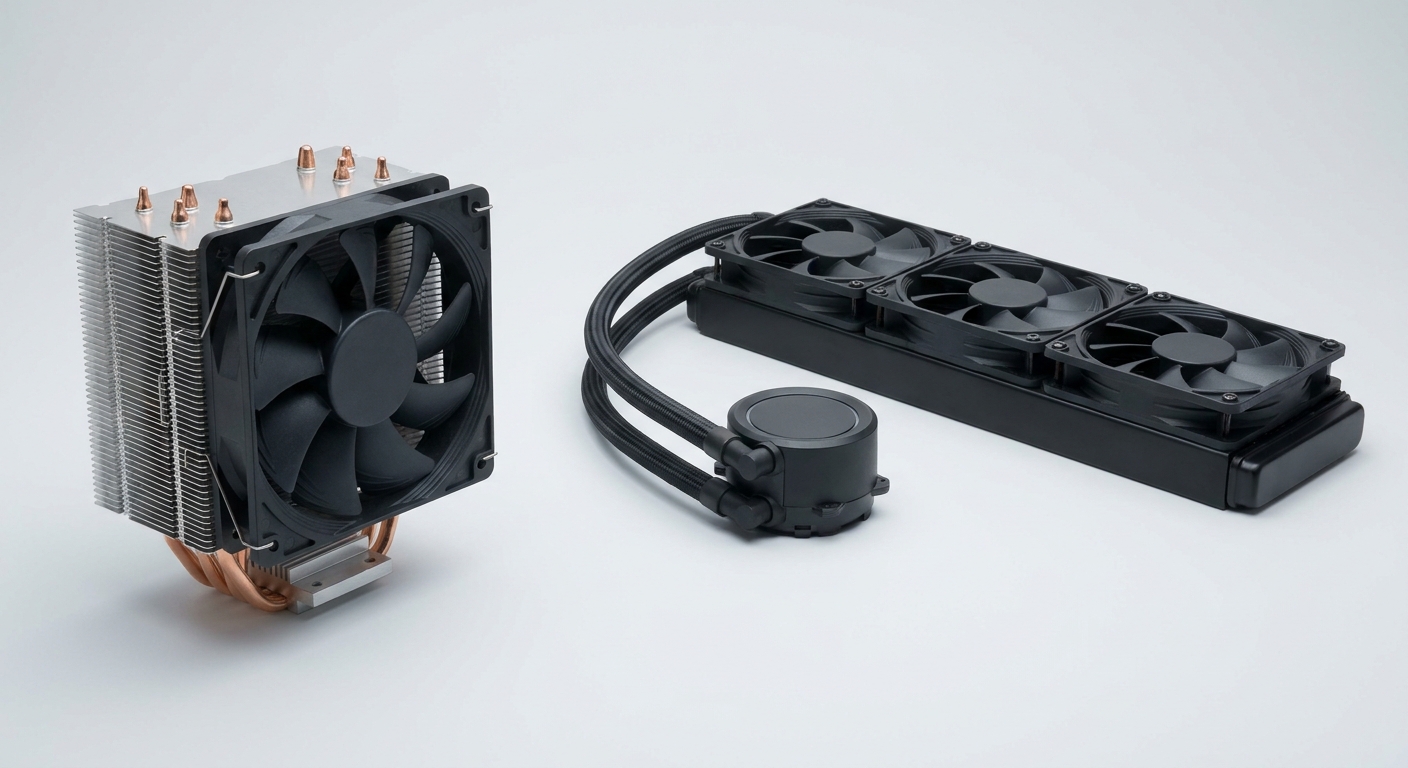
Cooler shopping goes wrong in a specific way. People read a thermal comparison, buy the winner, and then find out the tower fouls their memory or the radiator does not fit the case they already own. The performance difference between a good air cooler and a good 360mm radiator is real but modest. The fit difference is absolute.
So I have sorted these eight by situation rather than by temperature, because the situation is what actually decides.
Before Anything Else: Two Numbers
Your case lists a maximum CPU cooler height and a list of radiator sizes it accepts. Find both, write them down, and only then look at coolers. Every tower here sits between 154mm and 161mm, which is tall enough to be a problem in compact cases and fine in most mid-towers.
The second thing to check is your processor. A 65W chip and a 200W chip are different problems, and paying for a 360mm radiator to cool a 65W part is a waste of a good radiator.
Scenario One: A Normal Build, and You Want Quiet
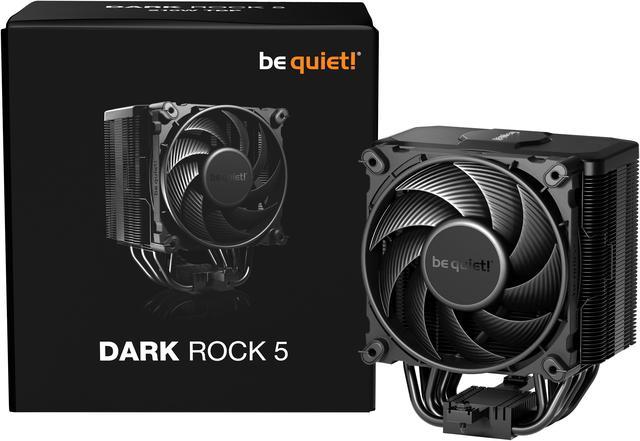
The be quiet! Dark Rock 5 is the one I would put in most machines. A 120mm Silent Wings 4 PWM fan on a fluid dynamic bearing, 2100 RPM, 29.8 dBA at maximum, an aluminium heatsink, a 210W rating and a 161mm height. Socket support runs from AM4 and AM5 through Intel LGA 1155 up to 1851.
That 29.8 dBA figure is the whole pitch. It is a cooler you stop hearing, which is worth more day to day than two degrees on a benchmark chart.
If you need a little more headroom, the be quiet! Pure Rock Pro 3 is rated to 250W with a rifle-bearing 120mm fan at 2000 RPM, a 155 x 124 x 114mm heatsink and a 155mm height. It is louder at 34.8 dBA maximum, which is the trade for the extra capacity.
Scenario Two: A Budget Build, or a 65W Processor
The be quiet! Pure Rock 3 Black is the honest answer here: a 190W rating, a 120mm rifle-bearing fan at up to 2000 RPM, 31.2 dBA maximum, an aluminium and copper heatsink at 154 x 124 x 46mm, and the same broad socket coverage. At 154mm it is also the shortest tower on this list by a hair.
A 190W rating is comfortably more than a 65W or 120W processor will ask for, which means the fan spends most of its life well below its maximum speed. That is where quiet actually comes from.
Scenario Three: An AMD Build With Room to Spare
The Cooler Master V8 ACE 3DHP is the unusual one: a dual-fan air cooler built specifically for AMD, with socket support listed only for AM4 and AM5. Two 120mm PWM fans on a loop dynamic bearing spinning from zero up to around 2050 RPM, with a 34 dB(A) rating and patented 3D heat pipes.
Check your memory clearance before ordering a dual-fan tower. The front fan is the one that usually collides with tall RGB modules, and moving it upward costs you some performance.
Scenario Four: A 200W Processor, or You Just Want the Radiator
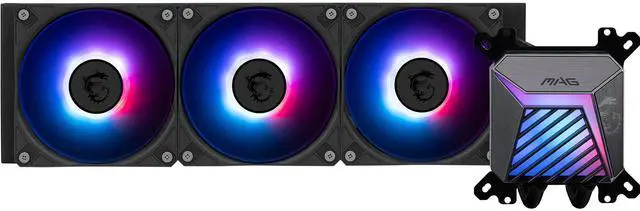
The MSI MAG Coreliquid A15 360 is my default 360mm pick. An aluminium radiator with three 120mm ARGB PWM fans rated at 64.89 CFM on rifle bearings, a 3400 RPM pump quoted at 20 dBA maximum, and block support for AM4, AM5, LGA 1700 and LGA 1851. The fans use a 5V ARGB 3-pin header, so check your board has one free.
If you want the radiator and a screen on top of it, the GAMDIAS CHIONE P5-360 adds a 3.4-inch customisable IPS panel on a rotatable magnetic pump, with a 396 x 120 x 27mm radiator, three 120mm hydraulic-bearing fans running 400 to 2200 RPM at up to 81.81 CFM, 11 to 34.91 dBA, a 2700 RPM pump and EPDM tubing. Its socket list is long and reaches back through several AMD generations.
Scenario Five: A Mid-Tower That Only Takes 240mm
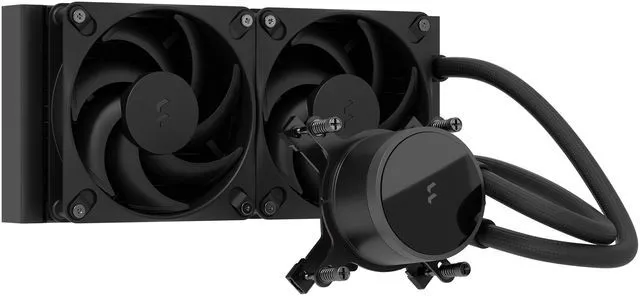
The Fractal Design Radius 240 is the 240mm cooler I would buy. A copper cold plate, a ceramic-bearing pump at 3400 RPM rated between 12 and 28 dBA, two 120mm rifle-bearing fans running from about 350 to 2200 RPM at 63.9 CFM, EPDM tubing, and support for AM4, AM5 and Intel LGA 115X through 18XX.
The Cooler Master Elite Liquid 240 is the simpler alternative: a dual-chamber pump at 3200 RPM under 25 dBA, a 277 x 119.6 x 27mm aluminium radiator and two ARGB PWM fans, with support from LGA 1150 through 1851 and AM4 and AM5. Note that radiator length — 277mm is longer than the nominal 240 and some cases are tight.
What I Would Actually Do
Measure first. Then: 65W to 120W processor in a normal case, Dark Rock 5, or Pure Rock 3 Black if you are counting every dollar. 200W processor, Coreliquid A15 360. Case that only takes 240mm, Radius 240. AMD build with clearance and a taste for air, V8 ACE 3DHP. Want the screen, CHIONE P5-360.
One last thing worth saying: the stock paste on most of these is fine. Replacing it on day one is a hobby, not a fix. Browse the current range in Newegg’s AIO liquid cooler listings.
Frequently Asked Questions
Is an AIO liquid cooler better than a good air cooler? For high-power processors under sustained load, a 360mm radiator has more capacity and usually runs quieter at the same temperature. For a 65W or 120W chip, a good air tower matches it closely and has fewer failure points. The bigger practical differences are clearance around the memory and whether your case can take the radiator at all.
What CPU cooler height will fit my case? Case specifications list a maximum CPU cooler height, and the towers here range from 154mm on the Pure Rock 3 Black to 161mm on the Dark Rock 5. Compare those numbers directly and leave a couple of millimetres of margin, because side panels are not always as flat inside as they look.
Does a 360mm radiator always beat a 240mm one? It has more surface area, so it can either run cooler at the same fan speed or the same temperature at a lower fan speed. On a modest processor that headroom goes unused and the two perform much alike. The 360mm option earns its place on high-power chips or in builds where quiet is the priority.
Do I need to worry about memory clearance? With dual-fan air coolers, yes. The front fan hangs over the memory slots and tall heat spreaders can prevent it from sitting at its intended height. Either check the cooler’s stated memory clearance against your module height, or choose lower-profile memory. Liquid coolers avoid this entirely, which is one of their quieter advantages.
How long does an AIO cooler last? Pumps are the wear item and most are specified for many years of continuous use, with the coolers here quoting pump speeds between 2700 and 3400 RPM. In practice, an AIO is the part of a build I would expect to replace before the processor rather than after it, which is worth factoring in if you plan to keep a system for a very long time.
Read More
- GamersNexus: CPU Cooler Megacharts — Standardised thermal and noise testing across air and liquid coolers on the same bench.
- Tom’s Hardware: Best CPU Coolers — Reviews covering mounting hardware, clearance and acoustics as well as temperature.
- be quiet!: CPU Coolers — Official specifications for the Dark Rock and Pure Rock families, including TDP ratings and heights.
- Fractal Design: Water Cooling — Manufacturer details for the Radius series, including pump bearing and radiator dimensions.
- Newegg: AIO Liquid Coolers — Filter by radiator size, socket support, fan count and pump specification.