
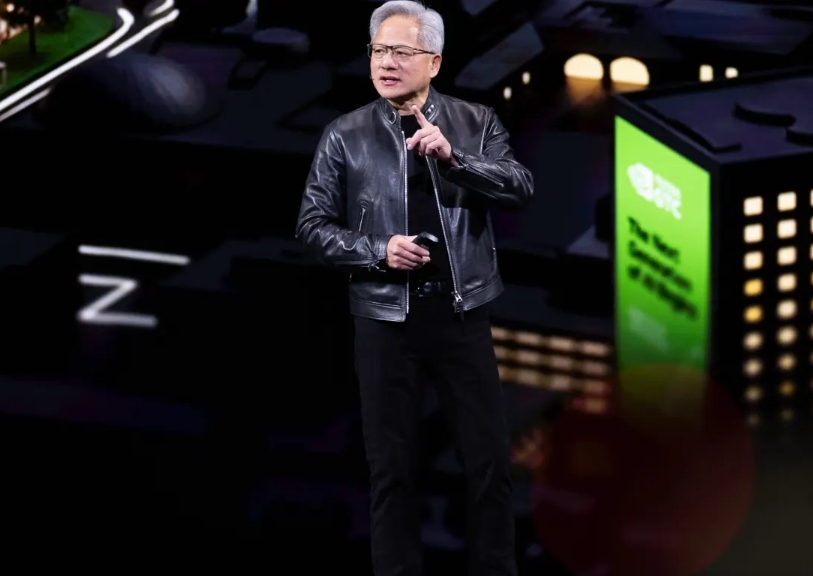
I’ll be honest with you — every year I tell myself GTC is going to be more of the same. Big numbers. Dense slides. Jensen Huang holding up a chip like it’s the One Ring. And every year I’m wrong.
GTC 2026 was two hours and change of announcements that genuinely changed how I’m thinking about what to buy, what to build, and what’s coming down the pipeline for the rest of this decade. If you missed the livestream — or you watched it and felt like you needed a decoder ring — this is for you.
I’m splitting this into three parts. Part 1 is about the hardware. It’s about chips and racks and roadmaps. And it starts, unexpectedly, with a birthday.
Twenty-Five Years of GeForce, Twenty Years of CUDA
Huang opened with history, and if you’re a Newegg regular, this part was for you more than anyone else in that stadium.
He reminded the room that twenty-five years ago, NVIDIA invented the programmable shader — the technology that made real-time 3D graphics look the way they do. Every game you’ve played on a GeForce card, every frame you’ve ever rendered, runs on the foundation that moment created. Five years after that, NVIDIA took the money it made from GeForce and made an enormous bet on CUDA — a programming framework that let developers use GPU cores for general-purpose computing, not just graphics.
“This is the house that GeForce made,” he said, holding up an old GTX 1080 box. The room understood exactly what he meant.
Here’s why that history lesson matters in 2026: The billions in revenue from selling GeForce cards to gamers funded CUDA. CUDA attracted developers. Those developers built deep learning frameworks. Those frameworks trained AI models. Those AI models created the data center boom that is now funding Vera Rubin, Groq, NemoClaw, and everything else Huang announced on Monday. The GeForce cards on Newegg today are the latest point in a straight line that started with a pixel shader in 2001.
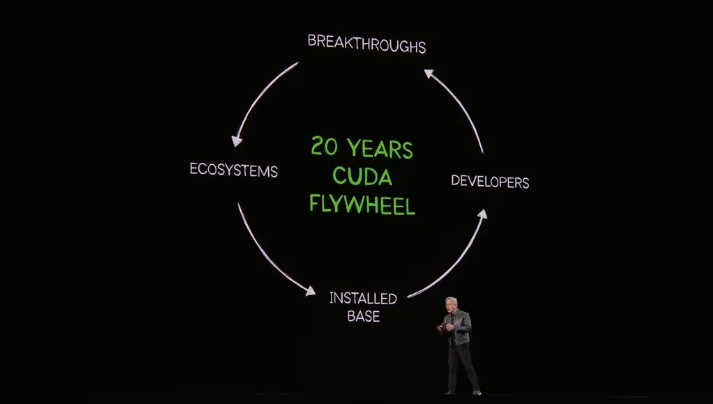
He also showed the CUDA flywheel — a slide he says represents “100% of NVIDIA’s strategy.” Install base attracts developers. Developers create breakthroughs. Breakthroughs create new markets. New markets expand the install base. The flywheel accelerates. And because NVIDIA supports every GPU architecturally across generations, even a six-year-old Ampere card is getting better over time as new software optimizations ship. Huang pointed out that cloud rental prices for Ampere cards have actually gone up over time, because the software stack running on them keeps improving.
For anyone who bought an RTX 50 Series GPU at Newegg recently, or is thinking about it: you’re buying into a platform with twenty years of software momentum behind it. That’s not marketing. That’s the flywheel Huang showed on a chart.
DLSS 5: Neural Rendering Is Here, and It Came Earlier Than Expected
About thirty minutes in, Huang dropped the announcement that most directly affects everyone reading this.
DLSS 5. First public demo. New name for a genuinely different approach to rendering.
Here’s the context: previous DLSS versions worked by upscaling lower-resolution frames or generating interpolated frames between rendered ones. DLSS 5 is something architecturally different. Huang called it “3D-Guided Neural Rendering” — combining the structured 3D data that game engines produce (geometry, depth, lighting) with generative AI to synthesize pixel-level detail. The game engine provides the structure and physics. The AI provides the visual fidelity.
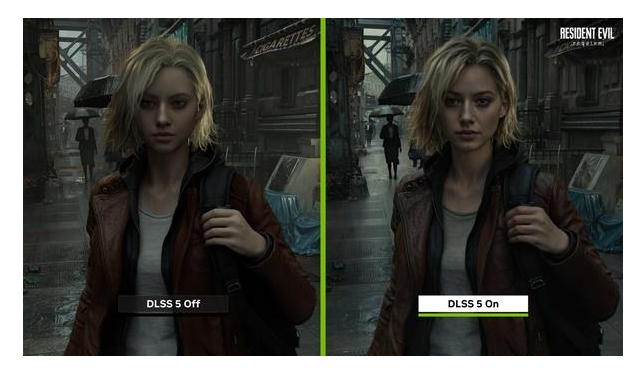
“Combining 3D graphics with generative AI, controlled through structured data,” Huang said. “Resulting in content that’s beautiful and controllable. Computer graphics come to life.”
The demo showed Resident Evil: Requiem, EA Sports FC 26, Starfield, and Hogwarts Legacy with DLSS 5 enabled. On stage, the improvements were visible. Some titles looked exceptional. A few looked slightly more stylized than their DLSS 4 counterparts — more painterly, less photorealistic. Online reactions ranged from “this is the future” to “it looks like a Snapchat filter.” My honest take: every version of DLSS has looked rough at GTC and significantly better when it ships in production drivers. I’m not judging on stadium-screen clips.
The practical takeaway: DLSS 5 ships as a driver update to existing RTX 50 Series cards. You don’t need new hardware. The GPU you buy today is the GPU that receives it.
The more immediate update: DLSS 4.5 Dynamic Multi Frame Generation — the feature that was conspicuously absent from the RTX 50 launch — hits beta driver on March 31st. If you’ve been waiting on that before buying, the wait is almost over. Check Newegg’s RTX 50 Series gaming laptops and desktop GPU lineup — these are the cards receiving that update in two weeks.
And a reminder I’ll keep making until people listen: neural rendering and frame generation don’t show up on a 60Hz display. You need a high-refresh panel to see what these technologies actually do. Newegg’s gaming monitor section has 1440p 165Hz options starting around $250. That’s where the visual payoff actually lives.
The Three Breakthroughs That Created This Moment
Before getting into the trillion-dollar infrastructure story, Huang named three specific events he says changed the trajectory of AI over the past two years. These matter because they explain why token demand has exploded and why the hardware story of GTC 2026 is as large as it is.
1. ChatGPT (late 2022): Moved AI from “retrieval” to “generation.” Computing went from looking things up to synthesizing new content. That shift changed computer architecture requirements fundamentally.
2. Reasoning AI — o1 and its successors: Gave AI the ability to self-reflect, plan, and decompose problems. “o1 made generative AI trustworthy,” Huang said. The catch: reasoning requires far more input tokens (context) and output tokens (thinking), which means far more compute per query. Every step up in reasoning capability is a multiplier on GPU demand.
3. Claude Code — the first agentic model: “It reads files, writes code, compiles, tests, evaluates, iterates.” Huang said 100% of NVIDIA’s engineers use Claude Code, Codex, or Cursor. The shift from “AI that answers questions” to “AI that does the work” is the current frontier — and it’s where token consumption goes exponential.
“Over the past two years, the compute required for reasoning has increased about 10,000 times. Usage has increased 100 times. Combined, computing demand has increased 1 million times.” That sentence is what the rest of the keynote was built to justify.
Everyone Should Use ChatGPT Every Day (He Actually Said It)
I want to flag this moment because it got less attention than it deserved.
Huang told the room: “Everyone should be using ChatGPT every day. I use it every morning.”
Jensen Huang — whose company makes the chips that power ChatGPT and its competitors at Google, Anthropic, and Meta — publicly told a crowd of 30,000 to use OpenAI’s product by name. Not “an AI assistant.” Not “these tools.” ChatGPT.
The interpretation I landed on: NVIDIA doesn’t care which AI model wins. They need GPUs to run them all. Huang recommending ChatGPT is like a power company recommending a specific appliance brand — the electrons flow regardless.
It was also a signal about how Huang thinks about his audience. He’s talking to people who build with AI, invest in it, and use it. He wants them using all of it, every day, because every interaction is a token, every token is compute, and every compute need eventually flows through an NVIDIA GPU.
$1 Trillion Through 2027 — and He Thinks It’s Conservative
The second half of Part 1 was the enterprise infrastructure argument. I’ll give you the short version because Part 2 covers the hardware in detail.
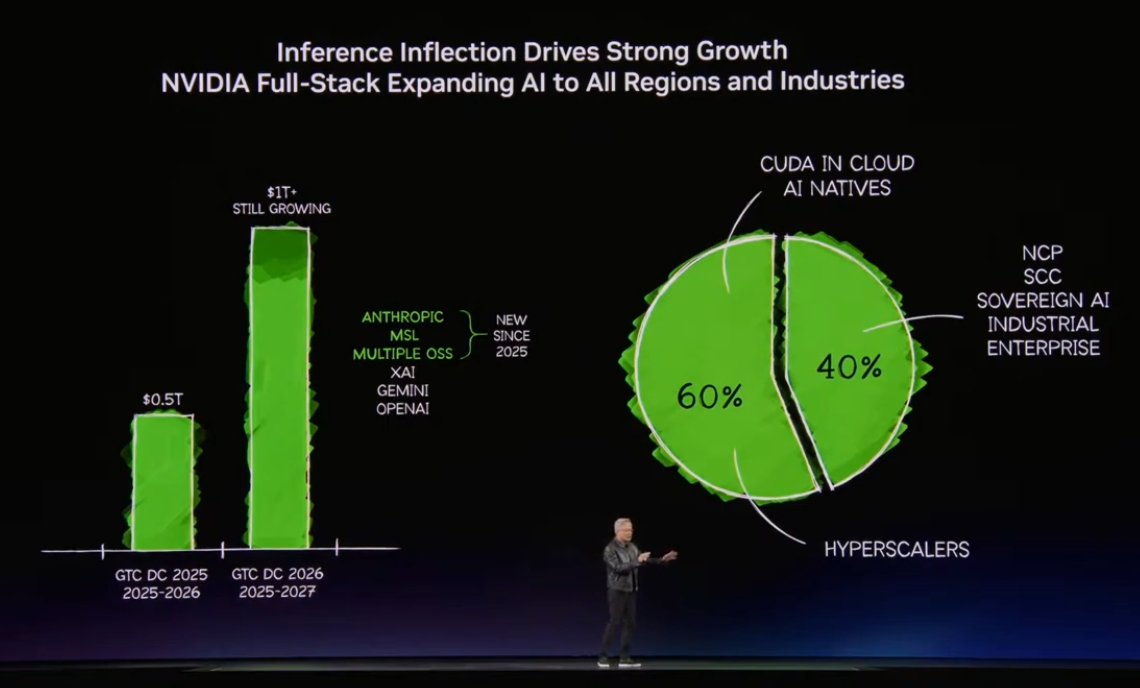
“Last year I said $500 billion in high-confidence demand through 2026. Today I see at least $1 trillion through 2027.”
Then he added: “I’m certain the actual demand will be much higher than this.”
The economic argument is what he calls Token Factory Economics. Data centers used to store files. Now they manufacture tokens. Every data center, every AI factory, is constrained by power — you can’t exceed a 1 gigawatt facility’s power budget. In a fixed-power environment, whoever produces the most tokens per watt wins on cost. “Your throughput and token generation speed,” Huang said, “will directly translate to your exact revenue next year.”
Tokens will be priced in tiers: free (high throughput, lower speed), through to ultra-high-speed at ~$150 per million tokens. The competitive moat is cost per token — and Huang cited independent analysis showing NVIDIA is currently the lowest-cost provider, by a significant margin.
NVIDIA’s 60% hyperscaler / 40% everything else breakdown tells you where the money is coming from. The 40% — sovereign clouds, enterprise, robotics, edge — is where growth comes from next.
For consumer PC builders: that $1 trillion is the ecosystem you’re buying into. Browse gaming desktops with RTX hardware at Newegg and you’re buying the consumer expression of the most heavily funded hardware platform in computing history.
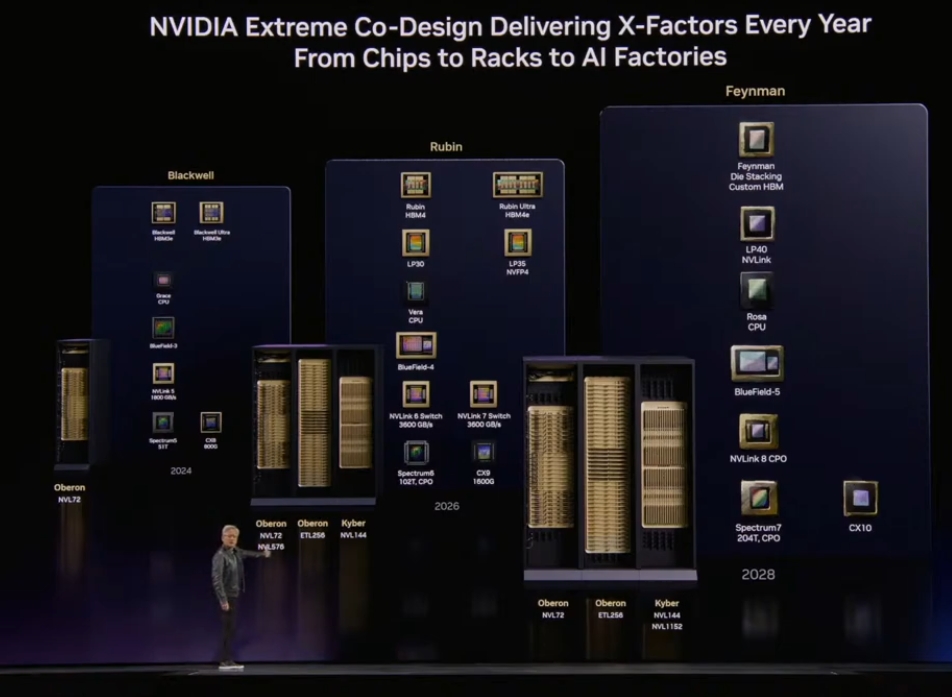
Part 2: Vera Rubin, the Groq integration, and why “350x in two years” isn’t marketing copy. Plus the roadmap . On Newegg Insider.
Related Posts
- NVIDIA GTC 2026, Part 3: The OpenClaw Revolution, Self-Driving Ubers, and Jensen’s Annual Tradition of the Perfect Finale
- Sales Tax Holiday 2026: Save on PC Components, Peripherals, Laptops, Desktops, and Workstations at Newegg
- Apple Intelligence Features at WWDC 2026: The New Siri, Photo Editing, and What Your Device Needs
- Apple Parental Controls at WWDC 2026: The New Child Account Tools Explained
- iOS 27 Performance Boost: Every Speed and Design Change Apple Showed at WWDC 2026