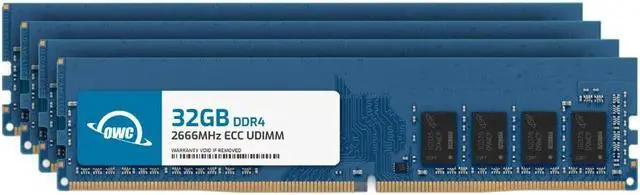
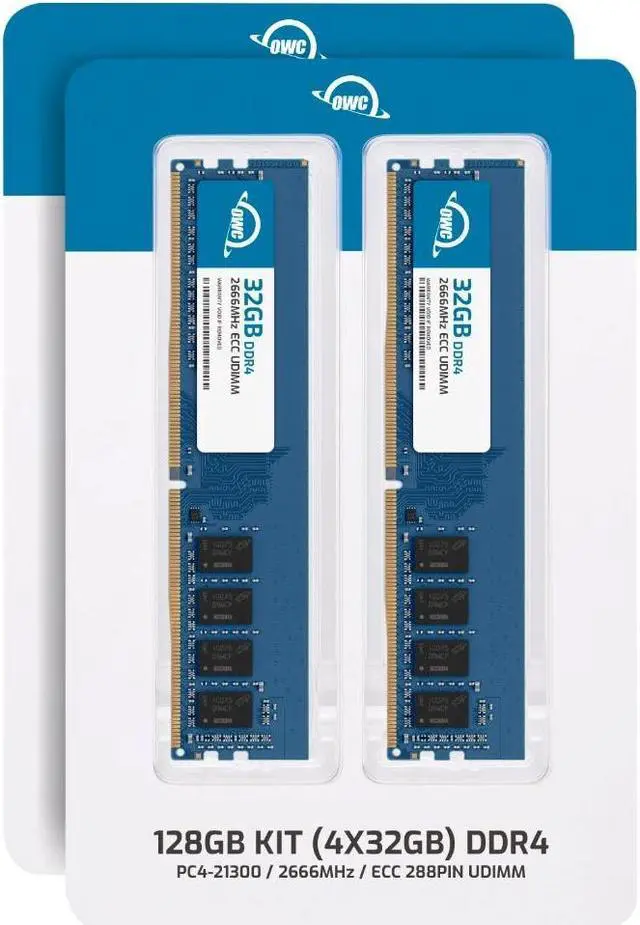
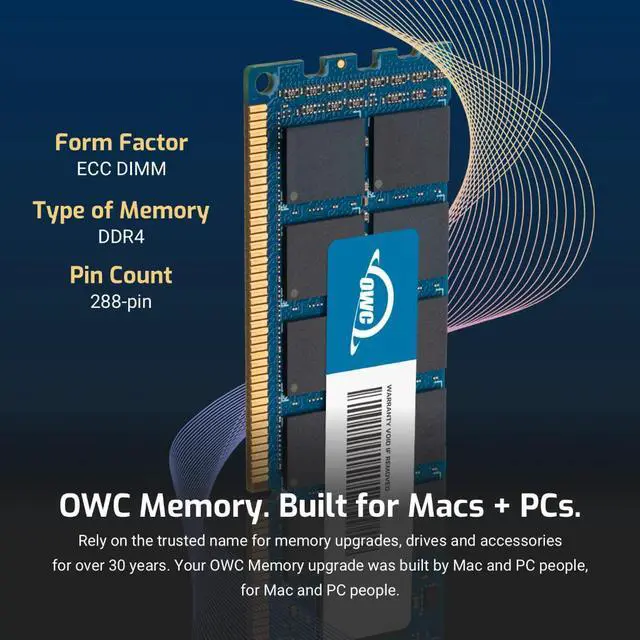
The OWC 128GB DDR4-2666 ECC unbuffered memory kit includes four 32GB modules for workstations, servers, and NAS systems that support this memory type and configuration.
Recommended For
- DIY TrueNAS or ZFS NAS builders who run storage services, apps, or virtual machines and need a 128GB ECC UDIMM kit; ECC only works if the CPU and motherboard support it.
- Workstation users running memory-heavy workloads—such as large project files, data processing, or multiple demanding applications—whose DDR4 platform supports 128GB across four 32GB ECC unbuffered DIMMs.
- Home-lab operators hosting several virtual machines or services on a compatible DDR4 workstation or entry-server board, where 128GB capacity and ECC error correction match the workload.
- Owners of an existing DDR4 workstation, server, or NAS that uses ECC unbuffered DIMMs and can accept four 32GB modules at up to 2666MHz, who want a matched 128GB upgrade kit.
Real-World Use Scenarios
- On an ECC-capable workstation handling very large 3D scenes, detailed models, or high-resolution textures, the added memory capacity can help keep more of the active project in memory and reduce slowdowns caused by running short of RAM; CPU, GPU, and storage still affect performance.
- For a small virtualization host, the 128GB kit can provide more physical memory to divide among several virtual machines and the host system, helping avoid memory contention when their combined workloads are active; the usable amount depends on the host platform and VM allocations.
- In a TrueNAS or other ZFS-based NAS serving frequently accessed files, additional RAM gives the system more room for its in-memory read cache and services, which may reduce repeated reads from slower storage when the active data is cacheable.
- For a NAS or home-lab server running storage services alongside plugins, containers, or virtual machines, the extra capacity can give those workloads more memory to share, reducing the need to compete for a smaller RAM pool during busy periods.
- For a ZFS system using deduplication, the available RAM can support a larger in-memory deduplication table, but the required memory depends on how much data is deduplicated; 128GB should not be assumed sufficient for every pool.




 here!