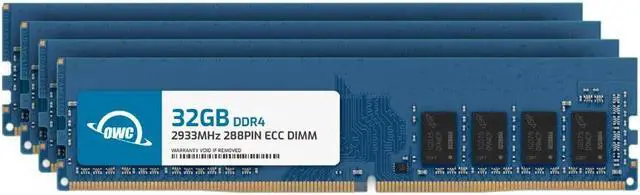
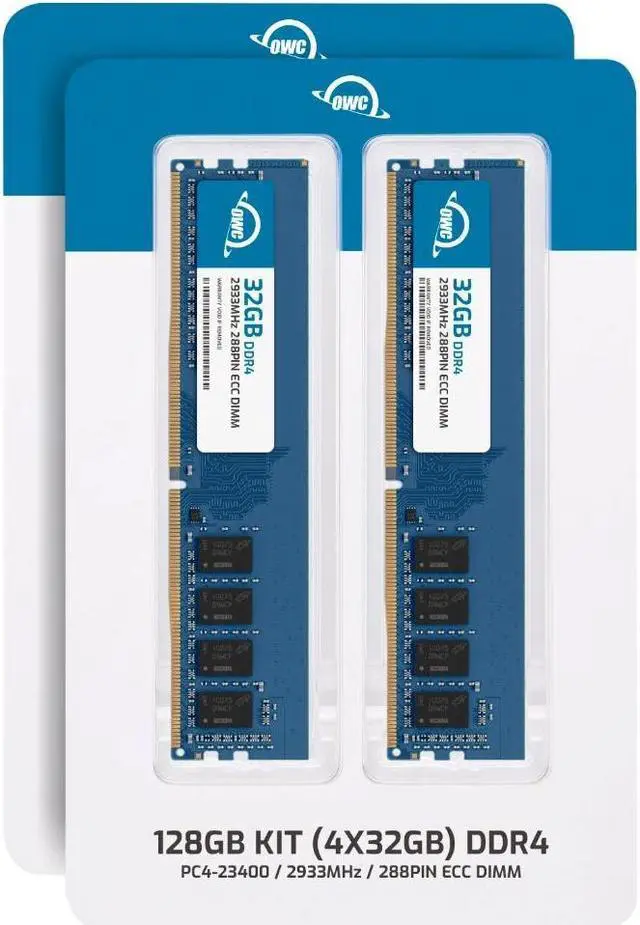
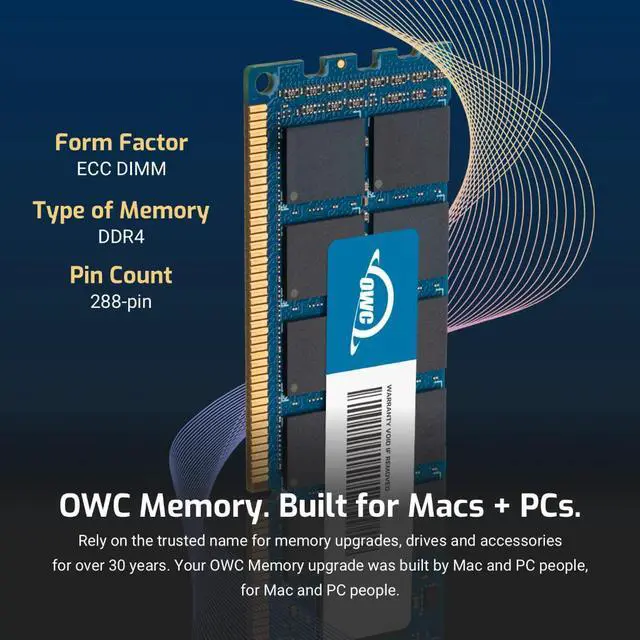
OWC’s 128GB DDR4-2933 ECC unbuffered memory kit includes four 32GB modules for compatible workstations, servers, and NAS systems that support 288-pin ECC UDIMMs.
Recommended For
- Workstation users running memory-intensive projects—such as large datasets, 3D or engineering workloads, or several virtual machines—who need 128GB of DDR4 ECC memory and have a platform that supports ECC UDIMMs. ECC support depends on the compatible processor and motherboard or chipset.
- Home-lab and NAS builders running data or virtualization services who want a 128GB ECC memory kit and whose system specifically supports DDR4 ECC UDIMMs. Community discussion reflects interest in ECC for NAS use, while noting that it is not a requirement for every home server.
- Small-server or workstation owners whose system specifies unbuffered ECC DIMMs rather than registered memory and can use four 32GB modules. The kit is not a substitute for RDIMMs in platforms that require registered memory.
- Owners upgrading a compatible DDR4 workstation, server, or NAS that needs a matched four-module 128GB kit at up to 2933 MT/s. Check the system’s memory limits and supported speed before buying.
Real-World Use Scenarios
- On a compatible ECC UDIMM workstation or server, assigning memory to several virtual machines lets a user run more test environments or services at once before the host has to reclaim memory or rely on disk swapping; the CPU and storage still determine overall performance.
- For a homelab host running a NAS alongside containers and other always-on services, the additional memory provides room for those workloads to share one system; it is most useful when the services actually use the capacity, rather than for basic file sharing alone.
- In a compatible ZFS NAS or storage server, extra memory can give the system more room for caching and memory-intensive services; the practical benefit depends on the storage workload and configuration, and ECC requires support from the system’s CPU and motherboard.
- For workstation tasks that keep large working sets in memory, such as handling several sizable projects or datasets at once, the larger capacity can reduce the need to close applications or move data out of memory; it does not by itself make CPU- or GPU-limited work faster.




 here!