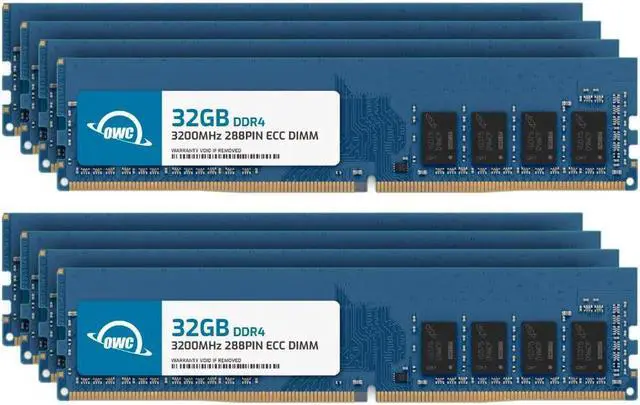
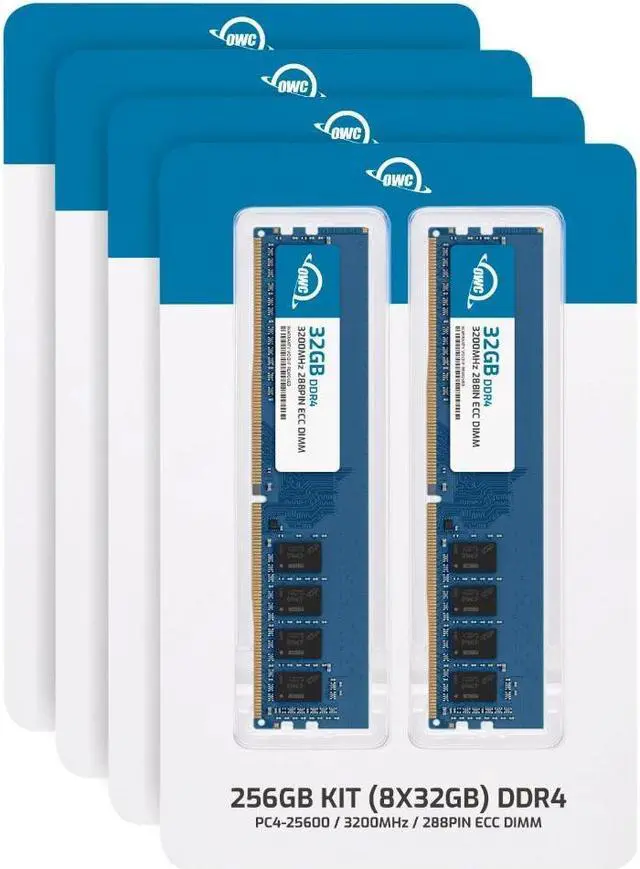
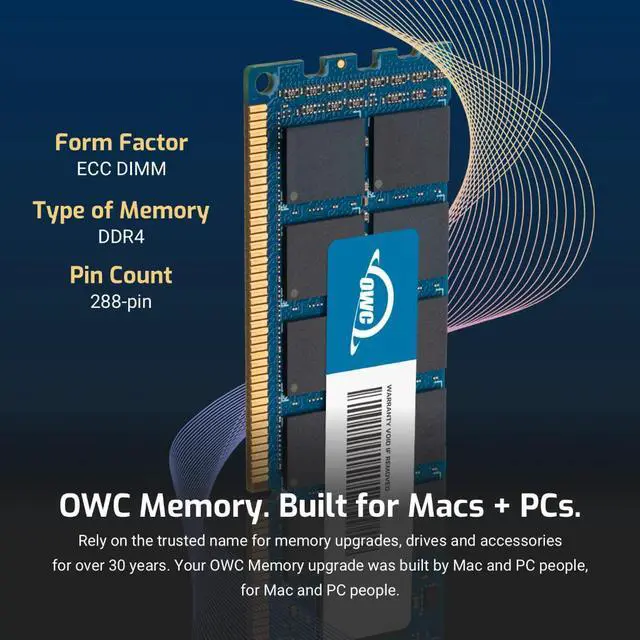
The OWC 256GB DDR4-3200 ECC Unbuffered UDIMM kit includes eight 32GB modules for compatible workstations, servers, and NAS systems that need high memory capacity and error-correcting memory.
Recommended For
- Workstation users running memory-heavy professional workloads—such as large project files or several demanding applications at once—whose system supports 256GB of DDR4 ECC UDIMMs across eight slots.
- NAS and TrueNAS builders prioritizing ECC memory for a compatible system that supports unbuffered ECC DIMMs; confirm the motherboard and CPU support this kit’s capacity and module type.
- Server and homelab operators who need a large memory pool for multiple services or virtual machines and have a platform designed for eight 32GB ECC UDIMMs—not one that requires registered DIMMs.
Real-World Use Scenarios
- For a TrueNAS or other ZFS storage server holding important files, this ECC memory can help correct certain in-memory bit errors; the added capacity can also give ZFS more RAM for frequently accessed data. ECC operation depends on CPU and motherboard support.
- When a TrueNAS server also hosts virtual machines or serves VM storage over iSCSI, the extra memory can be assigned to guest systems and storage activity, helping reduce memory pressure when the existing configuration is a bottleneck.
- For demanding video-editing projects, such as high-resolution or RAW footage, 256GB can provide room for larger projects and more frames or data to stay in memory, reducing slowdowns caused by running short of RAM. The benefit depends on the project and the rest of the workstation.
- When analyzing a large dataset that can fit in system memory, a data-science workstation with this much RAM can keep more of the dataset available to the CPU instead of relying on slower out-of-core processing. Results depend on the dataset and software.
- For large VFX or compositing projects in Nuke, the added capacity can accommodate bigger projects and caches in memory, helping avoid slowdowns when a smaller configuration would otherwise overflow into virtual memory.