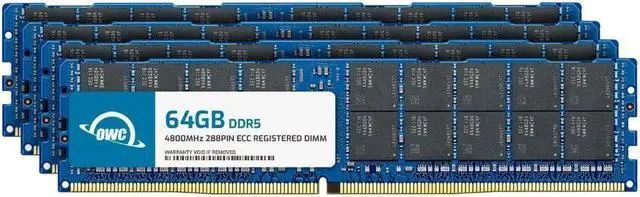
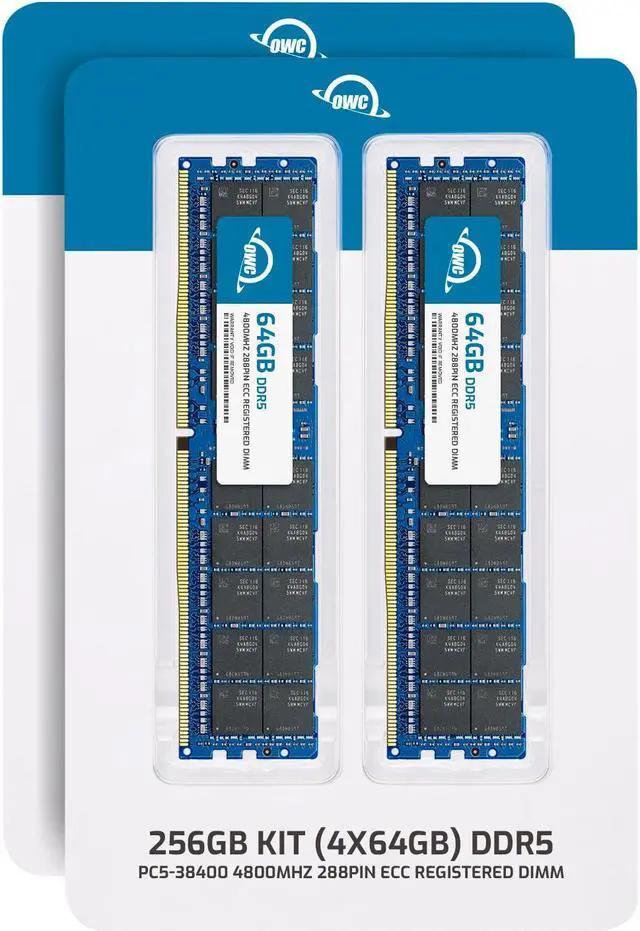
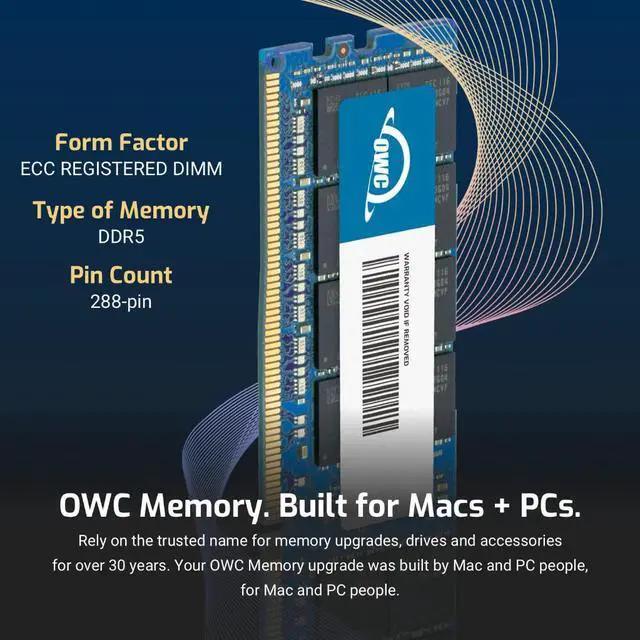
The OWC 256GB DDR5-4800 ECC Registered RDIMM kit includes four 64GB modules for upgrading compatible Dell PowerEdge C6600, C6620, MX760C, R660, or R6615 servers. It suits server administrators and builders needing high-capacity registered memory; it is intended for compatible server or workstation platforms, not standard desktops.
Recommended For
- IT administrators upgrading a listed Dell PowerEdge C6600, C6620, MX760C, R660, or R6615 who need a 256GB ECC registered memory kit for a server build or capacity expansion. Confirm the server’s CPU, memory population rules, and existing DIMMs before installing.
- Operators of virtualized Dell PowerEdge servers who want to add memory capacity for workloads such as hosting multiple virtual machines; Dell lists major hypervisors among the supported operating systems for the C6620 platform.
- Data-center teams maintaining dense or multi-node PowerEdge deployments who need server-grade registered ECC memory in four 64GB DIMMs, rather than desktop-style memory.
Real-World Use Scenarios
- When a compatible PowerEdge host is running out of memory for virtual machines, adding this kit can give the host more capacity for its VMs and reduce pressure to reclaim or swap memory, provided the server supports this configuration.
- For a database or analytics server whose working set is competing for RAM, the added capacity can leave more data available in memory and ease memory constraints; storage, CPU, and software configuration still affect query performance.
- In a virtual desktop environment, adding memory to a compatible server can help support more concurrent desktop sessions when host RAM is the limiting resource; the usable session count also depends on the applications and each desktop’s allocation.
- For containerized services sharing a compatible PowerEdge server, the extra RAM can provide more room for concurrent workloads and their in-memory data, if memory capacity is currently the bottleneck.
- For memory-intensive scientific or compute jobs on a compatible C6620, the added capacity can help accommodate larger in-memory datasets or more concurrent jobs, subject to the server’s supported memory layout and the workload’s CPU and I/O needs.