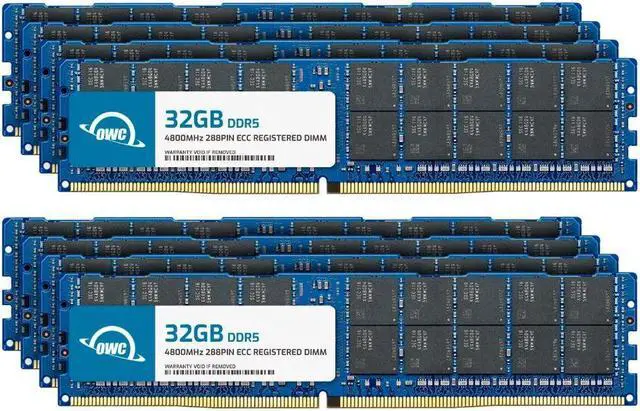
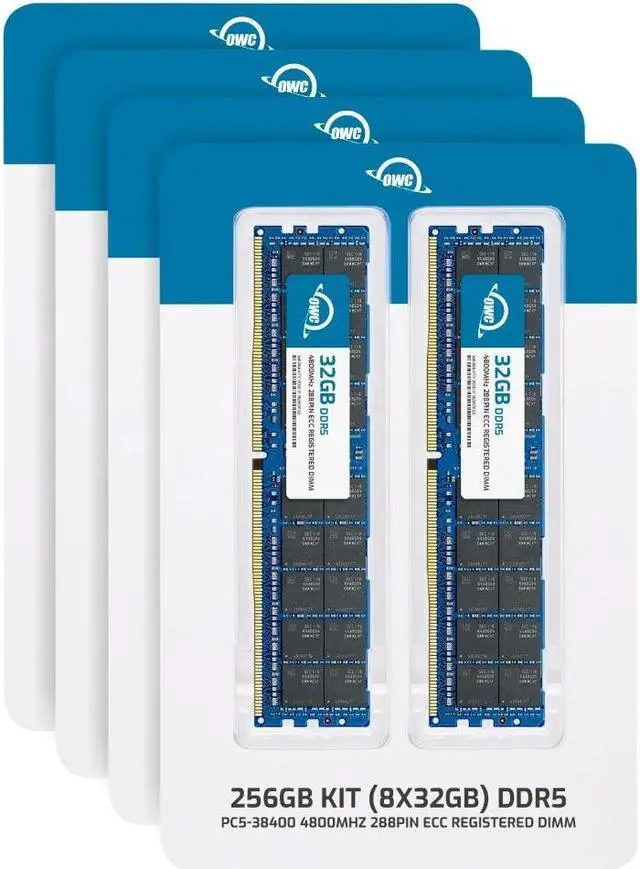
The OWC 256GB DDR5-4800 ECC Registered memory kit includes eight 32GB RDIMMs for PowerEdge R760xa, R860, and R960 servers, making it suitable for compatible server upgrades that need high-capacity error-correcting memory.
Recommended For
- PowerEdge R760xa, R860, or R960 administrators who need to add 256GB of DDR5 registered memory as an eight-DIMM upgrade.
- Virtualization and server administrators expanding memory capacity for workloads that need more RAM for virtual machines or concurrent services, provided the server and DIMM population support this kit.
- Operators of PowerEdge R760xa GPU servers who need additional system memory alongside GPU-accelerated workloads; this kit adds host RAM, not GPU memory.
- IT teams standardizing on compatible 32GB DDR5 RDIMMs for a server memory configuration that calls for eight modules, after checking processor limits and Dell’s slot-population rules.
Real-World Use Scenarios
- When a PowerEdge host is running out of memory for virtual machines, adding this kit can give the host more room for additional or larger VMs—provided memory, rather than CPU or storage, is the limiting resource.
- For GPU-backed AI inference or model-development work on an R760xa, the added system memory can provide more headroom for the operating system, data preparation, and supporting services; it does not increase GPU memory or guarantee faster model processing.
- When a server runs virtual desktops for employees, the extra capacity can help accommodate more desktop sessions or memory-heavy applications before the host reaches its RAM limit; actual user capacity depends on the workload and full server configuration.
- For a database or analytics server with a working set that fits in memory, adding RAM can leave more data available to the application and reduce pressure to retrieve it from storage; the benefit depends on the database and its memory settings.
- For render-farm or digital-twin workloads on an R760xa, the added memory can provide more room for scenes, data, and concurrent software tasks; it is most useful when those jobs are constrained by system RAM rather than GPU, CPU, or storage performance.




 here!