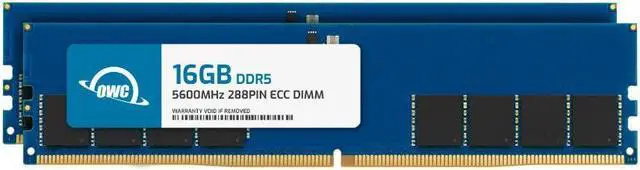
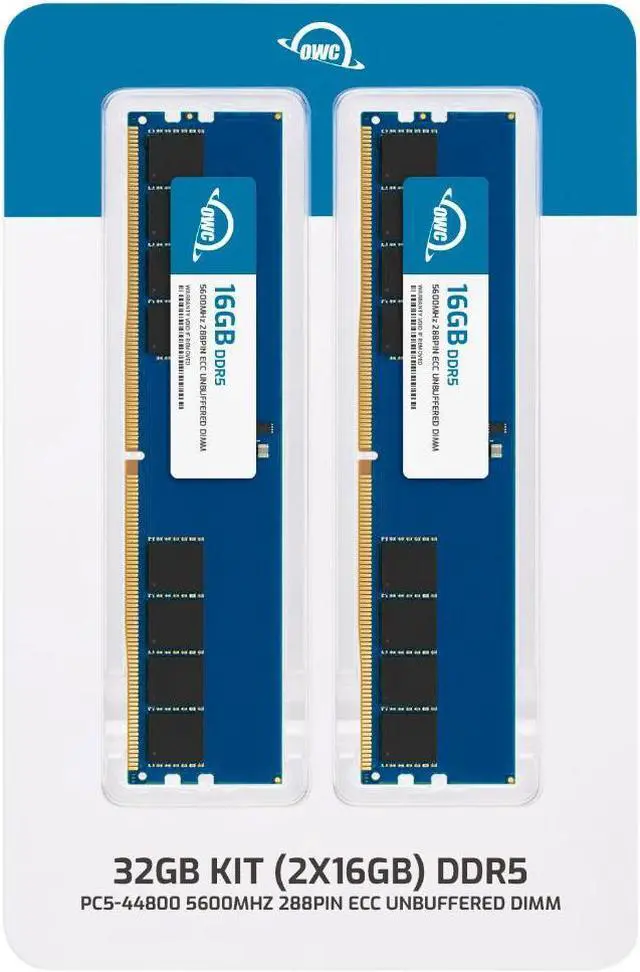
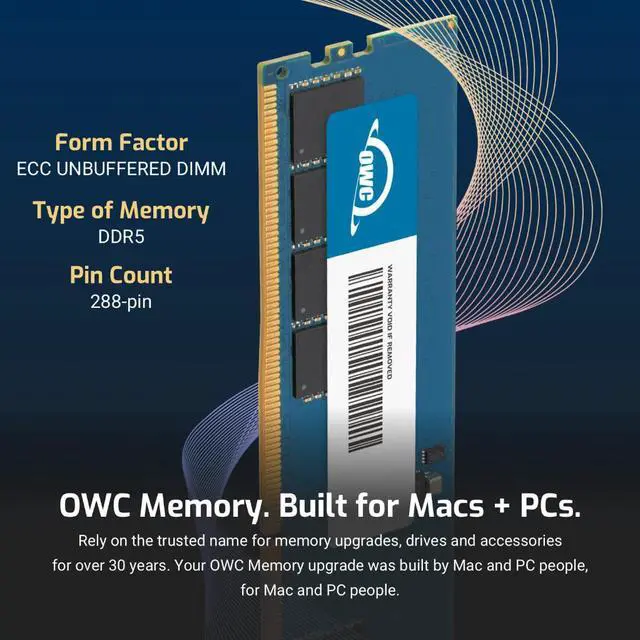
The OWC 32GB DDR5-5600 ECC Unbuffered UDIMM Kit includes two 16GB modules for select workstations, servers, and NAS systems that support this memory type and speed.
Recommended For
- NAS and home-server builders who run storage or virtualization workloads and want ECC memory, provided their CPU and motherboard support ECC UDIMMs.
- Workstation users running long or data-sensitive engineering, scientific, or financial workloads who prioritize memory error correction over gaming-oriented tuning; verify ECC support on the full system first.
- Owners of compatible 288-pin DDR5 ECC UDIMM workstations or servers who need a matched 2×16GB kit and whose platform supports operation at up to 5600 MT/s.
- Small-server or homelab builders who specifically need unbuffered ECC memory rather than registered memory, and have checked their board’s supported DIMM type and capacity.
Real-World Use Scenarios
- On a compatible workstation that runs short on memory during multitasking, adding this 32GB kit can give large project files and several open applications more room to stay in memory, reducing slowdowns caused by memory pressure.
- In a compatible NAS running TrueNAS, the added memory can provide more capacity for the system’s file cache; the practical benefit depends on the NAS workload, and network or drive speeds may remain the limiting factor.
- For a compatible small server hosting several services or light virtual machines, this kit can add memory headroom for those workloads; how many services it can handle depends on their memory needs and the system’s existing RAM.
- For a workstation processing large datasets or engineering projects, extra RAM can help when the working set exceeds available memory, reducing reliance on slower disk-based paging; it does not guarantee faster computation when memory is not the bottleneck.
- For a NAS or server that runs continuously and stores important working data, ECC can help detect and correct certain memory errors during operation—but only if the processor and motherboard support ECC functionality.




 here!