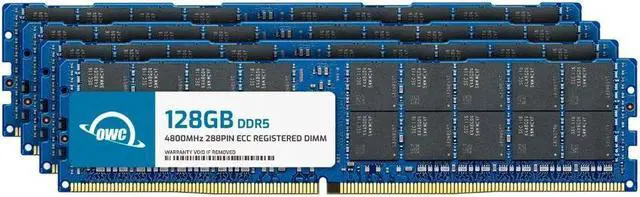
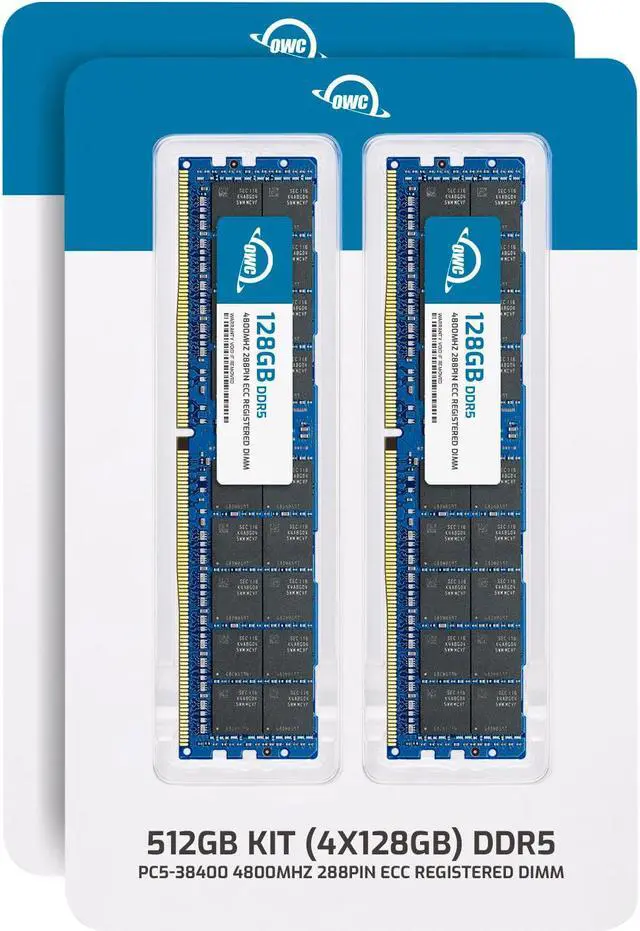
The OWC 512GB DDR5-4800 ECC Registered RDIMM kit includes four 128GB modules for compatible Dell PowerEdge R6625, R760, R7615, and R7625 servers, making it suitable for server operators expanding memory in those systems.
Recommended For
- Virtualization and infrastructure teams expanding a compatible PowerEdge host to run more memory-intensive VMs or consolidate workloads; Dell lists virtualization among the target workloads for these server families.
- Database and analytics teams running workloads that benefit from keeping larger working sets in server memory, provided their compatible PowerEdge configuration supports this 512GB, four-DIMM upgrade.
- HPC or VDI operators who need to increase installed memory in a listed PowerEdge server; Dell identifies HPC and VDI as target workloads for several of these models.
- Server administrators upgrading a compatible system with four matching 128GB DDR5-4800 ECC Registered DIMMs, after checking the server’s processor, existing memory, and DIMM population rules.
Real-World Use Scenarios
- When a PowerEdge host is running out of memory for virtual machines, an administrator can use this kit as part of a compatible memory expansion; more guest memory may stay available on the host instead of forcing workload reductions due to RAM pressure.
- For a virtual desktop infrastructure host supporting many desktop sessions, adding memory can provide more room for concurrent user workloads when the server is memory-constrained; actual session capacity also depends on the CPUs, software, and workload mix.
- For a database server whose working set is growing, the added capacity can give the database more memory to use for active data and caching, potentially reducing memory pressure; it does not by itself guarantee faster queries.
- For data analytics or data-warehouse workloads that keep larger datasets or more concurrent jobs in memory, this upgrade can add headroom when the existing server is short on RAM; the benefit depends on the application and its memory configuration.
- For memory-intensive high-performance computing jobs, such as simulations that need a large in-memory dataset, the extra capacity can help the workload fit in system memory when RAM is the limiting resource; compute performance still depends on the processors and software.




 here!