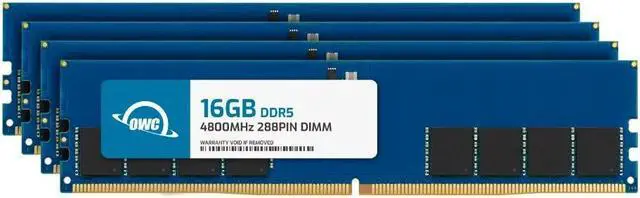
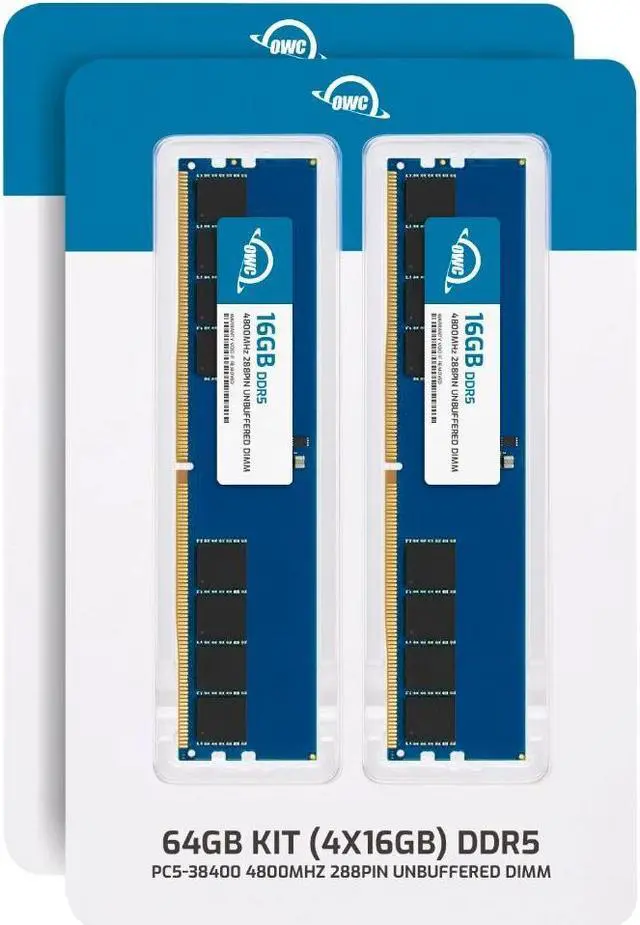
The OWC 64GB DDR5 desktop memory kit includes four 16GB, 4800 MT/s unbuffered, non-ECC UDIMMs with CL40 latency, suited to users upgrading compatible desktops that support DDR5 memory.
Recommended For
- Desktop video editors working with RAW footage, Fusion/compositing, or complex timelines who are running short on memory and need a 64GB upgrade. Puget Systems testing identifies 64GB as a useful threshold for Fusion and RAW workflows; confirm that the CPU and motherboard support this four-DIMM configuration.
- Desktop users running several virtual machines or development environments alongside their everyday tools, when their combined workloads fit within 64GB and their system supports four DDR5 UDIMMs.
- Creative professionals who keep several memory-heavy apps or large projects open at once and need more capacity to avoid running short of RAM; the benefit is capacity, not a promise of faster app performance.
- Desktop owners with a compatible four-slot DDR5 motherboard who want a matched 64GB kit at standard JEDEC speed and prioritize adding memory capacity over tuning for high memory clocks.
Real-World Use Scenarios
- When a compatible desktop runs short on memory during video editing, 64GB can give editing software and project assets more room to stay in memory, helping reduce slowdowns from memory pressure; CPU, GPU, storage, and project size still affect performance.
- For photo editors working with large batches or memory-intensive AI tools, moving to 64GB can provide more headroom for image data and editing tasks, especially when the current system is running low on available RAM.
- When keeping several creative apps open—for example, a video editor, motion-graphics software, and Photoshop—64GB can reduce memory contention and make switching between active projects less disruptive if the previous setup was RAM-limited.
- For software testing or development that involves running multiple virtual machines, 64GB gives the desktop more physical memory to share between the host and active VMs; the practical number of VMs depends on their assigned memory and workload.




 here!