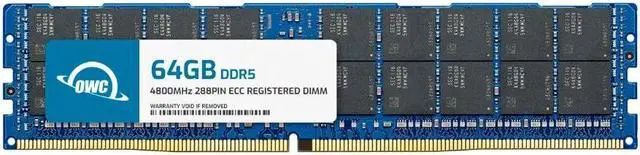
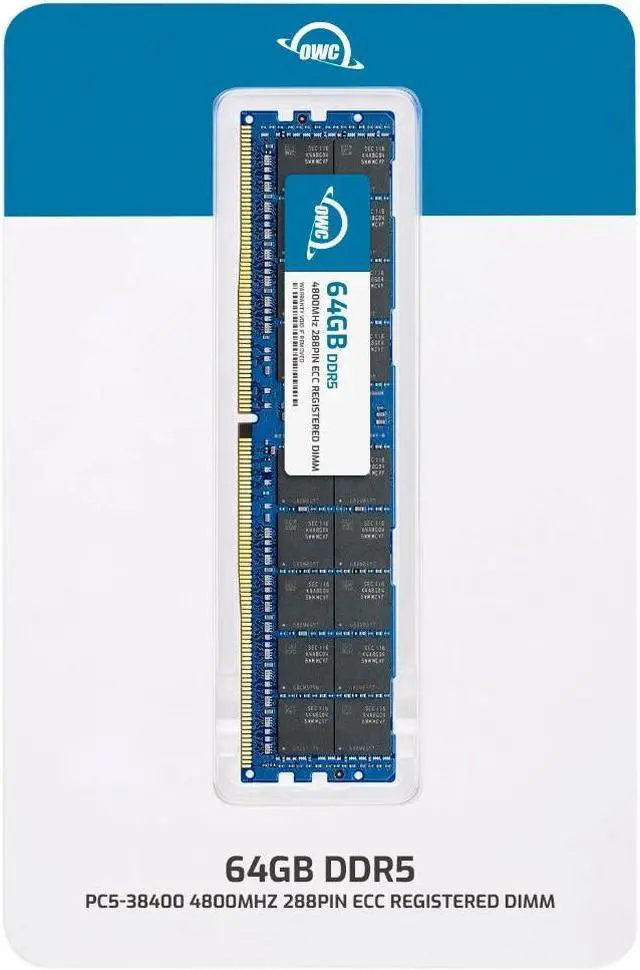
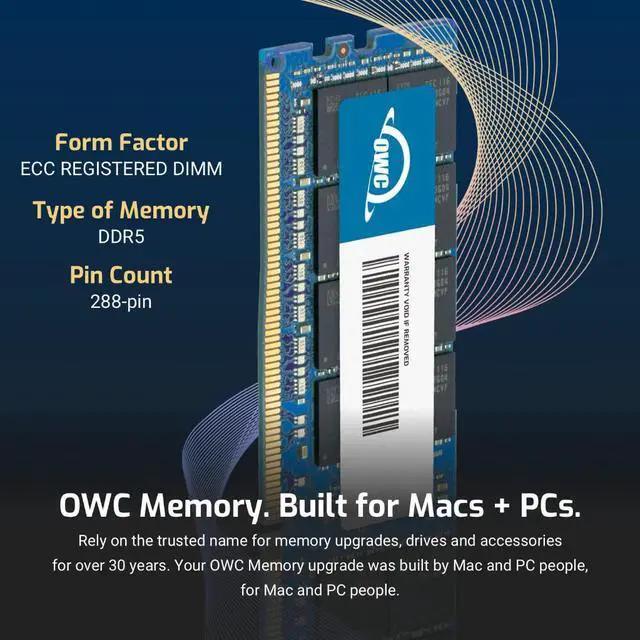
The OWC 64GB DDR5-4800 ECC Registered RDIMM is a server memory upgrade for HP Cray XD220v, XD225v, XD295v, and XD670 systems that support this memory type. It offers 64GB capacity, CL40 timing, and 1.1V operation in a single 288-pin module.
Recommended For
- IT administrators upgrading a compatible HPE Cray XD220v, XD225v, XD295v, or XD670 server who need to add a 64GB DDR5-4800 ECC registered DIMM.
- Server maintenance teams replacing a failed or missing 64GB 2Rx4 DDR5-4800 RDIMM in a supported Cray node and matching the module type to the system configuration.
- Operators extending the service life of existing supported Cray infrastructure who need a server-grade memory module rather than a consumer desktop DIMM.
- Data-center or HPC teams adding memory to compatible Cray nodes for workloads that need more server memory capacity, provided the DIMM matches HPE’s platform and population requirements.
Real-World Use Scenarios
- When expanding memory in a compatible Cray server used for virtualization, an administrator can use this module to add host-memory capacity; the added headroom may let the host support more or larger virtual machines, depending on the system’s configuration and workload.
- For a compatible Cray node running memory-intensive HPC jobs, adding capacity can give applications more room for data and intermediate results in system memory; whether a job runs faster depends on its memory needs and the server configuration.
- In an HPE Cray XD670 AI or deep-learning server, additional system memory can support CPU-side tasks such as preparing and staging data for GPU workloads; it does not increase GPU memory, and the benefit depends on the workload and memory configuration.
- When maintaining a compatible server fleet, this module can serve as a replacement for a failed memory module or as an added capacity module; the server’s supported memory configuration should be checked before installation.
- For a Cray system handling large in-memory datasets or data-heavy analysis, adding RAM may let more working data remain in system memory; the outcome depends on the application, existing capacity, and server configuration.




 here!