




 here!
I’m your shopping assistant for PC builds, upgrades, and everything tech.
Got questions? Ask away!
Start a conversation
here!
I’m your shopping assistant for PC builds, upgrades, and everything tech.
Got questions? Ask away!
Start a conversation



Any questions? Ask CelesteSM will help you find out quickly.

PINTECH is a high-tech enterprise specializing in the research, manufacturing and sales of measurement and testing instruments.
Currently, we offer over 70 products, including optical isolation voltage probes, differential probes, high-voltage attenuation rods, current probes, high-voltage amplifiers, power amplifiers, signal generators, oscilloscopes, multimeters, high-voltage power supplies, AC power supplies and DC power supplies.
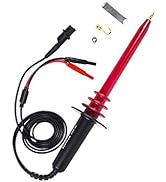
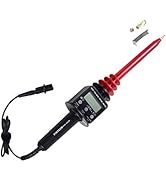
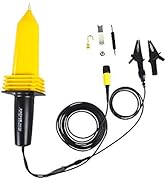
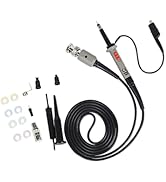
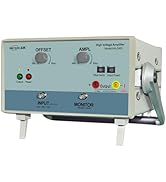
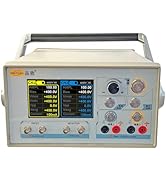
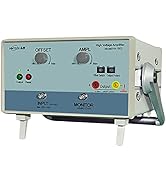
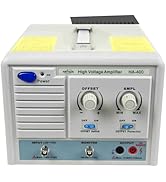

We not only provide professional measuring instruments and equipment, but also have a technical team that can offer professional advice according to your needs.
At PINTECH we have been designing and manufacturing electrical testing equipment since 2006.
PINTECH places great emphasis on pre-sales and after-sales service, prioritizing product quality to provide our customers with cost-effective products.
PINTECH is a high-tech enterprise specializing in the research, manufacturing and sales of measurement and testing instruments.
Currently, we offer over 70 products, including optical isolation voltage probes, differential probes, high-voltage attenuation rods, current probes, high-voltage amplifiers, power amplifiers, signal generators, oscilloscopes, multimeters, high-voltage power supplies, AC power supplies and DC power supplies.
We not only provide professional measuring instruments and equipment, but also have a technical team that can offer professional advice according to your needs.
At PINTECH we have been designing and manufacturing electrical testing equipment since 2006.
PINTECH places great emphasis on pre-sales and after-sales service, prioritizing product quality to provide our customers with cost-effective products.
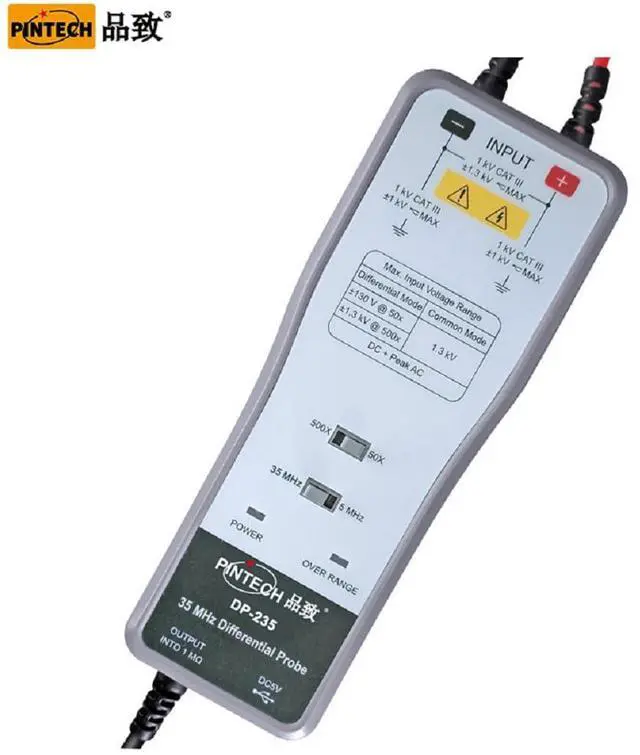
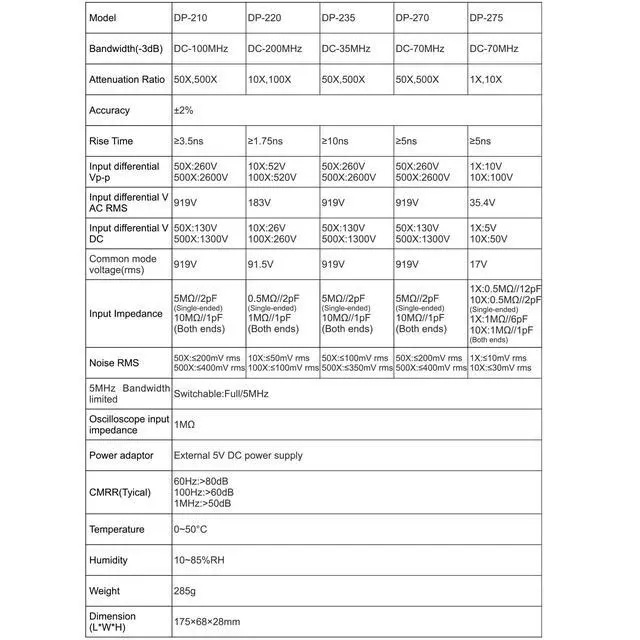
MODEL: DP-235
Bandwidth (-3dB): DC-35MHz
Input Impedance: Between the two ends: 10M//1pF , Single-ended to ground: 5M//2pF
Attenuation Rate: 50X/500X
Rising Time: 10ns
Input Voltage Range: ±130V (DC + AC peak) at 50X; ±1300V (DC + AC peak) at 500X
Maximum Input Voltage: ±1300V(DC+ACpeak)
Accuracy: ±2%
RMS value: 919V
Output Voltage: ±2.6V
Output Impedance: 50 ((In an oscilloscope system with 1M input impedance))
CMRR: 60Hz:>80dB; 100Hz:>60dB; 1MHz:>50dB
Noise RMS: 50X: 100mV; 500X: 350mV
5MHz bandwidth limitation: Switchable: Full/5MHz
Power Supply: Specify an external 5V DC power
Weight: 285g/0.63lb
Dimension(LxWxH): 175x68x28 mm
| Manufacturer | PINTECH |
| Item model number | DP-235 |
| Date First Available | June 30, 2025 |
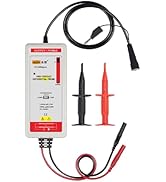
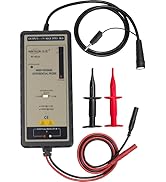
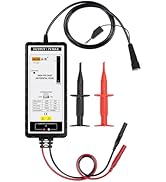
The PINTECH DP-235 is a high-voltage differential active oscilloscope probe with 2600V range, 35MHz bandwidth, and 50X/500X attenuation, suited for engineers, technicians, and lab users measuring motor drives, power electronics, and other high-voltage differential signals with standard BNC oscilloscopes.
| Attribute | Value |
|---|---|
| Best For | High-voltage differential measurements and converting two-point (floating) signals to ground for oscilloscopes, meters, and data acquisition; suited to motor and other high-voltage circuits requiring up to 2600V range, 35 MHz bandwidth, and selectable 50X/500X attenuation |
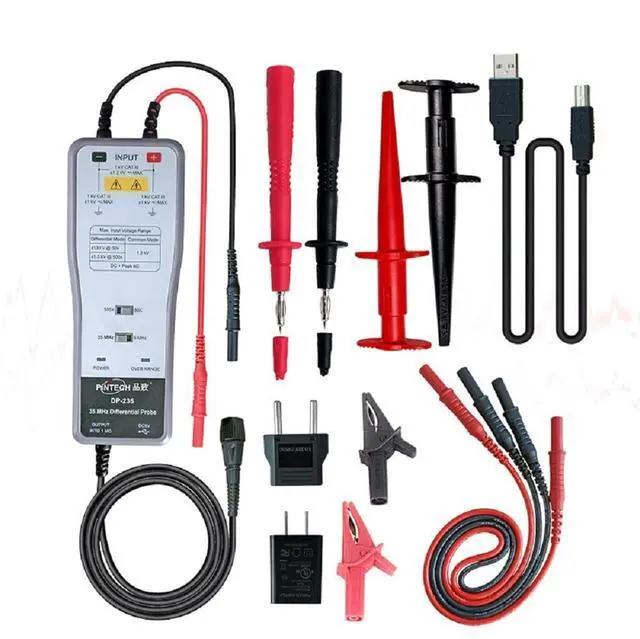
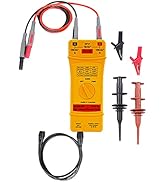
| Package Contents | Differential probe ×1, probe hook ×2, alligator clip ×2 — basic accessories for making insulated/differential connections |
Q: Should I choose the PINTECH DP-235 or a 100 MHz high-voltage differential probe?
A: Choose the PINTECH DP-235 when your main need is high-voltage measurement on motor drives, power electronics, inverters, or general floating-node troubleshooting where 35 MHz bandwidth is enough and 2600 Vp-p range matters more than edge fidelity. Choose a 100 MHz-class differential probe when you need cleaner visibility on faster switching edges, more harmonics, or gate-drive detail. In practice, the trade-off is straightforward: the DP-235 is positioned for mainstream high-voltage work, while higher-bandwidth probes are the better fit for faster transient analysis.
Q: Is the PINTECH DP-235 better than using two standard passive probes and math on the oscilloscope?
A: Yes, the DP-235 is the better choice when you need a true high-voltage differential measurement. A dedicated differential probe is designed to convert a floating two-point signal into a scope-safe ground-referenced signal through one BNC connection. Compared with using two passive probes plus channel math, it is usually the more practical option for higher-voltage measurements because it avoids tying measurements to two separately matched probes and preserves a setup intended for differential work. Two passive probes with math can still be acceptable for low-risk bench checks, but the DP-235 is the clearer choice for repeated high-voltage troubleshooting.
Q: Should I buy the DP-235 or move up to a higher-voltage model like a 7 kV differential probe?
A: Buy the DP-235 if your expected differential voltage stays within its 2600 Vp-p range and you want a simpler fit for typical inverter, motor-control, and power-stage measurements. Move up to a 7 kV-class probe when your application has higher bus voltage, more headroom requirements, or you work across a wider mix of industrial power systems. The main trade-off is not general quality but operating range: the DP-235 fits moderate high-voltage work, while higher-voltage probes provide extra margin for more demanding systems.
Q: For motor drives and VFD work, is the DP-235 enough or should I get a faster probe?
A: The DP-235 is often enough when your priority is safely observing high-voltage waveforms in motor drives, VFD outputs, and similar power circuits, because these use cases typically prioritize voltage range and differential measurement capability first. A faster probe becomes the better choice when you need to inspect switching transitions in more detail, compare device behavior at the edge level, or capture more high-frequency content. In short: choose the DP-235 for routine power-stage diagnostics, and choose a faster model for deeper switching analysis.
Q: Should I choose the DP-235 or a lower-voltage, higher-bandwidth differential probe?
A: Choose the DP-235 when measurement voltage is the limiting factor and you need substantially more high-voltage headroom. Choose a lower-voltage, higher-bandwidth differential probe when your circuits are well below that voltage range and your main goal is better visibility into fast digital or switching behavior. This is a classic trade-off in differential probes: the DP-235 favors voltage capacity for power work, while lower-voltage high-bandwidth models favor signal-detail work.
Q: Who is this probe suitable for?
A: This probe is suitable for engineers, technicians, and advanced hobbyists who need to measure high-voltage differential signals on grounded oscilloscopes. It is a better fit for power electronics, motor drives, inverters, and switching circuits than for basic low-voltage bench work. Its 2600 V rating and differential design are useful when neither test point is at ground, but its 35 MHz bandwidth makes it a general-purpose high-voltage probe, not a high-speed signal integrity probe.
Q: Will it work with my oscilloscope?
A: It should work with most oscilloscopes that have a standard BNC input, which makes it broadly compatible across brands. That said, compatibility is physical rather than smart-integrated: unlike some premium probes, this model does not appear to offer auto-scaling or auto-power interfaces, so you may need to set attenuation manually on the scope and use the included adapter/power arrangement.
Q: Is 35 MHz enough, or should I buy a higher-bandwidth differential probe?
A: 35 MHz is enough for many power-electronics and motor-control tasks, including general switching waveform checks and floating high-voltage measurements. It is not the best choice if you need fast edge fidelity, detailed switching transients, or higher-frequency digital and RF work. In short: buy this for high-voltage general diagnostics, not for high-speed precision analysis.
Q: Is a differential probe like this better than using two standard probes and math subtraction?
A: Yes, for real high-voltage floating measurements, a dedicated differential probe is the safer and more appropriate choice. Two standard probes plus channel subtraction can work for some lower-risk cases, but it depends heavily on grounding, common-mode voltage, and oscilloscope setup. A purpose-built differential probe is the better buying decision when you need safer measurement across two non-ground-referenced points.
Q: What are the main trade-offs versus a premium differential probe from Tektronix, Keysight, or Siglent?
A: The main advantage of this PINTECH model is practical high-voltage capability with broad BNC compatibility in a simpler package. The trade-offs are lower bandwidth than many premium models, fewer signs of integrated scope features, and less evidence of premium ecosystem support such as auto-probe interfaces or advanced accessories. It is the better value choice for routine high-voltage bench work, while premium probes are better for faster signals, tighter integration, and more demanding measurement workflows.
Q: Who is this kind of differential probe suitable for?
A: It is mainly suitable for bench-scope users who need to measure floating or non-ground-referenced voltages in power electronics, such as motor drives, inverters, and switch-mode power circuits. Based on the product data, this model is a high-voltage active differential probe with 35 MHz bandwidth, 50X/500X attenuation, and BNC output, so it fits general high-voltage troubleshooting better than low-voltage precision work.
Q: Is this a good choice for measuring motor drives, inverters, or mains-referenced switching circuits?
A: Yes, it is a reasonable fit for that use case. Community discussion around differential probes repeatedly points to motor drives, VFDs, generators, and switching power electronics as common reasons to buy one. This probe’s stated high-voltage rating and differential measurement design make it more appropriate for those jobs than a standard passive probe, provided its voltage and bandwidth limits match the circuit being tested.
Q: What are the main trade-offs of buying this probe instead of a higher-end differential probe?
A: The main trade-off is capability versus cost. From the product data, this model is focused on moderate bandwidth and high-voltage access: 35 MHz bandwidth, 50X/500X attenuation, and typical accuracy of ±2%. Reddit and YouTube discussions suggest buyers often compare differential probes on bandwidth, noise performance, attenuation options, input range, and common-mode rejection. That means this type of probe is more suitable for general power-electronics measurement than for high-speed digital analysis or very low-noise measurement.
Q: Can this replace using two standard oscilloscope channels in A-B math mode?
A: For many high-voltage floating measurements, yes, it is the better tool. Repeated Reddit discussion treats a real differential probe as the safer and more purpose-built option when the signal is not ground referenced. A-B math with two passive probes can be a workaround, but it is usually seen as less ideal for safety, convenience, and measurement quality.
Q: Is this worth buying if I mostly measure low-voltage or ground-referenced signals?
A: Probably not. For mostly low-voltage, ground-referenced work, a standard passive probe is usually simpler and more cost-effective. This product’s specifications and the surrounding community discussion both point to its value being in high-voltage differential measurement, not routine low-voltage scope use.



