




 here!
I’m your shopping assistant for PC builds, upgrades, and everything tech.
Got questions? Ask away!
Start a conversation
here!
I’m your shopping assistant for PC builds, upgrades, and everything tech.
Got questions? Ask away!
Start a conversation
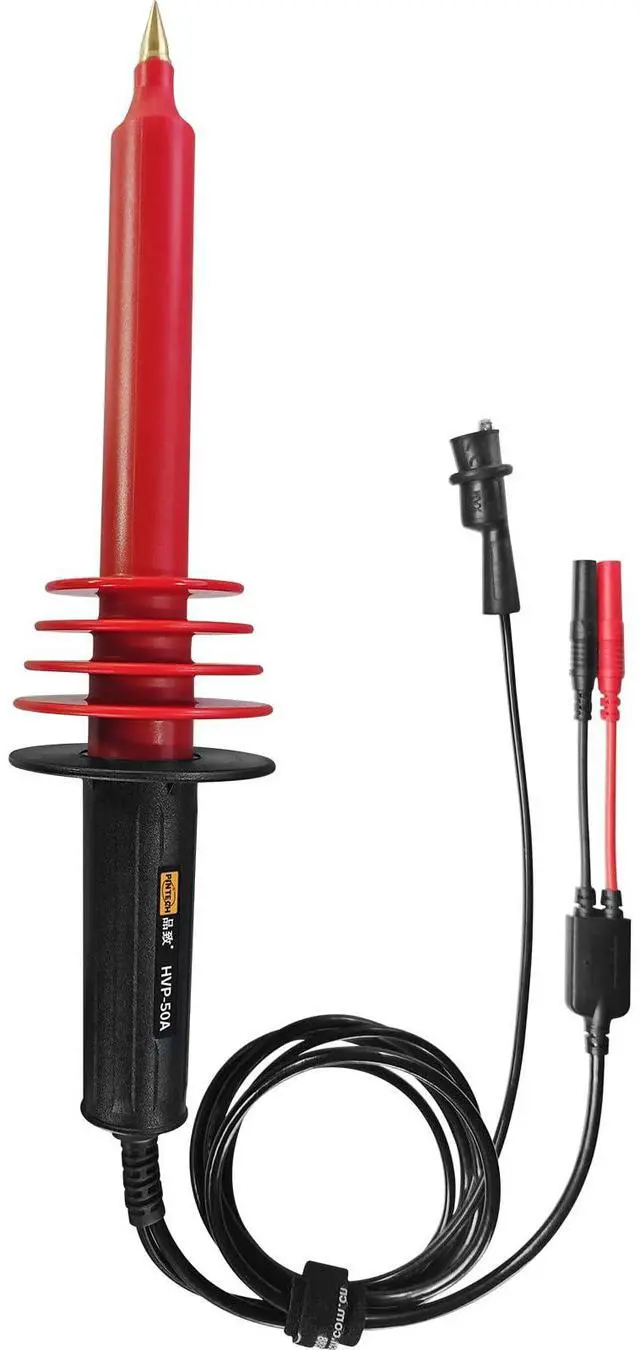
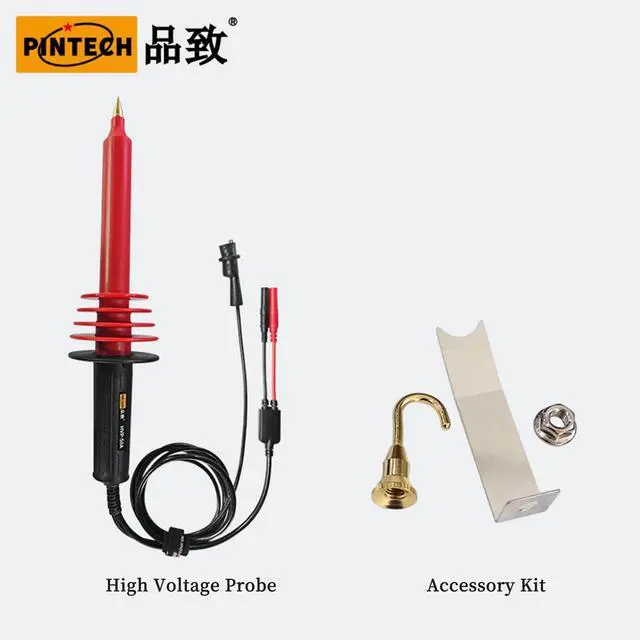
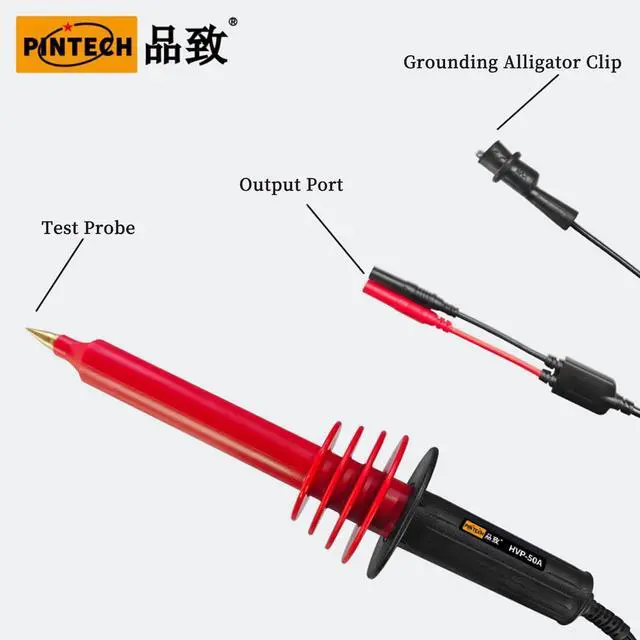



Any questions? Ask CelesteSM will help you find out quickly.
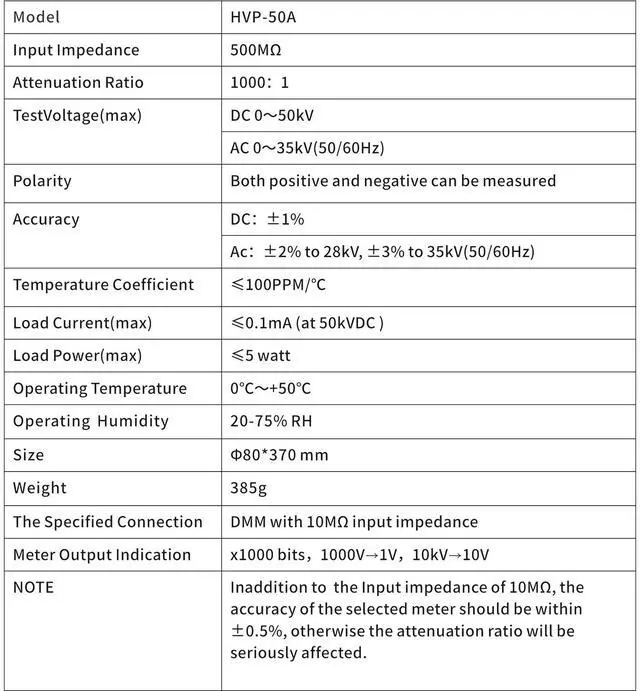
MODEL: HVP-50A
Input Impedance: 500M
Attenuation Rate: 10001
Test Voltage (max): DC 0~ ± 50kV, AC 0~ 35kV(50/60Hz)
Polarities: Positive/negative can be measured
Accuracy: DC±1%(full-scale), AC: ±2% to 28kV,±3% to 35kV(50/60Hz)
Temperature Coefficient: 100ppm/
Load Current (max): 0.1mA(at DC 50kV)
Load Power (max): 5W
Operating Temperature: 0 ~ +50
The Specified Connection: DMM with 10M input impedance
Meter Output Indication:x1000 bits1000V1V10kV10V
Weight: 385g/0.85lb
In addition to the input impedance of 10M, the accuracy of the selected meter should be within ±0.5%, otherwise the attenuation ratio will be seriously affected.
| Brand | PINTECH |
| Power Source | Corded Electric |
| Style | Classic |
| Color | Black |
| Specification Met | CE |
| Manufacturer | PINTECH |
| Item model number | HVP-50A |
| Date First Available | December 31, 2025 |
The PINTECH HVP-50A is a 50kV high-voltage probe for use with a digital multimeter, designed for technicians, engineers, and electronics users who need to measure high DC voltages up to 50kV or AC voltages up to 35kV at 50/60Hz with a 1000:1 attenuation ratio.
| Attribute | Value |
|---|---|
| Best For | Technicians and engineers who need a high-voltage probe for test and measurement tasks; intended for use with a compatible multimeter and includes an accessory kit for field or bench work |
| Package Contents | One high-voltage probe plus one accessory kit (1 piece total included) |
| Certifications | CE |
Q: Should I choose the PINTECH HVP-50A or a 40kV high-voltage DMM probe like the HVP-40?
A: Choose the HVP-50A if you need more headroom for DC or mains-frequency AC high-voltage work. Official PINTECH specifications place the HVP-50/HVP-50A at 50kV DC and 35kV AC with tighter AC accuracy than the HVP-40, while the HVP-40 is rated for 40kV DC and 28kV AC. The trade-off is input impedance: the HVP-50A uses 500MΩ, while the HVP-40 uses 1000MΩ, so the HVP-40 loads the circuit less. In practice, the HVP-50A is the better fit when voltage range and AC capability matter more than minimizing circuit loading.
Q: Is the PINTECH HVP-50A a better choice than a generic 1000:1 high-voltage probe for a multimeter?
A: The HVP-50A is the safer choice when you want a clearly documented rating and known meter matching. PINTECH publishes the 1000:1 ratio, the required 10MΩ DMM input, the 50kV DC / 35kV AC range, and stated accuracy limits. Many low-cost generic probes use the same basic divider concept, but community discussions repeatedly note that high-voltage probes depend on the meter input impedance and can show errors or unstable readings if the probe, meter, or frequency assumptions do not match. Choose the HVP-50A when you want a specified setup; choose a generic probe only if you are comfortable validating compatibility yourself.
Q: For sensitive circuits, should I get the HVP-50A or a higher-impedance high-voltage probe?
A: Choose a higher-impedance probe if minimizing circuit loading is the main goal. PINTECH's own selection guide shows the HVP-50A at 500MΩ input impedance, while some other PINTECH probes go higher, including the HVP-28HF at 500MΩ with faster signal support and the HVP-39pro at 900MΩ. The HVP-50A remains the better choice when you specifically need a simple DMM-based probe with up to 50kV DC range. The trade-off is straightforward: higher impedance is better for lighter loading, while the HVP-50A prioritizes higher maximum voltage in this DMM-oriented class.
Q: Should I use the PINTECH HVP-50A with a multimeter, or buy an oscilloscope high-voltage probe instead?
A: Use the HVP-50A when you only need steady or mains-frequency voltage readings on a digital multimeter. Official specs limit it to DMM use and 50/60Hz AC measurement. If you need waveform shape, transients, or higher-frequency behavior, an oscilloscope high-voltage probe is the better tool because those models are designed with bandwidth and compensation specifications. The trade-off is simplicity versus signal detail: the HVP-50A is for voltage measurement on a 10MΩ meter, while scope probes are for analyzing how the high-voltage signal behaves over time.
Q: Will this probe work with any digital multimeter?
A: Not with every multimeter. This probe is designed to be used with a digital multimeter that has 10 MΩ input impedance, and the product listing says the meter should also be within ±0.5% accuracy to preserve the stated divider accuracy. That makes it suitable for standard bench or handheld DMMs with 10 MΩ voltage input, but not a good fit for meters with different input impedance or unknown accuracy.
Q: Is this a good choice for occasional high-voltage checks, or mainly for trained technicians?
A: This is mainly a technician tool, not a casual DIY accessory. The product is built for measuring very high DC and low-frequency AC voltages, but comparable high-voltage probes are explicitly intended for trained users and require careful grounding, dry conditions, and disciplined connection order. It is a practical option for occasional service checks if you already understand high-voltage measurement procedure, but it is not a beginner-friendly probe.
Q: Can it measure both AC and DC high voltage?
A: Yes, but the limits are different. The listing says it measures DC up to 50 kV and AC up to 35 kV at 50/60 Hz, including both positive and negative voltages. That means it is better suited to high-voltage DC work or mains-frequency AC checks than to broader AC waveform analysis.
Q: What is the main trade-off versus a more established alternative like the Fluke 80K-40 or similar 40 kV probes?
A: The main trade-off is range and claimed accuracy versus brand track record and published documentation. This PINTECH model offers a higher stated DC range of 50 kV and tighter stated DC accuracy of ±1% full scale, while comparable 40 kV probes commonly require the same 10 MΩ meter pairing but may publish lower maximum voltage or looser accuracy. Buyers who value documented operating procedures and long-established model history may prefer a legacy brand; buyers who need the extra range may prefer this model if its compatibility and use conditions match their setup.
Q: Is this the right probe if I need portable field use, or is it better for bench and service work?
A: It is better suited to bench, lab, and service work than general field portability. The probe depends on a separate digital multimeter, needs a correct 10 MΩ meter pairing, and high-voltage probes of this type require controlled setup and grounding. If your priority is compact field convenience, a self-contained tester may be easier; if your priority is extending an existing DMM for occasional high-voltage measurement, this format makes more sense.
Q: Who is this high-voltage probe suitable for?
A: It is most suitable for users who already have a compatible digital multimeter with 10MΩ input impedance and need to measure very high DC voltage or mains-frequency AC high voltage through a 1000:1 divider. It fits bench diagnostics and repair work better than general electrical troubleshooting. It is not a beginner-friendly all-purpose probe.
Q: Do I need a specific multimeter for this probe to read correctly?
A: Yes. This probe depends on the meter as part of the divider setup, so it should be used with a digital multimeter that has 10MΩ input impedance and solid voltage accuracy. If the meter input impedance is different, the displayed voltage scaling can be wrong.
Q: Is this a good budget option if I only occasionally need to measure high voltage?
A: Yes, if your main goal is occasional high-voltage measurement with a standard DMM, this type of probe is a practical lower-cost option. The trade-off is that it is more specialized, depends on meter compatibility, and is less versatile than higher-end dedicated probes or differential probe setups.
Q: Can this replace a scope probe or differential probe?
A: No. This product is designed as a high-voltage divider probe for use with a digital multimeter, not as a general oscilloscope or differential probe replacement. It is appropriate for static or mains-frequency high-voltage measurement, but not for the broader signal-viewing use cases people expect from scope probes.
Q: What are the main trade-offs before buying this kind of 50kV probe?
A: The main trade-offs are specialization and setup dependence. You get very high-voltage measurement range, a simple 1000:1 attenuation model, and an insulated handheld format, but you also need a compatible 10MΩ meter, careful technique, and realistic expectations about use case. It is better for checking high voltage levels than for broad everyday multimeter tasks.


