




 here!
I’m your shopping assistant for PC builds, upgrades, and everything tech.
Got questions? Ask away!
Start a conversation
here!
I’m your shopping assistant for PC builds, upgrades, and everything tech.
Got questions? Ask away!
Start a conversationShipped by GUANGZHOU PINTECH CO LTD

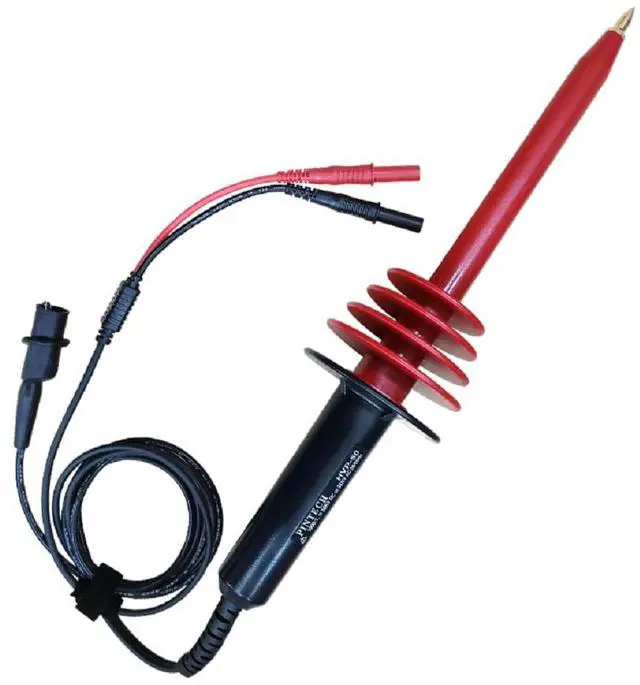



Any questions? Ask CelesteSM will help you find out quickly.
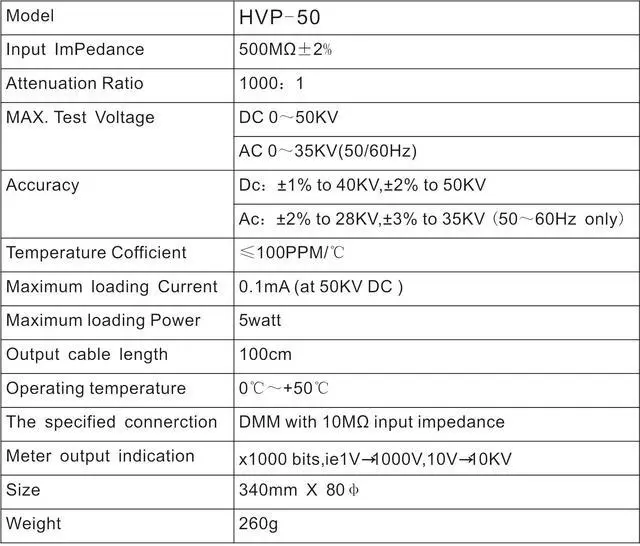
MODEL: HVP-50
Input Impedance: 500M±2%
Attenuation Rate: 100050kV; AC: 35kVp-p(50/60Hz)
Maximum Loading Current: 0.1mA(at 50kV DC)
Maximum Loading Power: 5 watt
Accuracy(DC): ±1% to 40kV, ±2% to 50kV
Accuracy(AC): ±2% to 28kV, ±3% to 35kV at 50~60 Hz
Ground Wire Length: 90cm/35.43in
Output Cable Length: 100cm/39.37in
Weight: 260g/0.57lb
Product information| Brand | PINTECH |
| Power Source | Corded Electric |
| Specification Met | CE |
| Manufacturer | PINTECH |
| Item model number | HVP-50 |
| Date First Available | July 11, 2025 |
The PINTECH HVP-50 is a high-voltage multimeter probe designed for technicians, electronics labs, and service users who need to measure up to 50kV DC or 35kV AC at 50/60Hz with 1000:1 attenuation for safer high-voltage testing.
| Attribute | Value |
|---|---|
| Best For | High-voltage measurements with a multimeter — DC up to 50 kV and AC up to 35 kV (50/60 Hz) using a 1000:1 attenuating probe to enable safer high-voltage readings |
| Measurement Range And Accuracy | DC range up to 50 kV (accuracy ±1% to 40 kV, ±2% to 50 kV); AC range up to 35 kV at 50–60 Hz (accuracy ±2% to 28 kV, ±3% to 35 kV) |
| Attenuation And Input Impedance | 1000:1 attenuation with input impedance 500 MΩ ±2% |
| Compatibility And Use Notes | Designed as a multimeter high-voltage probe for direct high-voltage DC/AC measurements; AC specifications apply at 50/60 Hz |
| Contents And Accessories | Includes one high-voltage probe and one accessories kit |
| Standards And Certifications | CE certified |
Q: Should I buy the PINTECH HVP-50 or a 40kV 1000:1 multimeter high-voltage probe like the Fluke 80K-40?
A: Choose the PINTECH HVP-50 when you specifically need a higher DC measurement range, since it is positioned as a 50kV DC / 35kV AC 1000:1 probe for DMM use. Choose a 40kV-class probe like the Fluke 80K-40 when your work stays within that range and you want a model that is widely referenced in field use and community guidance. The main trade-off is range versus established market familiarity; both are resistive divider probes intended for use with a multimeter rather than a standalone meter.
Q: Is the PINTECH HVP-50 a better fit than a lower-voltage probe for occasional high-voltage checks?
A: Yes, if your measurements can exceed the limits of common lower-voltage probes, the HVP-50 is the safer fit on paper because it is rated for up to 50kV DC and 35kV AC at 50/60Hz. A lower-voltage probe is the more practical choice only when your actual measurement range stays comfortably below its rating. The trade-off is simple: buy the higher-range probe for headroom, and the lower-range probe for narrower, known-voltage tasks.
Q: Should I choose the PINTECH HVP-50 or move up to a premium high-voltage probe with lower loading or oscilloscope-focused design?
A: Choose the HVP-50 when you want a DMM-oriented probe for basic high-voltage measurement and a straightforward 1000:1 workflow. Move up to a premium or specialized probe when lower circuit loading, pulse behavior, or oscilloscope use matters more than basic compatibility. Official product families from Pintech separate simple DMM probes from premium and scope-oriented models, which matches how reviewers and technical communities usually frame the upgrade decision: routine voltage checking versus more demanding measurement conditions.
Q: Is the PINTECH HVP-50 better for portability than a bench-style or specialty high-voltage measurement setup?
A: Yes, for portable field use, the HVP-50 is the simpler choice because it is a compact accessory designed to extend a standard multimeter with a 1000:1 divider. A bench-style or specialty setup makes more sense when you need deeper analysis, waveform behavior, or dedicated readout features rather than just a high-voltage measurement path. The trade-off is portability and simplicity versus measurement specialization.
Q: Should I use the PINTECH HVP-50 instead of a DIY resistor-divider method for measuring high voltage?
A: In most buying decisions, yes. A purpose-built probe like the HVP-50 is the more practical choice for users who want a defined attenuation ratio, published ratings, and a ready-to-use format for a multimeter. Community discussions around high-voltage measurement often mention DIY divider methods, but they also emphasize loading, meter compatibility, and safety concerns. The trade-off is customization with a DIY approach versus a standardized accessory built for repeatable DMM use.
Q: Who is the PINTECH HVP-50 best suited for?
A: The PINTECH HVP-50 is best suited for technicians, engineers, and advanced users who need to measure very high voltage with a standard digital multimeter through a 1000:1 probe. It is not a general-purpose multimeter accessory for routine household or automotive work. Its fit is strongest for specialized bench, lab, service, or maintenance use where DC up to 50 kV or AC up to 35 kV at 50/60 Hz must be checked.
Q: Can I use the HVP-50 with any multimeter?
A: Not with just any multimeter. The HVP-50 is a 1000:1 high-voltage probe intended for use with a digital multimeter, so the meter must be able to accurately read the probe's scaled-down output voltage and should be used exactly as the probe documentation specifies. Buyers should also check meter input characteristics and safe operating procedures before use. In practice, this is a specialist accessory, not a universal plug-and-go probe for every meter.
Q: Is the HVP-50 a good choice for normal electrical troubleshooting?
A: Usually no. For normal electrical troubleshooting, a standard multimeter or tester is a better fit because those products are built for common low-voltage tasks and simpler operation. The HVP-50 makes more sense only when you specifically need high-voltage measurement beyond normal meter ranges. Its main trade-off is specialization: much higher voltage capability, but less relevance for everyday testing.
Q: What are the main trade-offs versus a regular 600V or 1000V multimeter?
A: The main advantage is voltage range: the HVP-50 extends measurement capability far beyond the voltage limits of ordinary handheld multimeters. The trade-offs are that it is more specialized, only lists AC use at 50/60 Hz, and relies on a 1000:1 attenuation method rather than direct measurement. For buyers choosing between the two, a regular multimeter is better for broad everyday work, while the HVP-50 is better only when high-voltage measurement is the actual requirement.
Q: Is the HVP-50 a good travel or field-work device?
A: It can be convenient for field work only if your job already involves high-voltage measurement and you want a relatively compact probe to pair with a multimeter. The product description emphasizes small size and portability, but this does not make it a casual carry tool. For travel-friendly general diagnostics, a standard handheld meter is usually the more practical choice; the HVP-50 is portable in a specialist sense, not an all-purpose travel tester.
Q: Is the PINTECH HVP-50 a good choice if I already have a standard multimeter?
A: Yes, if your goal is occasional high-voltage measurement with a multimeter. The HVP-50 is a 1000:1 high-voltage probe made for DMM use, so it extends a regular meter into a much higher voltage range. The main trade-off is that it is a specialized accessory, not a standalone meter, and it is intended for high-voltage checks rather than general bench measurement.
Q: Who is the HVP-50 suitable for?
A: It is best suited to users who specifically need to measure high DC voltage up to 50 kV or AC up to 35 kV at 50/60 Hz with an existing multimeter. It fits hobbyist, repair, and lab situations where high-voltage measurement is needed, but it is not a general-purpose probe for everyday low-voltage work.
Q: What are the main trade-offs of choosing the HVP-50 instead of a dedicated high-voltage meter?
A: The main advantage is lower cost and portability if you already own a compatible multimeter. The trade-offs are added setup, dependence on the multimeter’s input and reading method, and narrower use: this probe is for high-voltage measurement only, with AC specified only at 50/60 Hz. It is more of a practical extension tool than an all-in-one instrument.
Q: Is the HVP-50 worth buying for occasional high-voltage troubleshooting?
A: It can be worth buying if you need a low-cost way to verify high-voltage output and already have a multimeter. Its value is strongest for occasional troubleshooting where a dedicated HV meter would be harder to justify. If you do not regularly measure high voltage, a specialized probe like this is usually a niche purchase rather than a general upgrade.
Q: Can the HVP-50 be used for general low-voltage or oscilloscope-style measurement?
A: Not really as its main use case. It is designed as a high-voltage probe for multimeters with 1000:1 attenuation, so it is most useful when voltage is far above normal meter limits. For routine low-voltage work, the large attenuation makes it less practical than standard probes, and it is not a replacement for a typical oscilloscope probe.



