




 here!
I’m your shopping assistant for PC builds, upgrades, and everything tech.
Got questions? Ask away!
Start a conversation
here!
I’m your shopping assistant for PC builds, upgrades, and everything tech.
Got questions? Ask away!
Start a conversationShipped by GUANGZHOU PINTECH CO LTD




Any questions? Ask CelesteSM will help you find out quickly.
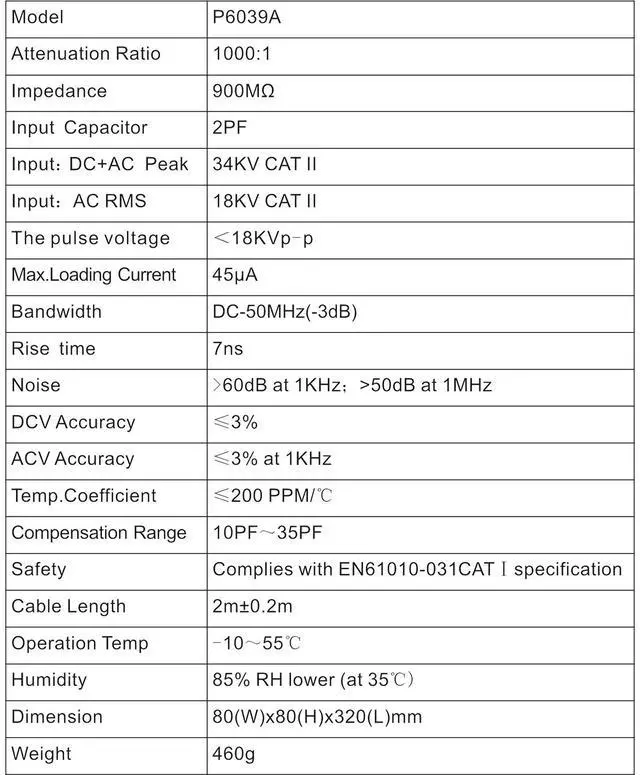
MODEL: P6039A
Input Impedance: 900M
Input Capacitance: 2.0 pF
Attenuation Rate: 1000:1
Bandwidth: DC-50MHz(-3dB)
Max.DC+AC peak: 34kV/30 sec
Max.AC RMS: 18kV/30 sec
Pulse Voltage: <18kVp-p
Rise Time: 7ns
DCV Accuracy: 3%
ACV Accuracy: 3% at 50Hz(0-10kV rms), 5% at 50Hz(10-20kV rms)
Noise: >60dB at 1kHz; >50dB at 1MHz
Max. Loading Current: 45A
Size: 80 x 80 x 320 mm
Weight: 460g/1lb
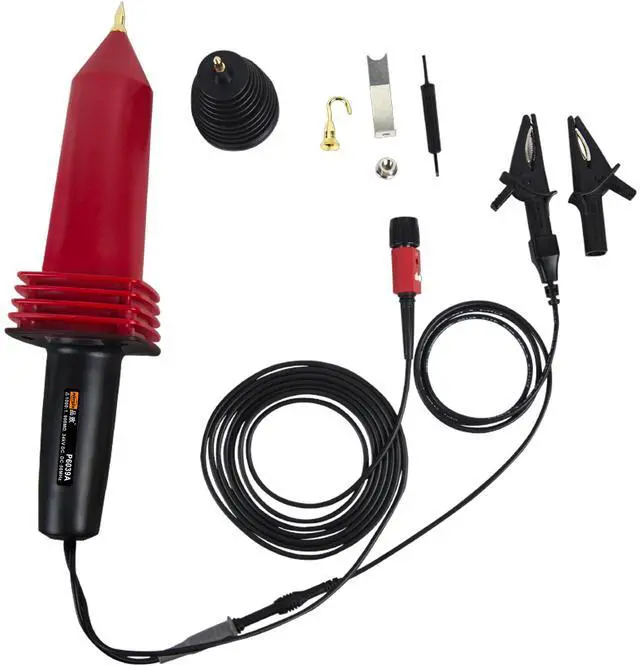
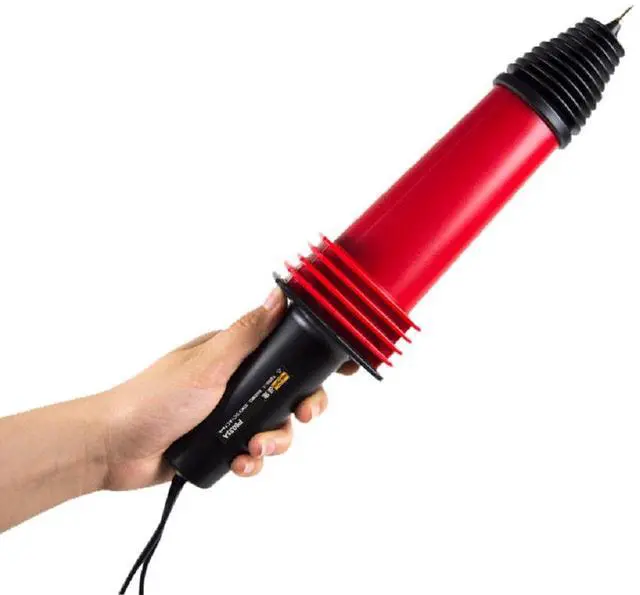
The PINTECH P6039A is a high-voltage oscilloscope probe with 1000:1 attenuation, rated for up to 34kV DC and 18kV AC, making it suitable for technicians, engineers, and electronics labs measuring high-voltage signals on standard BNC oscilloscopes.
| Attribute | Value |
|---|---|
| Best For | High-voltage electrical testing and measurements up to 34 kV DC / 18 kV AC, suited to electrical testing and measuring applications |
| Model Identifiers | PINTECH P6039A |
| Voltage Ratings | 34 kV DC maximum; 18 kV AC maximum |
| Accuracy | 3% across 0–35 kV |
| Physical Dimensions | 80 × 80 × 320 mm |
| Certifications | CE certified |
| Packaging And Units | Sold as one unit (1 pack) |
| Product Type | Electrical Testing & Measuring |
Q: Should I choose the PINTECH P6039A or a lower-voltage 1000:1 probe like the PINTECH P6018A?
A: Choose the PINTECH P6039A when your main need is higher voltage headroom. Official PINTECH specs position the P6039A at 34 kV DC / 18 kV AC with 50 MHz bandwidth, while the P6018A is positioned at 18 kV DC / 12 kV AC with 100 MHz bandwidth and lower input impedance. In practical buying terms, the P6039A fits high-voltage power, ignition, CRT, multiplier, and similar measurements where voltage margin matters more than bandwidth. The P6018A is the better fit when your signals are lower voltage but faster, and you want more bandwidth for waveform detail.
Q: Is the PINTECH P6039A a better choice than a standard 10x or 100x oscilloscope probe?
A: Yes, if you are measuring voltages far beyond ordinary scope-probe ranges. The P6039A is a dedicated 1000:1 high-voltage probe with 34 kV DC / 18 kV AC ratings and a standard BNC connection, so it is intended for voltage levels that standard general-purpose probes are not designed to handle. A normal 10x or 100x probe remains the better choice for routine low- to moderate-voltage bench work because it is simpler to use and usually offers more signal amplitude at the oscilloscope input. The decision is straightforward: choose the P6039A for true high-voltage measurement, and choose a standard probe for everyday electronics signals.
Q: PINTECH P6039A vs Tektronix P6015A: which one makes more sense?
A: Choose the PINTECH P6039A when you want a simpler, lower-cost passive high-voltage probe with modern availability and a 34 kV DC / 18 kV AC, 50 MHz specification. Choose the Tektronix P6015A when you specifically need a widely recognized high-voltage probe platform from a major oscilloscope brand and you value its established use in professional labs. Both are positioned as passive high-voltage probes rather than general-purpose probes. The practical trade-off is that the P6039A is easier to justify for users focused on voltage range and basic compatibility, while the P6015A is the more familiar reference option in legacy and lab environments.
Q: Should I buy the PINTECH P6039A or a high-voltage differential probe?
A: Buy the P6039A when you are measuring a high-voltage point relative to ground and want a passive 1000:1 probe with broad oscilloscope compatibility. Buy a high-voltage differential probe when you need to measure floating voltages or voltage differences between two non-ground points safely and accurately. Official application guidance from Keysight consistently treats single-ended and differential probes as different tools for different measurement setups. The key trade-off is measurement method: the P6039A is the better fit for grounded high-voltage measurements, while a differential probe is the better fit for floating or non-ground-referenced circuits.
Q: Is the PINTECH P6039A better for portable field use or for maximum waveform detail?
A: The P6039A leans more toward portable high-voltage access than maximum waveform fidelity. Official information and the product dimensions indicate a self-contained passive probe format with BNC connectivity and no separate amplifier box, which is convenient for carrying between benches or service environments. The trade-off is that its 50 MHz bandwidth prioritizes usable high-voltage measurement range over the higher bandwidth available from some lower-voltage or more specialized probes. Choose the P6039A when portability and direct high-voltage measurement matter most; choose a higher-bandwidth probe when signal detail at faster edges matters more than voltage ceiling.
Q: Is this a good fit if I need a general-purpose high-voltage oscilloscope probe for bench work?
A: Yes, if your main need is measuring high voltage on a standard 1MΩ-input oscilloscope with a BNC connection. The P6039A offers 1000:1 attenuation, up to 34kV DC / 18kV AC, and 50MHz bandwidth, which fits typical bench troubleshooting and waveform observation. It is a better fit for users who already understand high-voltage probing than for casual or entry-level use.
Q: Will this work with my oscilloscope?
A: Usually yes, if your oscilloscope has a standard BNC input and 1MΩ input impedance. The product description says it uses a standard BNC interface and is compatible with oscilloscopes broadly. As with comparable high-voltage probes, buyers should still confirm their scope's input impedance and compensation range before purchase.
Q: Is a single-ended high-voltage probe like this better than a differential high-voltage probe?
A: It depends on the measurement. A single-ended probe like the P6039A is suitable when one side of the signal can be referenced to scope ground safely. A differential high-voltage probe is the better choice for floating measurements, bridge circuits, switch-mode power stages, and other cases where grounding one side would be unsafe or would distort the result. The trade-off is that differential probes are usually more complex and expensive.
Q: What are the main trade-offs versus a higher-end alternative like the Tektronix P6015A?
A: The P6039A is positioned as a more basic high-voltage probe: 50MHz bandwidth, 1000:1 attenuation, and standard BNC compatibility. A higher-end model such as the Tektronix P6015A offers higher bandwidth and stronger brand support, but usually at a much higher price. The practical trade-off is value versus premium performance, documentation, and ecosystem support.
Q: Is this the right choice if I mainly care about portability or field travel?
A: Only partly. It is relatively compact for a high-voltage probe, but this is still a specialized bench test accessory rather than a travel-first tool. It makes more sense for technicians who occasionally carry test gear between sites than for users looking for a lightweight everyday field instrument.
Q: Is the P6039A a good choice if I need to measure very high voltage with a standard oscilloscope?
A: Yes, if your main need is occasional or routine high-voltage measurement on a grounded oscilloscope. Its core fit is straightforward: 1000:1 attenuation, standard BNC connection, and ratings up to 34 kV DC or 18 kV AC. That makes it more suitable for high-voltage bench work than a normal 10:1 probe. The main trade-off is that it is still a single-ended high-voltage probe, so it is best for users who already understand oscilloscope grounding and safe measurement practice.
Q: Who is the P6039A suitable for?
A: It is most suitable for electronics users who need to inspect high-voltage waveforms or DC levels with an oscilloscope, such as tube, power, ignition, or HV supply work. It is less suitable for beginners who only work below a few hundred volts, because a high-voltage probe adds complexity, attenuation, and safety requirements that are unnecessary for low-voltage debugging.
Q: Can the P6039A be used for low-voltage measurements too, or is it only for high voltage?
A: It can be used on lower-voltage signals, but it is usually not the best tool for that job. Because the attenuation is 1000:1, small signals become much harder to read on the scope, so it is better reserved for situations where a normal 1:1, 10:1, or 100:1 probe would exceed its safe voltage range. For general low-voltage troubleshooting, a standard probe is typically more practical.
Q: What are the main trade-offs of choosing the P6039A instead of a normal oscilloscope probe?
A: The main advantage is voltage range. The main trade-offs are reduced signal amplitude at the scope because of the 1000:1 divider, limited usefulness for small low-voltage signals, and the need to match scope settings correctly. It is a specialized probe: better for safely extending voltage range, but less convenient than a normal probe for everyday low-voltage electronics work.



