




 here!
I’m your shopping assistant for PC builds, upgrades, and everything tech.
Got questions? Ask away!
Start a conversation
here!
I’m your shopping assistant for PC builds, upgrades, and everything tech.
Got questions? Ask away!
Start a conversationShipped by GUANGZHOU PINTECH CO LTD

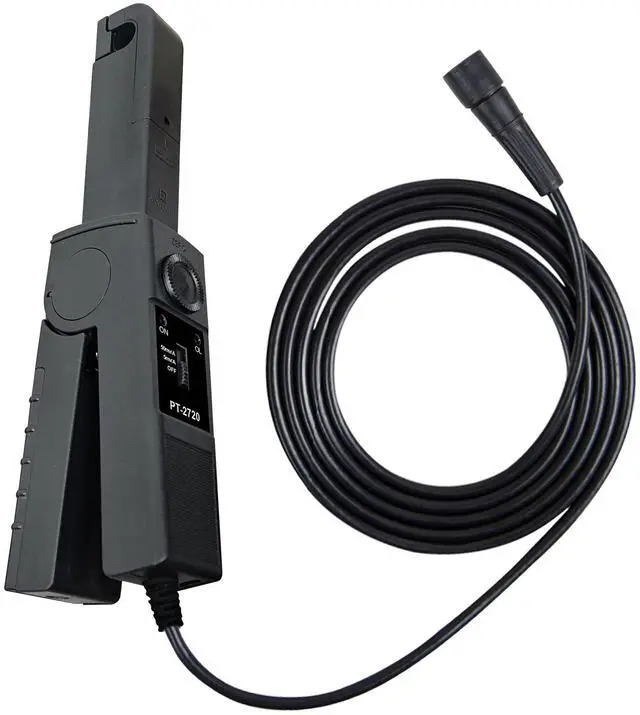
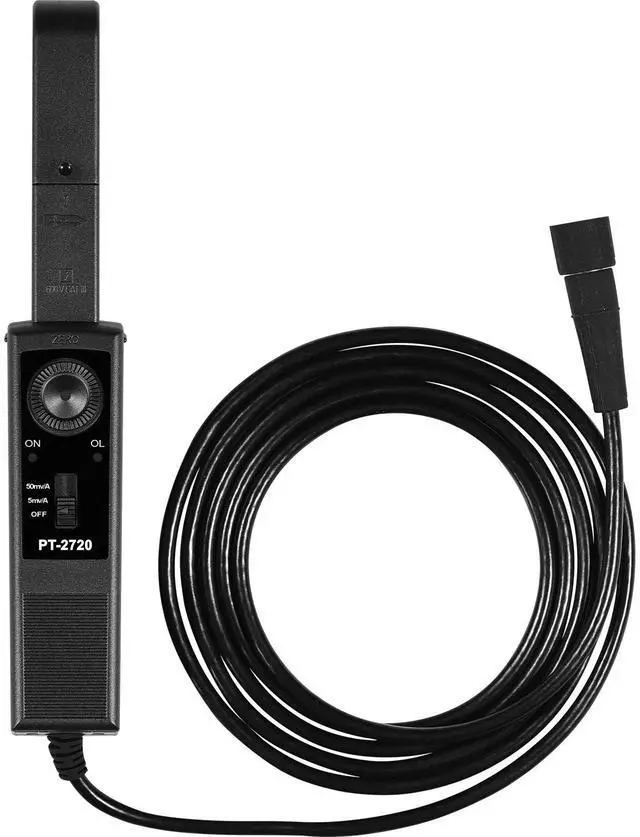



Any questions? Ask CelesteSM will help you find out quickly.
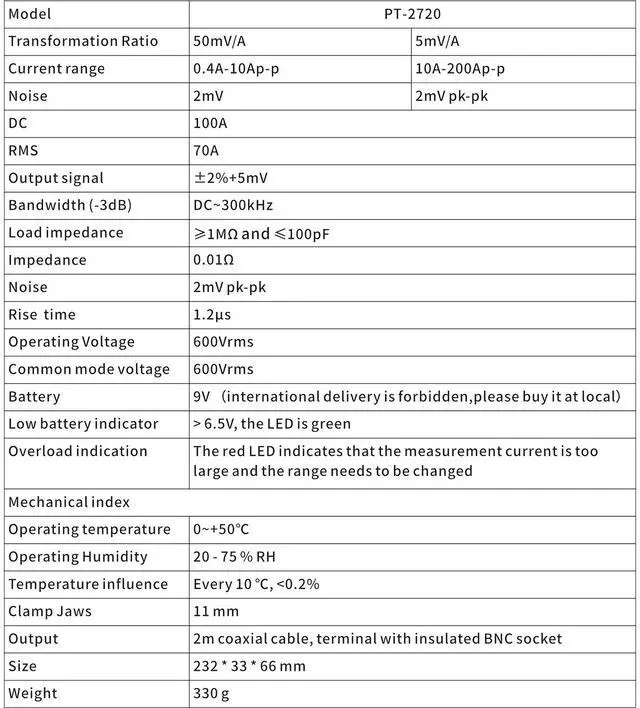
MODEL: PT-2720
Bandwidth (-3dB): DC-300kHZ
Transformation Ratio: 50mV/A; 5mV/A
Current Range: 0.4A-10Ap-p; 10A-200Ap-p
DC: 100A
RMS: 70A
Output Signal Percentage Error: ±2%+5mV
Load Impedance: 1 M and 100 p F
Impedance: 0.01
Noise:2mV; 2mV pk-pk
Rise Time: 1.2s
Operating Voltage: Max 600 Vrms Common Mode Voltage: Max 600 Vrms
Battery: 9V(NOT INCLUDED)
Low Battery Indication: >6.5V, LED is green
Overload Indication: The red LED indicates that the measured current is too high and that the measuring range needs to be changed
Max Clamp Diameter: 11mm/0.43in
Output: 2 metre coaxial cablem, terminated with insulated BNC socket
Size: 232 x 33 x 66 mm
Weight: 330g/0.73lb
The PINTECH PT-2720 is an AC/DC current clamp probe for oscilloscopes, built for technicians, engineers, and electronics labs that need non-intrusive current measurement from 0.4A to 200A with up to 300kHz bandwidth through a standard BNC connection.
| Attribute | Value |
|---|---|
| Best For | Oscilloscope-based AC/DC current measurements using a clamp probe; suited to clamp-style waveform/output measurements and power-related tests where low phase shift and BNC oscilloscope compatibility matter |
| Model Identifiers | PINTECH PT-2720 clamp probe |
| Type | Electrical testing & measuring clamp probe |
| Physical | Compact clamp probe form factor, 232 x 33 x 66 mm; sold as a single unit |
| Accuracy | ±2%+5mV output accuracy |
| Standards/Certifications | CE certified |
Q: Should I choose the PINTECH PT-2720 or a 100A-class 300kHz current probe like the PINTEK PA-622?
A: Choose the PT-2720 when you need more current headroom while keeping oscilloscope-focused bandwidth. Official specs place the PT-2720 at 0.4A to 200A with 300kHz bandwidth, while the PA-622 is a 300kHz probe that tops out at ±100A and is positioned with higher low-range sensitivity. In practice, the PT-2720 is the better fit for inverter, motor drive, and power-stage work where current peaks can exceed 100A. A 100A-class probe is the better fit when lower-current resolution matters more than maximum range.
Q: Is the PT-2720 a better choice than a lower-range probe such as the PINTECH PT-2710?
A: The PT-2720 is the better choice if you expect current peaks above about 60A or want more room for troubleshooting unknown loads. Product-line specs position the PT-2710 as a 200kHz, up-to-60A model, while the PT-2720 moves to 300kHz and up to 200A. The trade-off is that lower-range probes are often preferred when the work stays in smaller current windows, because they can make fine low-current changes easier to view on the scope.
Q: Should I buy the PT-2720 or move up to a higher-current model like the PT-2740?
A: Choose the PT-2720 for bench and field measurements where 200A coverage and 300kHz bandwidth are enough. Move up to the PT-2740 when your work regularly involves larger bus currents, battery systems, or power electronics that can exceed 200A. Official lineup data positions the PT-2740 at the same 300kHz bandwidth but with a much higher current range, so the decision is mainly about current capacity rather than frequency response.
Q: Is the PT-2720 better for oscilloscope work than using a clamp meter or multimeter current accessory?
A: Yes, if your goal is waveform analysis rather than just reading RMS current. The PT-2720 is positioned as an oscilloscope current probe with BNC output, AC/DC measurement, low phase shift, and up to 300kHz bandwidth, which makes it suitable for switching waveforms, startup transients, and ripple analysis. A clamp meter or multimeter accessory is the better choice when you mainly need a stable numeric reading and do not need to see current shape over time.
Q: For portable field troubleshooting, should I choose the PT-2720 or an older bench-style current probe system?
A: Choose the PT-2720 when portability and direct scope connection matter. Community comparison discussions around the PT-2720 versus older Tektronix AM503/P6303-style setups note the appeal of the newer clamp-style format and report competitive noise performance, while classic bench systems remain attractive for users who already own compatible amplifier hardware. The PT-2720 is the more practical option for technicians who want a self-contained probe rather than a probe-plus-amplifier setup.
Q: Will this current probe work with a standard oscilloscope, or do I need a special scope?
A: It should work with most oscilloscopes that accept a standard BNC input and have a 1 MΩ input setting. This type of question appears often on retail and manufacturer Q&A pages because compatibility is a common buying concern. For the PT-2720 specifically, the product listing says it uses a standard BNC interface and is compatible with oscilloscopes; similar probe guidance also notes that 1 MΩ scope input is the expected setup, not 50 Ω.
Q: Is this a good choice for measuring both AC and DC current waveforms on a scope?
A: Yes, if you specifically need to view both AC and DC current on an oscilloscope. The PT-2720 is an AC/DC probe, which matters because many lower-cost clamp accessories are AC-only or are aimed at multimeter use rather than waveform viewing. Its stated DC to 300 kHz bandwidth makes it more suitable for observing current behavior over time than a basic clamp meter, but it is still a general-purpose probe rather than a high-bandwidth lab model.
Q: Who is this probe best suited for?
A: It is best suited for technicians, electronics repair users, power electronics work, inverter or motor-drive troubleshooting, and anyone who wants to see current waveforms directly on an oscilloscope. It is less ideal for buyers who only need a handheld clamp meter for quick RMS checks, or for advanced lab users who need much higher bandwidth, larger jaw capacity, or very low-current precision.
Q: What are the main trade-offs versus a cheaper clamp meter or lower-end current clamp accessory?
A: The main advantage is that this probe is built for oscilloscope current waveform measurement, not just numerical current readout. Compared with a basic clamp meter, you get time-domain waveform visibility and AC/DC measurement on a scope. The trade-offs are that you must manage probe setup correctly, including range selection and zeroing practices common to this category, and the maximum clamp opening is relatively small at 11 mm, which limits use on thicker conductors.
Q: Is this a better fit than a high-end current probe from brands like Keysight, Tektronix, or NI?
A: It is a better fit if you need a lower-cost, general-purpose AC/DC current probe with BNC connection and up to 200 A range. It is not a better fit if your priority is premium bandwidth, tighter low-current performance, deeper scope integration, or higher-end lab validation. High-end alternatives often offer much higher bandwidth and stronger ecosystem compatibility, but they target a different budget and use case.
Q: Who is the PINTECH PT-2720 most suitable for?
A: The PT-2720 is best suited to users who need to view AC or DC current waveforms on an oscilloscope without breaking the circuit, especially for bench electronics, power analysis, and general troubleshooting in the 0.4A to 200A range. It is a better fit for scope-based current waveform work than for people who only need simple clamp-meter readings.
Q: Is the PT-2720 a good choice for SMPS and switching power troubleshooting?
A: It can be a practical choice for general SMPS and power-electronics debugging if your currents fall within its 0.4A to 200A range and 300kHz bandwidth is enough for the waveform detail you need. The trade-off is bandwidth: it is suitable for many routine switching-current measurements, but it is not the best choice if you specifically need finer high-frequency detail or want to analyze faster edges and harmonics.
Q: Is 300kHz bandwidth enough, or should I buy a higher-bandwidth current probe instead?
A: 300kHz is enough when your goal is general current-waveform viewing, power troubleshooting, and lower-frequency switching analysis. You should consider a higher-bandwidth probe if your work depends on capturing faster transients, sharper switching behavior, or more detailed waveform shape. In short: the PT-2720 is the value-oriented choice for general use, not the better choice for demanding high-frequency analysis.
Q: What are the main trade-offs of the PT-2720 compared with simpler clamp meters or higher-end current probes?
A: Compared with a basic clamp meter, the PT-2720 is more useful when you need waveform visibility on an oscilloscope rather than just a current number. Compared with higher-end current probes, its main trade-offs are lower bandwidth and potentially less suitability for very fast or specialized measurements. Its advantage is broader day-to-day usefulness for oscilloscope users who need AC/DC current measurement with a standard BNC connection.
Q: Is the PT-2720 worth buying if I already have an oscilloscope?
A: It is worth considering if your oscilloscope setup already works for voltage measurements and your missing capability is non-intrusive AC/DC current waveform measurement. It is less compelling if you mainly need occasional current checks, because a standard clamp meter is simpler and cheaper for that job. The PT-2720 makes the most sense when current waveform capture is a recurring part of your troubleshooting workflow.



