




 here!
I’m your shopping assistant for PC builds, upgrades, and everything tech.
Got questions? Ask away!
Start a conversation
here!
I’m your shopping assistant for PC builds, upgrades, and everything tech.
Got questions? Ask away!
Start a conversationShipped by GUANGZHOU PINTECH CO LTD




Any questions? Ask CelesteSM will help you find out quickly.
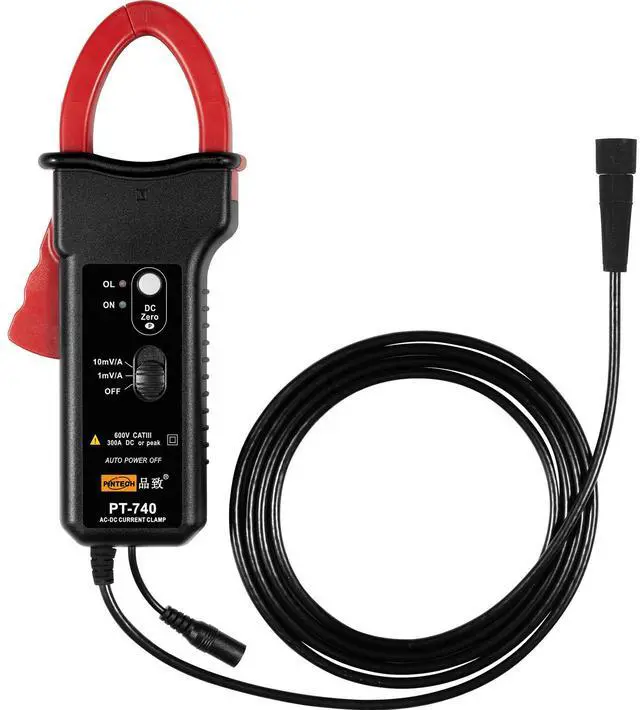
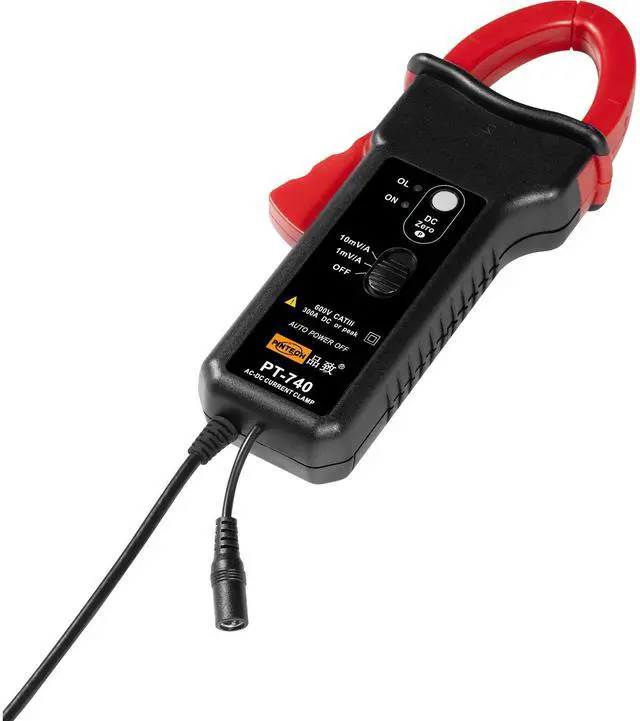
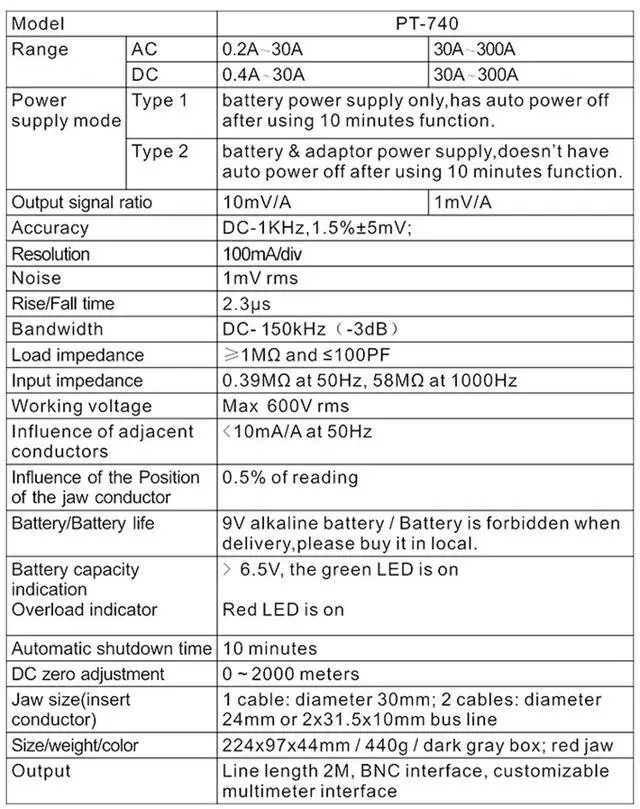
MODEL: PT-740
Bandwidth (-3dB): DC-150kHz
Current Range:
Peak:0.2A~30A, 30A~300A
DC:0.4A~30A, 30A~300A
Out Signal Ratio: 10mV/A(100:1), 1mV/A(1000:1)
Out Signal Inaccuracy(typical):±1.5%+5mV
Noise:1mV rms
Rise/Fall Time:2.3s
The load impedence:1M and 100pF
Insert Impedance: 0.39m at 50Hz, 58m at 1000Hz
Working Voltage: Max 600V rms
Common-mode voltage: Max 600V rmsv Influence of Adjacent Conductors: <10mA/A at 50Hz
Influence of Jaw Conductor Position: 0.5% of reading
Battery Capacity Indicator: When >6.5V,the green LED illuminates
Overload Indicator: Red LED is on
Automatic Shutdown Time: 10 minutes
DC Zero Adjustment: Supprot
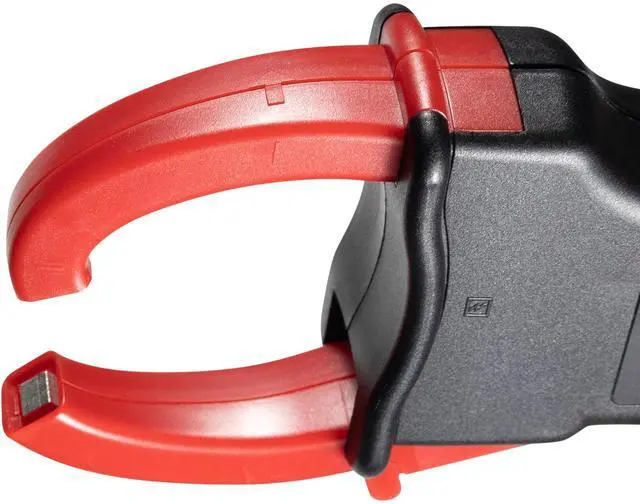
Jaw Size(insert conductor): 1 cable: 30mm diameter; 2 cables: 24mm diameter or 2×31.5×10mm busbar
Output: Cable length 2M/78.7in, BNC connector
Weight: 440g/0.97lb
Size: 224 x 97 x 44 mm
The PINTECH PT-740 is an AC/DC current probe for oscilloscopes, designed for technicians, engineers, and lab users who need to measure current up to 300A with a BNC-connected clamp for circuit, power, and waveform analysis.
| Attribute | Value |
|---|---|
| Best For | Technicians and engineers who need an oscilloscope-compatible AC/DC current probe/clamp for measuring electrical current on circuits and power systems |
| Model Identifiers | PINTECH PT-740, sold individually |
| Measurement Accuracy And Performance | Accuracy ±1.5% + 5 mV |
| Physical Dimensions | 224 x 97 x 44 mm physical dimensions |
| Category And Use | Electrical testing and measuring instrument intended for current measurement and oscilloscope use |
| Certifications And Safety | CE certification |
Q: Should I choose the PINTECH PT-740 or a 100A class probe like the Micsig CP2100A?
A: Choose the PT-740 when you need more current headroom and general-purpose AC/DC current measurement on a standard BNC oscilloscope. Its published positioning is 300A with 150kHz bandwidth, which better fits inverter, motor drive, power line, and higher-current bench work. Choose a 100A class probe like the Micsig CP2100A when your circuits stay below 100A and you want more bandwidth for seeing faster switching detail; the CP2100A is specified to 800kHz, so it is better aligned with higher-frequency waveform inspection than the PT-740.
Q: Is the PINTECH PT-740 a better fit than a 100kHz 100A probe such as the Keysight 1146B?
A: The PT-740 is the better fit when current range matters more than brand continuity with an existing Keysight setup. Based on published specs, the PT-740 extends to 300A and 150kHz, while the 1146B is positioned at 100A and 100kHz. A 100A, 100kHz probe remains a sensible choice for lower-current power measurements where that range already covers the job, but the PT-740 is the more flexible option for users who expect higher current peaks or want extra bandwidth within this low-frequency clamp-probe class.
Q: Should I buy the PT-740 or move up to a high-bandwidth Tektronix current probe?
A: Buy the PT-740 if your priority is measuring larger DC or low-to-mid-frequency AC currents on a broad range of BNC oscilloscopes without moving into a higher-end probe ecosystem. Move up to a Tektronix current probe when bandwidth and small-signal fidelity are the main goals. Tektronix models such as the TCP202/TCP2020 family are positioned for much higher bandwidth operation, which is more suitable for fast edges and detailed switching analysis, but they also operate in a lower current class than the PT-740 and may involve Tek-specific power or interface considerations depending on model.
Q: Is the PT-740 better for portability-focused work or for performance-first bench analysis?
A: The PT-740 leans more toward practical bench and field current measurement than toward performance-first high-frequency analysis. Its BNC output and adapter-powered design make it broadly compatible and straightforward for routine oscilloscope setups, while its 300A range supports heavier electrical work. If your main goal is portability and simple current capture across different standard scopes, the PT-740 fits well. If your main goal is resolving faster switching behavior, a higher-bandwidth probe class is the better match even if it gives up current range.
Q: Will this current probe work with my oscilloscope?
A: Usually yes if your oscilloscope has a standard 1 MΩ BNC input. The PT-740 uses a BNC output and the product page states a 1 MΩ / 100 pF load. The main trade-off is that not every oscilloscope probe interface is plain BNC; some Tektronix models use TekVPI, TekConnect, or other interfaces, so those scopes may need an adapter or may not be a direct fit. This is best for users who already have a standard BNC-input bench scope.
Q: Is the PT-740 a good choice for low-current and high-current measurements?
A: It is more versatile than a high-current-only clamp because it supports two ranges: 0.2 A to 30 A peak / 0.4 A to 30 A DC, and 30 A to 300 A on the high range. That makes it suitable for mixed bench work where you may check both smaller DC loads and much larger current events. The trade-off is sensitivity: at the high range the output is 1 mV/A, so very small current details are less ideal than on a dedicated low-current probe.
Q: Who is this probe most suitable for?
A: The PT-740 is best suited to technicians, power electronics users, inverter or motor-drive troubleshooting, and general oscilloscope users who need AC and DC current waveforms up to 300 A. It is less suitable for buyers who only need a simple clamp meter reading, because this is an oscilloscope accessory with analog BNC output rather than a standalone display tool.
Q: Is 150 kHz bandwidth enough, or should I look for a faster current probe?
A: 150 kHz is enough for many power, automotive, inverter, SMPS ripple-current, and general troubleshooting tasks, but it is not a high-speed probe for fast switching edge analysis. If your main goal is viewing broad current waveform behavior and RMS-related power work, it is a practical fit. If you need detailed high-frequency switching transients, a higher-bandwidth probe is the better alternative.
Q: What are the main trade-offs versus a simpler or cheaper current clamp alternative?
A: The PT-740 gives you waveform output to an oscilloscope, DC-capable measurement, and up to 300 A range, which is more useful for diagnosis than a basic clamp meter. The trade-offs are higher cost, the need for an oscilloscope with compatible input, and extra setup such as power arrangement and zero adjustment. If you only need a numeric current reading, a standard clamp meter is simpler; if you need to see the current waveform over time, this type of probe is the better tool.
Q: Who is the PINTECH PT-740 best suited for?
A: The PT-740 is best suited for users who need to view AC or DC current waveforms directly on a standard oscilloscope through a BNC input, especially for bench troubleshooting, power measurements, and general current profiling up to 300 A. It is a better fit for technicians and electronics users who specifically need a current probe than for beginners who only need occasional current checks, because simpler shunt-based methods or basic clamp meters are often discussed as lower-cost alternatives.
Q: Is the PT-740 a good choice if I want a lower-cost oscilloscope current probe?
A: It can be a reasonable choice if your priority is getting AC/DC current measurement on an oscilloscope without moving into premium probe pricing. The main trade-off is performance versus cost: Reddit discussions repeatedly show that buyers of budget current probes worry about waveform fidelity, bandwidth limits, and whether cheaper probes are good enough for their use case. For lower-frequency power work and general troubleshooting, a probe in this class is easier to justify than for demanding high-speed switching analysis.
Q: Is the PT-740 suitable for switching power supply or inverter waveform analysis?
A: It is suitable for moderate-bandwidth current measurements, but it is not the safest choice if your main goal is detailed analysis of fast switching waveforms. Community discussions around budget current probes repeatedly focus on bandwidth as a decision factor, and users note that limited-bandwidth probes can smooth or distort switching-current detail. With a stated 150 kHz bandwidth, the PT-740 is more appropriate for lower-frequency power analysis and general troubleshooting than for precise high-speed converter development.
Q: Is the PT-740 a good replacement for using shunt resistors to measure current on a scope?
A: It is a practical replacement when you want non-contact current measurement and do not want to break the circuit. That is the main advantage of a clamp-style oscilloscope probe. The trade-off is that shunt methods are often still preferred when maximum accuracy, simplicity, or low-cost measurement is enough for the job. The PT-740 makes more sense when circuit interruption is inconvenient or when you want quicker current waveform setup on an oscilloscope.
Q: What are the main trade-offs of the PT-740 before buying?
A: The main trade-offs are bandwidth, measurement range, and setup style. The PT-740 offers broad current range up to 300 A and works with standard BNC oscilloscopes, which makes it flexible for general bench use. In exchange, its 150 kHz bandwidth means it is not aimed at high-speed current analysis, and its adapter-powered default configuration may be less convenient if you prefer a battery-powered probe. Buyers should choose it for compatibility and general-purpose current waveform viewing, not as a substitute for a higher-bandwidth lab probe.



