




 here!
I’m your shopping assistant for PC builds, upgrades, and everything tech.
Got questions? Ask away!
Start a conversation
here!
I’m your shopping assistant for PC builds, upgrades, and everything tech.
Got questions? Ask away!
Start a conversationShipped by GUANGZHOU PINTECH CO LTD





Any questions? Ask CelesteSM will help you find out quickly.
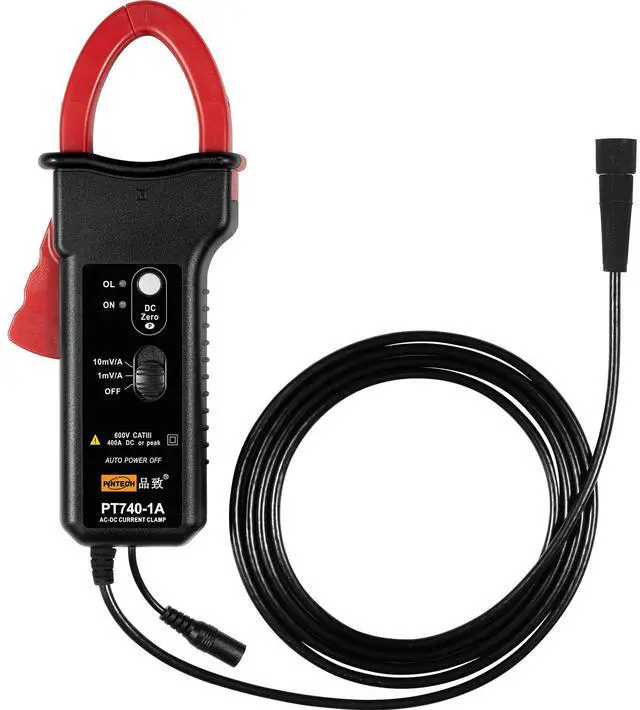
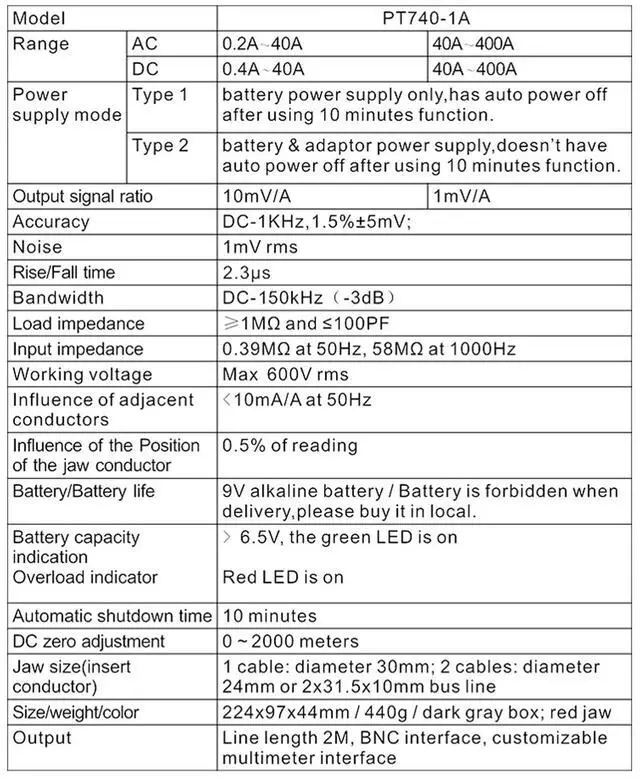
MODEL: PT740-1A
Bandwidth (-3dB): DC-150kHz
Current Range:
Peak:0.2A~40A, 40A~400A
DC:0.4A~40A, 40A~400A
Out Signal Ratio: 10mV/A(100:1), 1mV/A(1000:1)
Out Signal Inaccuracy(typical):±1.5%+5mV
Noise:1mV rms
Rise/Fall Time:2.3s
The load impedence:1M and 100pF
Insert Impedance: 0.39m at 50Hz, 58m at 1000Hz
Working Voltage: Max 600V rms
Common-mode voltage: Max 600V rmsv Influence of Adjacent Conductors: <10mA/A at 50Hz
Influence of Jaw Conductor Position: 0.5% of reading
Battery Capacity Indicator: When >6.5V,the green LED illuminates
Overload Indicator: Red LED is on
Automatic Shutdown Time: 10 minutes
DC Zero Adjustment: Supprot
Jaw Size(insert conductor): 1 cable: 30mm diameter; 2 cables: 24mm diameter or 2×31.5×10mm busbar
Output: Cable length 2M/78.7in, BNC connector
Weight: 440g/0.97lb
Size: 224 x 97 x 44 mm
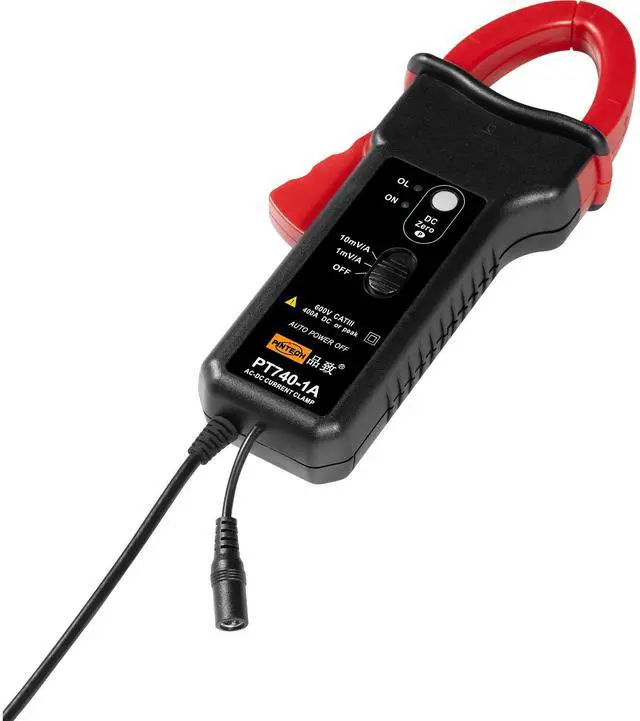
The PINTECH PT740-1A is an AC/DC oscilloscope current probe for measuring current up to 400A with 150kHz bandwidth, making it well suited for electricians, power electronics engineers, and technicians who need BNC-compatible current testing on standard oscilloscopes.
| Attribute | Value |
|---|---|
| Best For | Technicians and engineers performing oscilloscope-based AC/DC current measurements and general electrical testing, integration into bench oscilloscope workflows |
| Model Identifiers | PINTECH PT740-1A electrical testing & measuring probe; sold individually |
| Measurement Accuracy | ±1.5% + 5 mV accuracy for measured signals |
| Standards/Certifications | CE certification |
| Physical Dimensions | 224 × 97 × 44 mm (listed dimensions) |
Q: Should I choose the PINTECH PT740-1A or a lower-range 65A current probe for oscilloscope work?
A: Choose the PT740-1A if you need one clamp probe that can cover both low-current troubleshooting and much higher current measurements up to 400A, while still measuring AC and DC with a standard BNC output. A 65A-class probe is the better fit when your work stays on smaller circuits and you want more of the probe's usable range concentrated at lower current. The trade-off is that the PT740-1A gives you much more headroom, while lower-range probes are usually the more focused option for low-current bench work.
Q: PT740-1A vs a shunt resistor setup: which is better for current waveform measurements?
A: Choose the PT740-1A when you want non-intrusive current measurements with a clamp that works directly with an oscilloscope and avoids inserting a resistor into the circuit. Choose a shunt resistor setup when maximum bandwidth or very small current detail matters more than convenience, and you can accept circuit intrusion plus the need for a suitable differential measurement method. In practice, the PT740-1A is the easier option for general power, motor-drive, and service measurements, while shunts are the more specialized option for higher-bandwidth analysis.
Q: Is the PT740-1A enough, or should I move up to a higher-bandwidth current probe like the Micsig CP2100A?
A: Choose the PT740-1A if your priority is measuring higher current levels and general AC/DC waveform behavior, especially in power and industrial troubleshooting where 400A range is useful. Move up to a higher-bandwidth probe like the CP2100A when you are analyzing faster switching edges and higher-frequency current detail, and your current range fits within that probe's lower maximum current capability. The trade-off is straightforward: PT740-1A favors current range and broad compatibility, while higher-bandwidth probes favor signal detail at lower peak current.
Q: PT740-1A vs Hantek CC-650: which makes more sense for higher-current testing?
A: Choose the PT740-1A if you want a higher-current AC/DC clamp with materially more oscilloscope-oriented bandwidth than entry-level high-current clamps. Choose a CC-650-class probe if your main need is broad high-current coverage at lower frequency and cost-sensitive troubleshooting. The practical trade-off is that PT740-1A is the stronger fit for waveform viewing beyond low-frequency current behavior, while a CC-650-style probe is the simpler fit when high current matters more than bandwidth.
Q: Will this current probe work with my oscilloscope?
A: Usually yes, if your oscilloscope has a standard BNC input and 1 MΩ input impedance. The PT740-1A is a BNC-output AC/DC current probe, and comparable probes from Keysight are also specified for scopes with BNC input and at least 1 MΩ impedance. Buyers should still confirm that their scope can display the probe’s output scaling correctly and that its bandwidth is not the limiting factor.
Q: Who is this probe best suited for?
A: This probe is best suited for bench testing, power electronics, inverter, motor-drive, and general waveform analysis where you need to view AC and DC current on an oscilloscope without breaking the circuit. Its 400 A maximum range and BNC output make it more appropriate for technicians, engineers, and advanced hobbyists than for casual household electrical checks.
Q: Is 150 kHz bandwidth enough, or should I buy a higher-bandwidth current probe?
A: 150 kHz is enough for many power, automotive, inverter, switching-supply, and general troubleshooting tasks, but it is not ideal for fast-edge or higher-frequency analysis. If your main goal is observing current ripple, startup behavior, PWM-related current shape, or DC-plus-AC current trends, this bandwidth is often sufficient. If you need cleaner visibility into faster transients or higher-frequency harmonics, a higher-bandwidth probe is the better choice.
Q: Is this a good choice for low-current precision work?
A: It is usable for moderate low-current work, but it is not the best choice if very small current detail is your priority. The PT740-1A starts at 0.2 A peak and 0.4 A DC, with stated typical inaccuracy of ±1.5% + 5 mV and 1 mV rms noise. That makes it better for medium-to-high current waveform analysis than for very fine milliamp-level measurement.
Q: What are the main trade-offs versus a simpler AC clamp or cheaper current probe?
A: The main advantage of this model is that it measures both AC and DC current and outputs a live waveform to an oscilloscope through BNC, which is more useful than a basic clamp meter when you need timing, ripple, surge, or waveform shape. The trade-offs are that it requires a compatible scope, it is less convenient than a standalone clamp meter for quick field checks, and its 150 kHz bandwidth is mid-range rather than high-end.
Q: Is the PT740-1A a good fit for general oscilloscope current measurements, or should I buy a higher-bandwidth probe?
A: The PT740-1A is a practical fit for general-purpose power electronics and AC/DC current waveform work when 150 kHz bandwidth is enough. It is less suitable if you need to capture faster switching edges or higher-frequency current detail, because users discussing oscilloscope current probes repeatedly compare low-cost models against higher-bandwidth options when bandwidth is the deciding factor.
Q: Who is the PT740-1A most suitable for?
A: It is most suitable for users who need clamp-style AC/DC current measurement on an oscilloscope for bench troubleshooting, power analysis, motor drives, inverter work, or other moderate-frequency current measurements. Its main appeal is broad compatibility through a standard BNC connection and a wide 0.2 A to 400 A measurement span, but it is not the best choice for RF or very fast switching analysis.
Q: What are the main trade-offs of buying the PT740-1A instead of a cheaper meter clamp or a more expensive current probe?
A: The main trade-off is capability versus bandwidth and refinement. Compared with a basic clamp meter, the PT740-1A is better for viewing current waveforms directly on a scope and for measuring AC with DC present. Compared with more expensive current probes, the trade-off is lower bandwidth and potentially less usefulness for high-speed switching work. It is a decision-oriented buy if you need waveform visibility more than maximum frequency performance.
Q: Is the PT740-1A worth buying for high-current work?
A: Yes, if your priority is measuring relatively large AC/DC currents on an oscilloscope and 400 A peak range matters more than high-frequency detail. No, if your work is mostly low-current precision measurement or fast transient analysis, where higher sensitivity or higher bandwidth would matter more than maximum current range.
Q: Will the PT740-1A work with my oscilloscope?
A: It will work with most standard oscilloscopes that accept a BNC input, so compatibility is generally straightforward. The bigger question is not connector fit, but whether your scope use case matches the probe's 150 kHz bandwidth, 400 A peak range, and adapter-powered setup.



