




 here!
I’m your shopping assistant for PC builds, upgrades, and everything tech.
Got questions? Ask away!
Start a conversation
here!
I’m your shopping assistant for PC builds, upgrades, and everything tech.
Got questions? Ask away!
Start a conversationShipped by GUANGZHOU PINTECH CO LTD

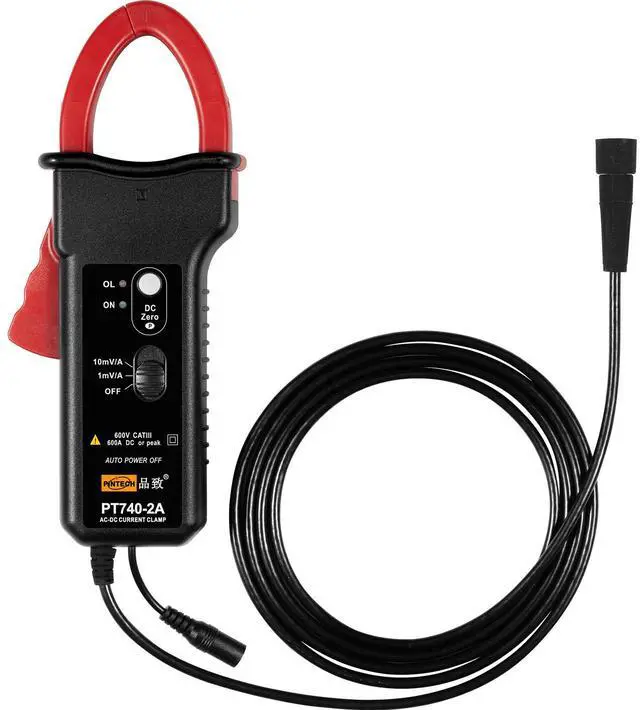
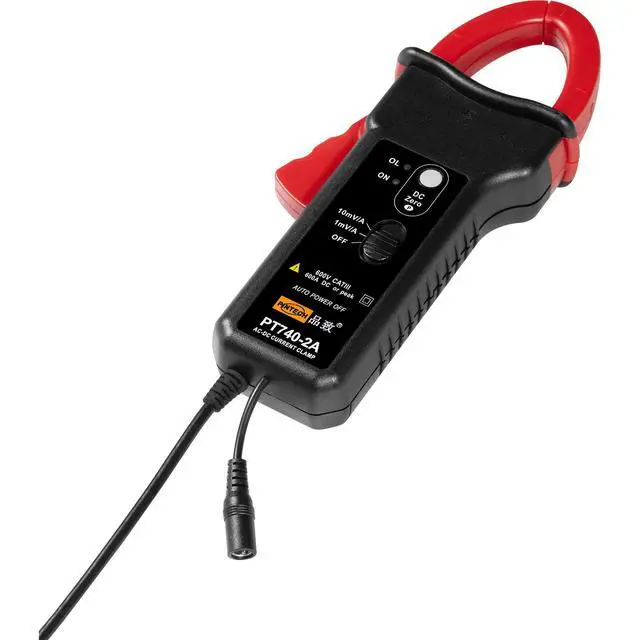



Any questions? Ask CelesteSM will help you find out quickly.
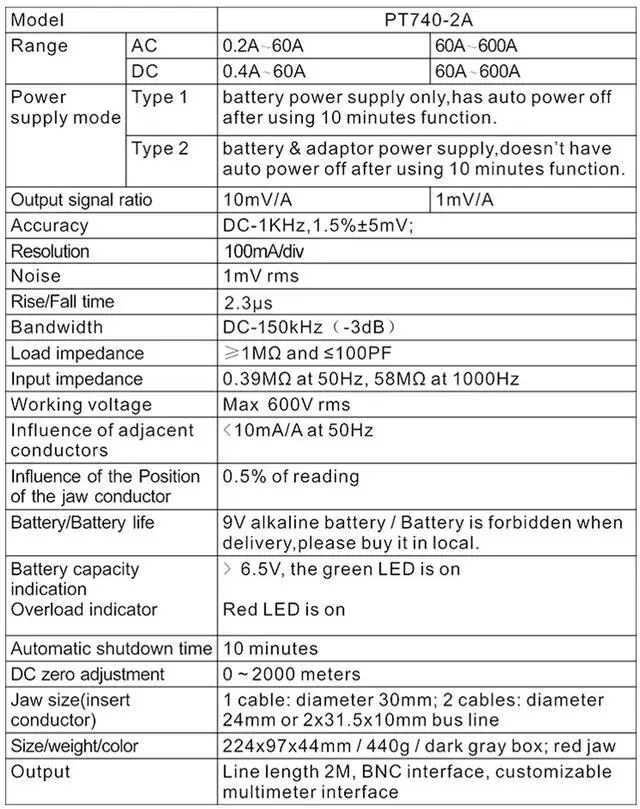
MODEL: PT740-2A
Bandwidth (-3dB): DC-150kHz
Current Range:
Peak:0.2A~60A, 60A~600A
DC:0.4A~60A, 60A~600A
Out Signal Ratio: 10mV/A(100:1), 1mV/A(1000:1)
Out Signal Inaccuracy(typical):±1.5%+5mV
Noise:1mV rms
Rise/Fall Time:2.3s
The load impedence:1M and 100pF
Insert Impedance: 0.39m at 50Hz, 58m at 1000Hz
Working Voltage: Max 600V rms
Common-mode voltage: Max 600V rmsv Influence of Adjacent Conductors: <10mA/A at 50Hz
Influence of Jaw Conductor Position: 0.5% of reading
Battery Capacity Indicator: When >6.5V,the green LED illuminates
Overload Indicator: Red LED is on
Automatic Shutdown Time: 10 minutes
DC Zero Adjustment: Supprot
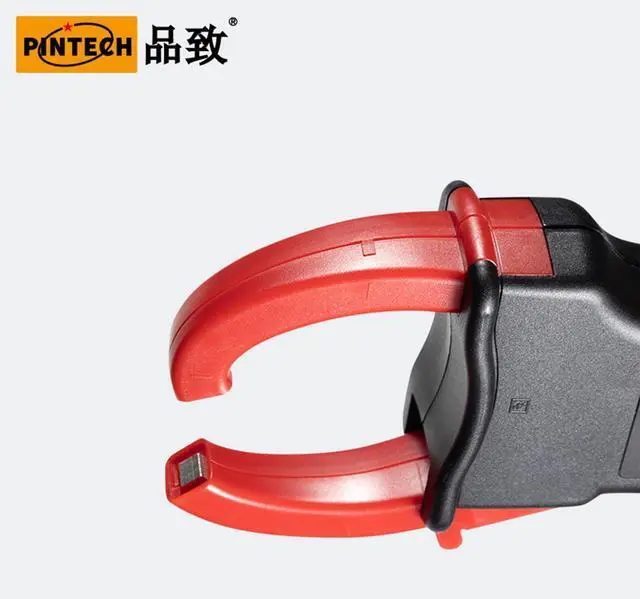
Jaw Size(insert conductor): 1 cable: 30mm diameter; 2 cables: 24mm diameter or 2×31.5×10mm busbar
Output: Cable length 2M/78.7in, BNC connector
Weight: 440g/0.97lb
Size: 224 x 97 x 44 mm
The PINTECH PT740-2A is an AC/DC current probe for oscilloscopes that measures up to 600A with 150kHz bandwidth and a BNC connection, making it well suited for electricians, power electronics engineers, and lab users who need current waveform and RMS analysis in industrial or bench-testing setups.
| Attribute | Value |
|---|---|
| Best For | Technicians and engineers who need a current probe for AC and DC current and power measurements with oscilloscopes |
| Model Identifiers | PINTECH PT740-2A current probe |
| Physical Dimensions | 224?97?44mm |
| Accuracy And Measurement | Measurement accuracy ±1.5%+5mV |
| Device Type | Electrical Testing & Measuring device |
| Compliance And Certification | CE |
| Selling Unit | Each (sold individually) |
Q: Should I choose the PINTECH PT740-2A or a Hantek CC-65 for oscilloscope current measurements?
A: Choose the PT740-2A when you need much higher current range and wider bandwidth on a standard BNC oscilloscope input. Official specs place the PT740-2A at up to 600 A with 150 kHz bandwidth, while the Hantek CC-65 is a lower-range 65 A probe with 20 kHz bandwidth. That makes the PT740-2A the more suitable fit for inverter, motor drive, power distribution, and higher-current switching work. The CC-65 is the more practical option when your work stays at lower current and you mainly want a simpler budget-oriented clamp for basic waveform viewing.
Q: Is the PT740-2A a better fit than a 100 A class probe like the Tektronix A622 or Keysight 1146B?
A: Choose the PT740-2A if your priority is measuring substantially higher current on a general-purpose BNC oscilloscope. The PT740-2A is positioned at 600 A and 150 kHz, while Tektronix A622 is 100 A peak at 100 kHz and Keysight 1146B is 100 A class at 100 kHz. In practice, the 100 A probes are the better fit when your circuits stay below that range and you want a more established mainstream ecosystem from major scope vendors. The PT740-2A is the stronger match when current headroom matters more than staying inside a premium-brand probe family.
Q: Should I buy the PT740-2A or move up to a higher-bandwidth probe like the Micsig CP2100A?
A: Choose the PT740-2A when you need higher current capacity and your measurements are focused on lower-frequency power electronics, mains, motor, or DC plus ripple work. Choose a higher-bandwidth probe like the Micsig CP2100A when you need to see faster current edges in switching circuits. Official specs put the PT740-2A at 150 kHz and 600 A, while the CP2100A is rated to 800 kHz but only 100 A peak. Community buying discussions around oscilloscope current probes commonly treat this as a bandwidth-versus-current-range trade-off rather than a simple upgrade path.
Q: For bench work, is the PT740-2A better than using a shunt resistor and differential probe?
A: Choose the PT740-2A when you want isolated, clamp-on current measurement without breaking the circuit. That is usually the easier path for bench diagnostics, RMS checks with DC present, and repeated hookup changes. A shunt plus differential probe is often the better choice when you need very low-current sensitivity, tighter control over measurement bandwidth, or a lower-cost workaround for fixed test setups. Industry application notes consistently frame this as a convenience-and-isolation versus intrusion-and-setup trade-off.
Q: Is the PT740-2A a better choice than a Rogowski-style probe for high-current testing?
A: Choose the PT740-2A when you need to measure both DC and AC current, because AC/DC clamp probes combine Hall-effect sensing with transformer-based measurement. Choose a Rogowski-style probe when your work is AC-only and you need higher bandwidth, more flexibility around large conductors, or very high peak-current capture. The PT740-2A is the more suitable option for mixed DC and AC power electronics troubleshooting, while Rogowski probes are typically chosen for fast switching and large-AC-current applications.
Q: Will this current probe work with a regular oscilloscope, or only with specific models?
A: It should work with most oscilloscopes that accept a standard BNC input, because this probe outputs a scaled voltage signal rather than requiring a proprietary probe interface. The main requirement is that your scope can display and scale the probe's output correctly. In practice, compatibility is usually straightforward, but measurement quality still depends on the oscilloscope's own resolution, noise performance, and voltage scaling options.
Q: Is this a good choice for automotive diagnostics like starter current and charging tests?
A: Yes, it is a practical fit for automotive current waveform work, especially when you want to view starter draw, charging current, or other high-current circuits on an oscilloscope without breaking the circuit. Its 600A range and BNC output match the same use cases commonly discussed for comparable 600A AC/DC oscilloscope clamps. The trade-off is that final usefulness depends on your oscilloscope setup and whether you need more advanced automotive features such as built-in filtering or higher vertical resolution.
Q: Is this better for high-current work than a standard clamp meter?
A: Yes, if your goal is to see current waveforms over time on an oscilloscope. A probe like this is better than a standard clamp meter when you need to observe transient behavior, ripple, inrush, or waveform shape, not just a single numeric reading. A clamp meter is usually simpler for quick spot checks, while this probe is more suitable for troubleshooting dynamic electrical behavior.
Q: What are the main trade-offs versus a higher-end current probe from brands like Pico, Tektronix, or Fluke?
A: The main advantage of the PT740-2A is broad utility: it supports AC/DC measurement, up to 600A, and standard BNC scope connection. The likely trade-offs versus higher-end alternatives are not the basic concept, but refinement: premium probes often offer better documentation, stronger ecosystem support, and in some cases higher bandwidth, tighter integration, or more advanced filtering and calibration workflows. If you need general-purpose high-current scope measurements, this model is suitable; if you need top-end waveform fidelity or premium support, higher-tier probes are usually the safer choice.
Q: Is this suitable for beginners, or is it mainly for users who already understand oscilloscope current scaling?
A: It is better suited to users who already know how to set up oscilloscope measurements and interpret probe scaling. Comparable product discussions repeatedly show that the probe may physically work with many scopes, but correct readings depend on understanding output scaling, range selection, and basic current-clamp measurement technique. For beginners, it can still be useful, but it is not as simple as using a self-contained clamp meter.
Q: Who is the PT740-2A best suited for?
A: The PT740-2A is best suited for users who need to view current waveforms on an oscilloscope without breaking the circuit, especially for mixed AC and DC measurements. It fits bench troubleshooting, power electronics, motor drives, inverter work, and general lab diagnostics better than basic clamp meters, because it provides a BNC oscilloscope output and supports DC measurement.
Q: Is the PT740-2A a good choice if I need to measure both DC and AC current on a scope?
A: Yes, if DC capability matters. The PT740-2A is an AC/DC Hall-effect current probe, so it is more suitable than AC-only clamp-style options when you need to see DC offset, startup behavior, or combined AC-plus-DC current waveforms. Its trade-off is lower bandwidth than higher-end current probes, so it is better for general power and troubleshooting work than for fast switching detail.
Q: What are the main trade-offs of buying the PT740-2A instead of a higher-bandwidth current probe?
A: The main trade-off is bandwidth versus cost and range. The PT740-2A offers up to 600A measurement and 150kHz bandwidth, which is enough for many power, automotive, and industrial current checks, but it is not the right choice if you need to inspect very fast switching edges or higher-frequency detail. Users comparing current probes often focus on whether extra bandwidth is worth the higher price; this model is the better fit when current range and DC capability matter more than high-frequency analysis.
Q: Is the PT740-2A worth buying for occasional hobby use?
A: Usually only if you specifically need current waveforms on a scope. For occasional hobby use, a current probe like this is most justified when a shunt resistor is impractical, when you need non-contact clamping around a conductor, or when you need to observe transient current behavior. If your work is mostly low-current basics or general multimeter tasks, a simpler measurement setup may be more cost-effective.



