




 here!
I’m your shopping assistant for PC builds, upgrades, and everything tech.
Got questions? Ask away!
Start a conversation
here!
I’m your shopping assistant for PC builds, upgrades, and everything tech.
Got questions? Ask away!
Start a conversationShipped by GUANGZHOU PINTECH CO LTD




Any questions? Ask CelesteSM will help you find out quickly.
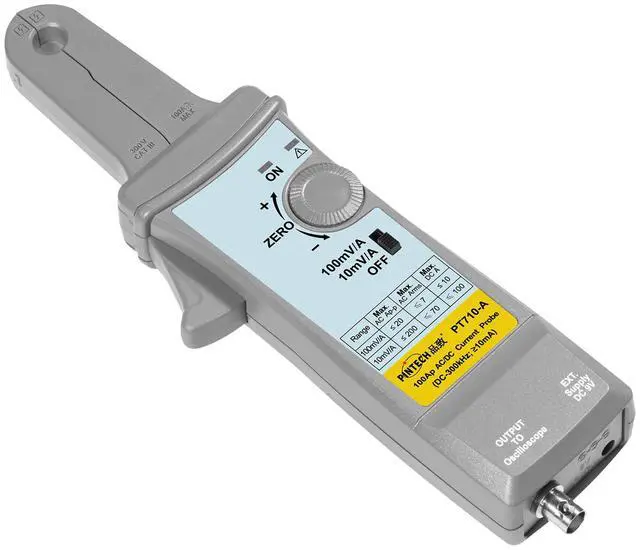
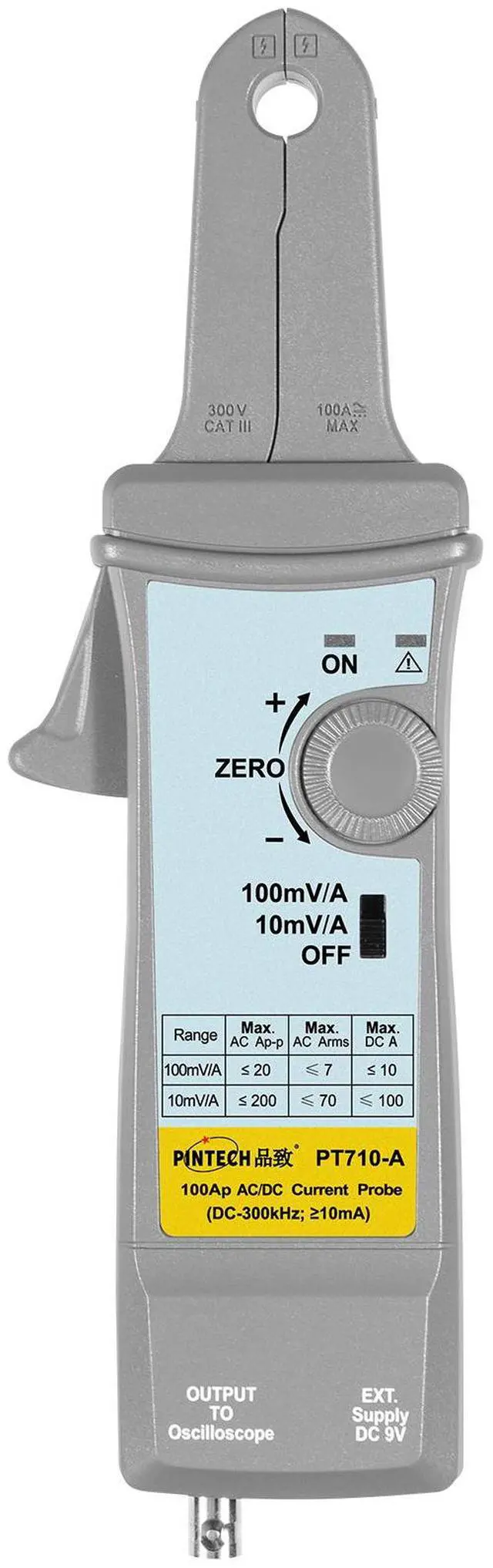
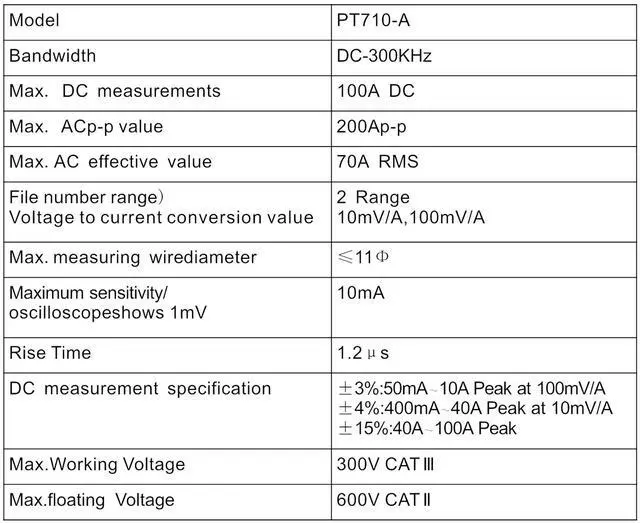
MODEL: PT710-A
Bandwidth (-3dB): DC-300kHZ
Max. ACp-p value: 200Ap-p
Mac DC Current: 100A
Max AC Effective Value: 70A RMS
Range Gears: 2 Ranges
Voltage and Current Conversion Values: 10mV/A, 100mV/A
Maximum Diameter of Measuring Wire: 11mm
Maximum Sensitivity: 10mA
Rise Time:1.2 s
Measurement Accuracy: ±3%: 50mA~10Apeak at 100mV/A; ±4%: 500mA~40Apeak at 10mV/A; ±15%: 40A~100Apeak at 10mV/A
Maximum Working Voltage: 300V CAT III
Maximum Floating Voltage:600V CAT II
Weight: 260g/0.57lb
Size: 280 x 70 x 32 mm
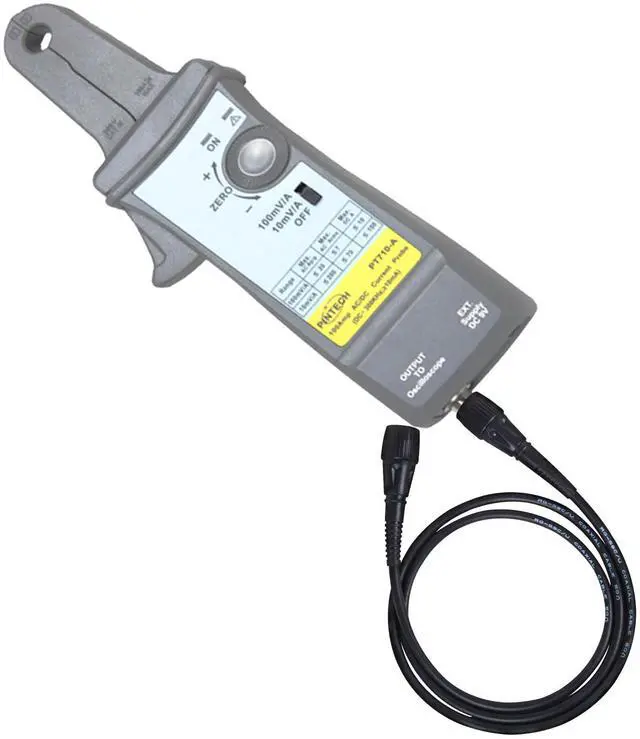
The PINTECH PT710-A is an AC/DC current probe for oscilloscopes and multimeters, built for technicians, electronics labs, and field troubleshooting that need non-intrusive current measurement up to 200A AC, 100A DC, and bandwidth up to 300kHz.
| Attribute | Value |
|---|---|
| Best For | Field and bench electrical testing and troubleshooting that require a handheld current probe for AC/DC current measurement and interfacing with oscilloscopes or multimeters |
| Model Identifiers | PINTECH PT710-A |
| Device Type | Electrical testing & measuring device (current probe category) |
| Physical Dimensions | 280 x 70 x 32 mm compact handheld form factor |
| Accuracy And Certifications | ±3% measurement accuracy; CE certified |
| Purchase Unit | Sold individually (each) |
Q: Should I choose the PINTECH PT710-A or a basic clamp-style current probe like the Hantek CC-65?
A: Choose the PINTECH PT710-A when you need oscilloscope-first current waveform measurement with higher bandwidth and better visibility into switching edges, ripple, and transient behavior. The PT710-A is positioned as an AC/DC current probe with a BNC oscilloscope interface, 100A DC / 200Ap-p range, and 300kHz bandwidth, while the Hantek CC-65 is a lower-bandwidth AC/DC clamp intended for general current measurement and basic waveform viewing at 20kHz. The trade-off is that a lower-bandwidth clamp is often enough for slower power, automotive, and mains-frequency checks, while the PT710-A is the stronger fit for lab debugging where waveform detail matters.
Q: Is the PT710-A enough, or should I step up to a higher-bandwidth current probe like the Micsig CP2100A?
A: The PT710-A is the better choice when your priority is moderate-bandwidth AC/DC current measurement with broad oscilloscope compatibility and you do not need sub-microsecond edge detail. A higher-bandwidth option like the Micsig CP2100A makes more sense for faster switching analysis because it extends bandwidth to 800kHz while keeping a similar 10A/100A dual-range class. Community discussions around current probes commonly treat the jump to 800kHz as worthwhile when bandwidth is the main buying factor. The trade-off is that the PT710-A is sufficient for many power electronics and service tasks, while the higher-tier option gives more headroom for transient-focused work.
Q: How does the PT710-A compare with a low-current probe for small-signal work?
A: Choose the PT710-A when you need one probe that can cover both DC and AC current on larger loads up to 100A DC or 200Ap-p AC, especially for power stages, motor drives, and general bench troubleshooting. A dedicated low-current probe is the better fit when your main job is measuring small currents with higher sensitivity and lower-current optimization. PINTECH's own lineup separates these use cases: the PT710 series is for broader current range and higher bandwidth, while low-current models such as the PT-7010/PT-7020 are positioned for small-current measurement scenarios. The trade-off is range versus fine low-current focus.
Q: Is the PT710-A a better fit than older 100kHz versions of the PT-710 family?
A: Yes, the PT710-A is the better choice if you want more bandwidth within the same general probe family. Older PT-710 listings commonly show 100kHz bandwidth, while current official PINTECH materials position the PT710-A at 300kHz. That makes the newer model more suitable when you want to see faster current transitions and more waveform detail without moving into a much more expensive class of probe. The trade-off is simple: older 100kHz versions remain usable for slower measurements, but the PT710-A gives more diagnostic headroom.
Q: For portable field checks, should I get the PT710-A or use a regular clamp meter instead?
A: Choose the PT710-A when portability still needs to include waveform analysis on an oscilloscope or occasional multimeter connection through its adapter. Choose a regular clamp meter when the main goal is fast numeric current readings with minimal setup. The PT710-A is a compact split-core probe with BNC output and multimeter adapter support, so it sits between a pure oscilloscope accessory and a basic clamp meter. The trade-off is convenience versus visibility: a clamp meter is quicker for spot checks, while the PT710-A is more useful when you need to see current shape, ripple, and timing.
Q: Is the PT710-A a good fit for general oscilloscope current measurements, or is it mainly for basic troubleshooting?
A: The PT710-A is best suited to general-purpose current troubleshooting and waveform checks, especially when you need AC/DC current measurement with a standard BNC oscilloscope connection. Based on the provided specs, it covers up to 200A peak, up to 300kHz bandwidth, and includes a multimeter adapter, which makes it practical for bench and field diagnostics. The trade-off is that it is not positioned like higher-end current probes used for fast switching analysis, MHz-class power electronics, or high-precision lab work.
Q: Who is the PT710-A most suitable for?
A: The PT710-A is most suitable for technicians, electronics troubleshooters, maintenance users, and engineers who need a clamp-style AC/DC current probe that works with a standard oscilloscope and can also feed a multimeter. It is a practical match for users measuring moderate-to-high current without breaking the circuit. It is less suitable for buyers who need very high bandwidth, top-tier accuracy, or specialized probe ecosystems tied to premium oscilloscope platforms.
Q: Can the PT710-A replace a regular clamp meter or a high-end current probe?
A: It can replace a regular clamp meter only in some workflows, not all. The PT710-A adds waveform visibility on an oscilloscope and includes a multimeter adapter, so it is more useful than a basic clamp meter when you need to see current behavior over time. However, it is not a full substitute for a premium current probe if you need much higher bandwidth, tighter accuracy, stronger brand-specific compatibility, or advanced power-analysis use cases.
Q: What are the main trade-offs versus a higher-end alternative?
A: The main trade-off is capability versus cost and simplicity. Compared with higher-end alternatives, the PT710-A offers useful AC/DC current measurement, BNC compatibility, and portable clamp-style convenience, but premium probes typically provide much higher bandwidth, better accuracy, broader validation on specific oscilloscope platforms, and stronger support for demanding switching or power-analysis measurements. If your work is routine diagnostics, the PT710-A is the more practical class of tool; if you need fast transient detail, a higher-end probe is the safer choice.
Q: Is the PT710-A a good choice if I want one probe for both scope and multimeter use?
A: Yes, that is one of its clearest decision advantages. The provided product data says it uses a standard BNC interface for oscilloscopes and includes an adapter for multimeter connection, so it fits buyers who want one current clamp for both waveform viewing and simpler meter-based current checks. The trade-off is that dedicated tools are still better when you need either advanced oscilloscope performance or the convenience of a standalone clamp meter with built-in display and power calculations.
Q: Who is the PT710-A best suited for?
A: The PT710-A is best suited for users who need a clamp-style current probe for general oscilloscope or multimeter work on low- to mid-frequency power electronics, DC current checks, motor drive signals, and troubleshooting where breaking the circuit is inconvenient. It is a better fit for bench diagnostics than for precision low-current logging or very high-frequency switching analysis.
Q: Is the PT710-A a good choice if I want one probe for both an oscilloscope and a multimeter?
A: Yes, if dual-use flexibility matters more than specialization. The PT710-A has a standard BNC connection for oscilloscopes and includes a multimeter adapter, so it can cover waveform viewing and basic current measurement with one accessory. The trade-off is that it is still primarily a current probe, not a full-featured clamp meter, so convenience and display features depend on the instrument you connect it to.
Q: What are the main trade-offs of the PT710-A?
A: The main trade-offs are bandwidth, accuracy, and high-current performance. Its 300 kHz bandwidth is suitable for many power and general electronics measurements, but it is not ideal for fast switching edges or RF work. Its stated accuracy is ±3%, which is acceptable for troubleshooting and trend checking but not for calibration-grade measurement. It also measures up to 100 A DC and 200 A peak AC, so it favors moderate-to-high current tasks over very low-current precision work.
Q: Is the PT710-A worth buying for high-frequency switching power analysis?
A: Usually only if your measurement needs stay within moderate bandwidth limits. For debugging general current waveforms, ripple trends, and many inverter or power-supply checks, it can be useful. If you specifically need to capture very fast current peaks or fine switching details, a higher-bandwidth current probe would be the better choice.
Q: Is the PT710-A a good pick for precise low-current or long-duration measurement?
A: Not usually. The PT710-A's 10 mA sensitivity helps with small-signal visibility, but clamp-style current probes are generally less suitable than shunt-based methods for precision low-current measurement or long-term logging. If your priority is accurate small-current monitoring over time, a dedicated inline measurement method is usually a better fit.



