




 here!
I’m your shopping assistant for PC builds, upgrades, and everything tech.
Got questions? Ask away!
Start a conversation
here!
I’m your shopping assistant for PC builds, upgrades, and everything tech.
Got questions? Ask away!
Start a conversationShipped by GUANGZHOU PINTECH CO LTD

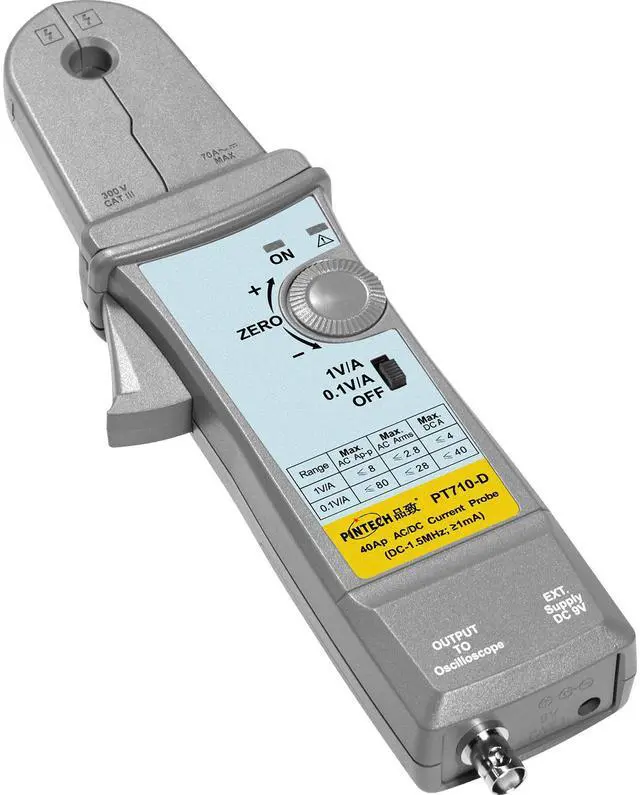
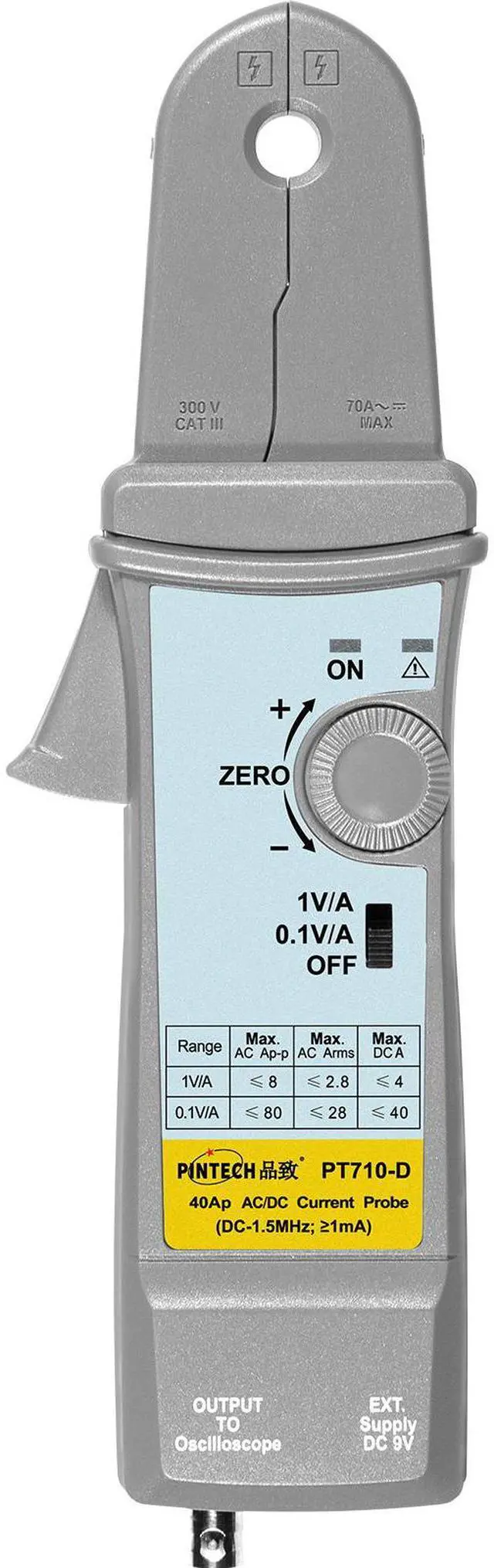



Any questions? Ask CelesteSM will help you find out quickly.
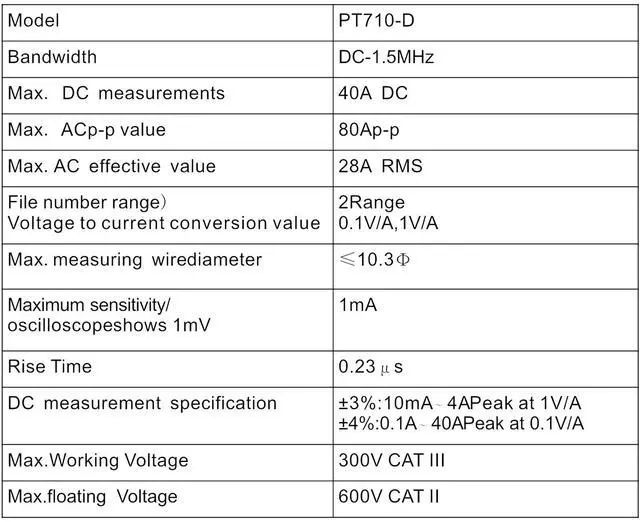
MODEL: PT710-D
Bandwidth (-3dB): DC-1.5MHz
Max. ACp-p value: 800Ap-p
Mac DC Current: 40A
Max AC Effective Value: 28A RMS
Range Gears: 2 Ranges
Voltage and Current Conversion Values: 0.1V/A, 1V/A
Maximum Diameter of Measuring Wire: 10.3mm
Maximum Sensitivity: 1mA
Rise Time:0.23 s
Measurement Accuracy: ±3%: 10mA~4Apeak at 1V/A; ±4%: 0.1A~40Apeak at 0.1V/A;
Maximum Working Voltage: 300V CAT III
Maximum Floating Voltage:600V CAT II
Weight: 260g/0.57lb
Size: 262 x 81 x 36 mm
The PINTECH PT710-D is an AC/DC current probe for oscilloscopes and multimeters, designed for technicians, electronics testers, and lab users who need BNC-based current measurement with up to 1.5MHz bandwidth, 1mA sensitivity, and support for AC currents to 80A and DC current measurement in lower-range diagnostic work.
| Attribute | Value |
|---|---|
| Best For | Oscilloscope and multimeter current measurements for electrical testing and troubleshooting |
| Model Identifiers | PINTECH PT710-D |
| Product Type | Electrical Testing & Measuring |
| Measurement Accuracy | ±3% accuracy |
| Physical Dimensions | 262 × 81 × 36 mm (external dimensions) |
| Compliance | CE certified |
| Selling Information | Sold individually |
Q: Should I choose the PINTECH PT710-D or a budget 20kHz current clamp like the Hantek CC-65 for oscilloscope work?
A: Choose the PINTECH PT710-D when you need to see switching-current detail, current spikes, and faster waveform edges on an oscilloscope. Its published bandwidth is 1.5MHz, while the Hantek CC-65 is specified at 20kHz, so the PT710-D is the more suitable option for power electronics troubleshooting, waveform inspection, and higher-frequency current analysis. A 20kHz clamp is the better fit for lower-frequency current checks and basic AC/DC measurement where cost matters more than waveform detail.
Q: Is the PINTECH PT710-D a better choice than the standard PINTECH PT-710 for higher-frequency measurements?
A: Yes, if your main goal is higher-frequency oscilloscope measurement. Official PINTECH materials list the PT710-D at 1.5MHz bandwidth with up to 1mA sensitivity, while the standard PT-710 is a 100kHz model with broader high-current coverage. The PT710-D is the better choice for resolving faster current transitions and smaller waveform details. The PT-710 is the more practical choice when your signals are lower frequency and you want a wider current range up to about 100A.
Q: How does the PINTECH PT710-D compare with the Micsig CP2100A?
A: These two probes target a similar use case, but the PT710-D is positioned for users who want more bandwidth, while the CP2100A favors a wider top-end current range. Official specs show the PT710-D at 1.5MHz and the CP2100A at 800kHz. The CP2100A supports up to 100A peak-class measurement, while PT710-D product data is centered on higher sensitivity and lower-current detail, with published accuracy around ±3% in its main range. Choose the PT710-D for finer high-frequency waveform work and small-current visibility; choose the CP2100A if you more often work on moderate-bandwidth signals and want extra current headroom.
Q: Should I buy the PT710-D or move up to a higher-current probe like the PINTECH PT710-F or PT710-H?
A: Buy the PT710-D if your priority is bandwidth and sensitivity for lower-current or detail-oriented oscilloscope work. In the PT710 family, the PT710-D is listed at 1.5MHz with 1mA maximum sensitivity, while higher-current models such as the PT710-F and PT710-H trade some bandwidth and sensitivity for substantially larger current capacity. That makes the PT710-D the stronger fit for lab analysis of smaller signals, and the higher-current models the better fit for inverter, motor, or bus-current work where current range matters more than top-end waveform resolution.
Q: Is the PT710-D better for portable field checks or for bench performance work?
A: The PT710-D is better aligned with bench performance work than simple field checks. Its BNC oscilloscope connection, published 1.5MHz bandwidth, and higher sensitivity make it more useful when you want to inspect waveform shape, switching behavior, and transient current detail. For portable field use focused on quick current verification rather than waveform analysis, a simpler clamp meter or lower-bandwidth clamp can be the more convenient choice.
Q: Who is the PINTECH PT710-D most suitable for?
A: The PT710-D is best for bench technicians, electronics repair, power-supply debugging, and general oscilloscope users who need non-intrusive AC/DC current measurement with a standard BNC connection. It is less ideal for buyers who need deep oscilloscope integration, automatic amp scaling, or high-end lab performance from brand-specific probe ecosystems.
Q: Is the PT710-D a good choice if I want one probe for both an oscilloscope and a multimeter?
A: Yes, that is one of its clearest buying advantages. The PT710-D uses a standard BNC interface for oscilloscopes and includes an adapter for multimeter use, so it fits buyers who want one clamp-style current probe for both waveform viewing and basic current checks. The trade-off is that generic BNC probes usually require manual scaling and offer less instrument-side integration than proprietary probes from major oscilloscope brands.
Q: Is the PT710-D better for low-current sensitivity or for high-current industrial work?
A: It is better positioned for lower-current and mixed bench work than for heavy industrial current measurement. Its stated 1 mA maximum sensitivity and 10 mA to 80 A range make it more useful when you need to see smaller current changes, while the 300 V maximum working voltage and modest current ceiling make it a less natural fit for high-current industrial environments that often call for higher CAT ratings, higher voltage ratings, or much larger current ranges.
Q: Is 1.5 MHz bandwidth enough for most oscilloscope current measurements?
A: It is enough for many repair, power, and general electronics tasks, but it is not a high-bandwidth specialist probe. A 1.5 MHz current probe is typically suitable for observing switching behavior, ripple trends, startup events, and general waveform shape in lower-frequency circuits. Buyers working on very fast edges, RF-related work, or advanced power electronics may prefer higher-bandwidth alternatives that extend into tens or hundreds of MHz.
Q: What are the main trade-offs versus premium current probes from Tektronix, LeCroy, or Rohde & Schwarz?
A: The PT710-D offers broader compatibility and likely lower entry cost, but the trade-offs are integration and performance tier. Premium probes commonly offer tighter oscilloscope integration, automatic current scaling, dedicated power interfaces, calibration features such as degauss or autozero from the scope UI, higher third-party safety coverage, and much higher bandwidth options. The PT710-D is the more practical choice for general-purpose compatibility; premium models are the stronger choice for advanced lab workflows.
Q: Who is the PT710-D most suitable for?
A: The PT710-D is best suited to users who need a compact AC/DC current probe for basic oscilloscope or multimeter current checks, especially bench troubleshooting and general electronics work. It is a better fit for low-to-moderate current measurement and broad compatibility than for high-end power electronics analysis.
Q: Is the PT710-D a good choice for switching power supply or fast waveform work?
A: It can work for general current waveform viewing, but it is not the safest choice if your main goal is detailed switching-power analysis. Community discussions around oscilloscope current probes repeatedly focus on bandwidth limits, and cheaper probes are often described as less reliable for fast switching waveforms. With a 1.5 MHz bandwidth, the PT710-D is more suitable for general troubleshooting than demanding high-speed switching measurements.
Q: Is the PT710-D a good buy if I want one probe for both an oscilloscope and a multimeter?
A: Yes, if dual-use flexibility matters. The PT710-D includes a standard BNC connection for oscilloscopes and an adapter for multimeter use, which matches a common buyer preference seen in discussion threads: one current clamp that can serve both tools. The trade-off is that this kind of general-purpose probe is usually chosen for convenience, not for the highest measurement performance.
Q: What are the main trade-offs of the PT710-D?
A: The main trade-offs are range, bandwidth, and precision. Based on the product data, it offers AC measurement up to 80 A, DC current up to 4 A, 1 mA maximum sensitivity, 1.5 MHz bandwidth, and ±3% accuracy. That makes it convenient and versatile, but not ideal when you need high DC range, tighter accuracy, or stronger confidence in high-frequency waveform fidelity.



