




 here!
I’m your shopping assistant for PC builds, upgrades, and everything tech.
Got questions? Ask away!
Start a conversation
here!
I’m your shopping assistant for PC builds, upgrades, and everything tech.
Got questions? Ask away!
Start a conversationShipped by GUANGZHOU PINTECH CO LTD




Any questions? Ask CelesteSM will help you find out quickly.
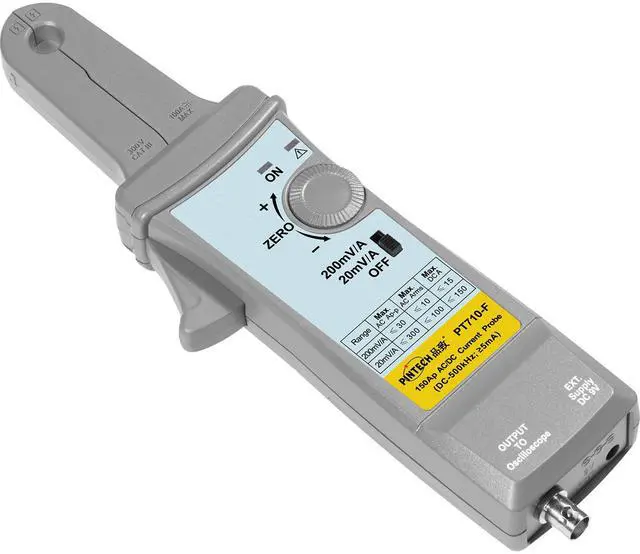
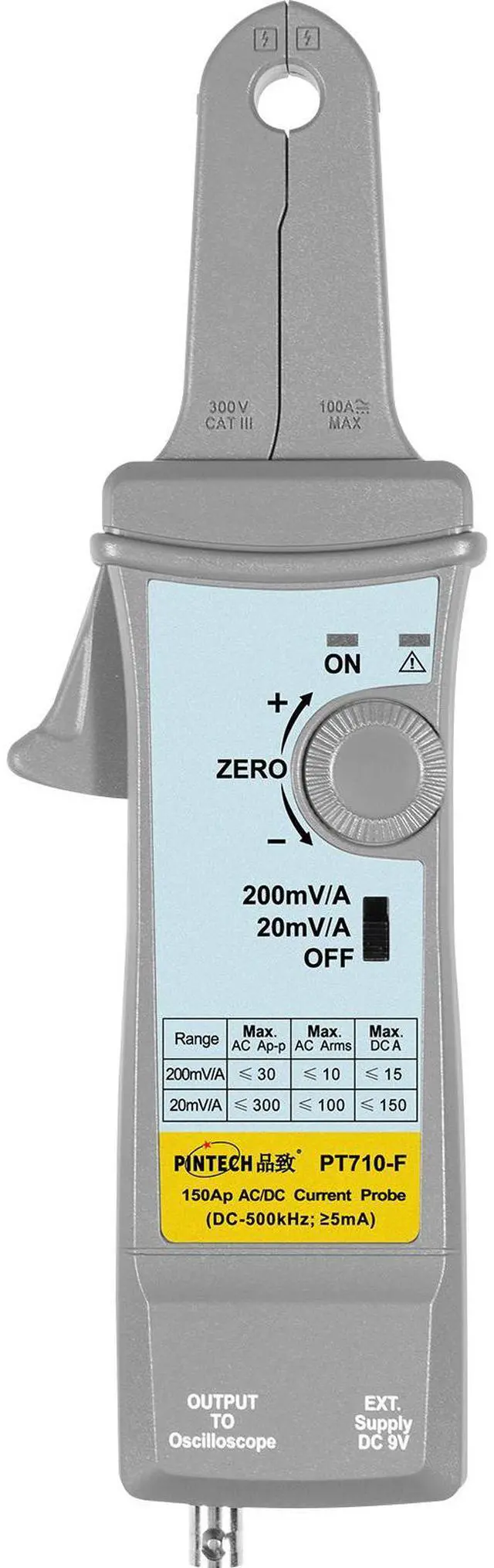
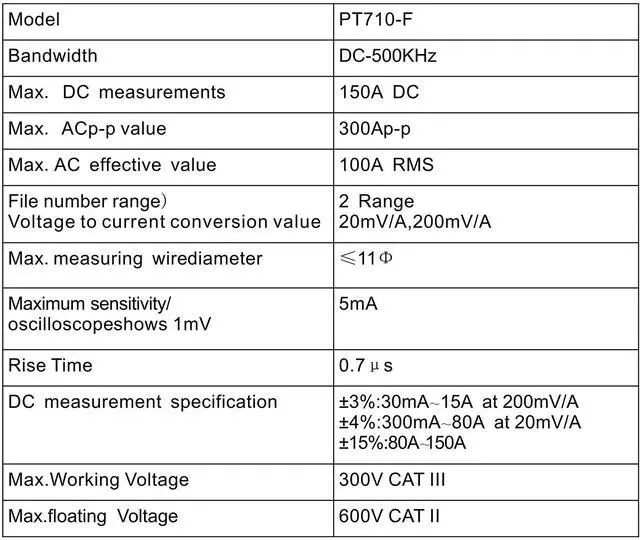
MODEL: PT710-F
Bandwidth (-3dB): DC-500kHZ
Max. ACp-p value: 300Ap-p
Mac DC Current: 150A
Max AC Effective Value: 100A RMS
Range Gears: 2 Ranges
Voltage and Current Conversion Values: 20mV/A, 200mV/A
Maximum Diameter of Measuring Wire: 11mm
Maximum Sensitivity: 5mA
Rise Time:0.7 s
Measurement Accuracy: ±3%: 30mA~15Apeak at 200mV/A; ±4%: 300mA~80Apeak at 20mV/A; ±15%: 80A~150Apeak at 20mV/A
Maximum Working Voltage: 300V CAT III
Maximum Floating Voltage:600V CAT II
Weight: 260g/0.57lb
Size: 280 x 70 x 32 mm
The PINTECH PT710-F is an AC/DC current probe with a BNC output for oscilloscopes and an adapter for multimeters, making it well suited for technicians, electronics labs, and field users who need to measure up to 300A AC or 150A DC with bandwidth up to 500kHz.
| Attribute | Value |
|---|---|
| Best For | Bench and field measurement of AC and DC currents using oscilloscopes or multimeters; suited for monitoring higher currents and capturing signals up to 500 kHz using the probe’s BNC output and included multimeter adapter |
| Model Identifiers | PINTECH PT710-F current probe |
| Measurement And Accuracy | AC current up to 300 A, DC current up to 150 A, maximum working voltage 300 V, sensitivity down to 5 mA, bandwidth up to 500 kHz, measurement accuracy ±3% |
| Physical Specifications | Dimensions 280 x 70 x 32 mm |
| Connectivity And Compatibility | Standard BNC output for oscilloscope connection and includes an adapter to connect to a multimeter for compatibility with both instruments |
| Product Type And Packaging | Electrical testing & measuring tool, sold each; package includes PT710-F probe, BNC cable and adapters, and manual |
| Certifications | CE certified |
Q: Should I buy the PINTECH PT710-F or a basic AC-only oscilloscope current clamp?
A: Choose the PT710-F when you need to measure both DC and AC current on an oscilloscope or multimeter, especially in power electronics, battery, motor-drive, or mixed-signal work. AC-only clamp probes are simpler and can be suitable for sinusoidal AC checks, but they do not capture DC current content. The PT710-F’s AC/DC design, BNC output, and multimeter adapter make it the better fit when waveform visibility and DC measurement matter more than the lowest-cost setup.
Q: Is the PT710-F worth getting over the older PT710-B?
A: Yes, the PT710-F is the more practical choice when you need more current headroom. PINTECH positions it as an updated version of the PT710-B, and the available specs show why: PT710-F increases max DC current to 150A and AC peak current to 300A p-p while keeping 500 kHz bandwidth and similar sensitivity. PT710-B remains suitable for lower-current work, but PT710-F is the safer choice for users who expect higher startup surges, inverter loads, or broader measurement range.
Q: How does the PT710-F compare with a lower-cost clamp like the Hantek CC-65?
A: Choose the PT710-F if your priority is higher bandwidth and higher current capability for oscilloscope waveform analysis. The PT710-F is specified for DC to 500 kHz and up to 150A DC / 300A p-p AC, while the Hantek CC-65 is a lower-range option with 20 kHz bandwidth and 65A capacity. That makes the Hantek more suitable for basic low-frequency troubleshooting, while the PT710-F is the better fit for switching power supplies, transient events, and applications where waveform detail above audio-range frequencies matters.
Q: Should I choose the PT710-F or step up to a higher-bandwidth probe like the Micsig CP2100A?
A: Choose the PT710-F when you need more current range at moderate bandwidth. Choose a higher-bandwidth probe like the Micsig CP2100A when your measurements focus on faster switching edges or finer high-frequency detail and your current range stays lower. In published specs, PT710-F offers 500 kHz bandwidth with higher current capability, while CP2100A offers 800 kHz bandwidth but around 100A peak range. The trade-off is straightforward: PT710-F favors current headroom, while CP2100A favors bandwidth.
Q: For portable field work, is the PT710-F better than a standalone clamp meter?
A: Choose the PT710-F when you want one accessory that can feed an oscilloscope through BNC and also connect to a multimeter for flexible bench or field diagnostics. A standalone clamp meter is usually simpler for quick go/no-go current checks, but it does not provide oscilloscope waveform visibility. The PT710-F makes more sense when portability still matters but you also want to inspect current shape, ripple, or transient behavior rather than only read a numeric value.
Q: Is the PT710-F a good choice if I need to view current waveforms on an oscilloscope, not just read amperage?
A: Yes. The PT710-F is better suited to oscilloscope waveform work than a basic clamp meter because it has a BNC output, supports AC and DC current, and is rated up to 500 kHz bandwidth. That makes it more appropriate for observing current shape, ripple, switching behavior, and transient trends. A standard clamp meter is usually better for simple RMS spot checks, but not for waveform analysis.
Q: Can I use the PT710-F with both an oscilloscope and a multimeter?
A: Yes, if your setup matches the included interfaces. The PT710-F uses a standard BNC connection for oscilloscopes and the product listing says it includes an adapter for multimeter use. In practice, accessory current clamps used with multimeters typically require a millivolt-reading input and the correct adapter, so compatibility depends on the meter's input type and resolution rather than on the clamp alone.
Q: Is the PT710-F suitable for low-current work, or is it mainly for higher-current circuits?
A: It is mainly a higher-current clamp with some low-current capability, not a precision low-current specialist. Its main advantage is handling up to 300 A AC peak and 150 A DC, while the listing also claims sensitivity down to 5 mA. For buying decisions, that means it fits power electronics, inverter, motor, and supply-current troubleshooting better than bench-level microcurrent measurement where a dedicated shunt-based or high-sensitivity probe would usually be more accurate.
Q: Who is the PT710-F best suited for?
A: The PT710-F is best suited for technicians, engineers, and advanced hobbyists who need non-intrusive AC/DC current measurement on an oscilloscope and occasionally on a multimeter. It is a better fit for lab troubleshooting, power electronics, automotive electrical diagnosis, and switching-circuit observation than for casual household testing. Buyers who only need basic current checks will usually get more value from a standard clamp meter.
Q: What are the main trade-offs versus a regular clamp meter?
A: The trade-off is capability versus simplicity. The PT710-F gives you waveform visibility, AC/DC measurement, BNC scope connection, and broader analysis use, but it is more specialized and depends on external instruments. A regular clamp meter is simpler for quick field readings and often more convenient for routine electrical checks, but it usually does not show waveform detail and may be less useful for switching or transient analysis.
Q: Who is the PINTECH PT710-F best suited for?
A: The PT710-F is best suited for bench troubleshooting where you need to view AC or DC current waveforms on an oscilloscope and occasionally use a multimeter adapter. Its 500 kHz bandwidth and 300 A / 150 A range make it more relevant for power electronics, motor drives, and general current tracing than for very high-frequency switching analysis or precision lab metrology.
Q: Is the PT710-F a good choice for switch-mode power supply work?
A: It can be a practical choice for SMPS troubleshooting if your goal is to observe current shape, startup behavior, ripple trends, and general switching behavior within a mid-bandwidth range. The trade-off is that 500 kHz bandwidth may be limiting for very fast edges, higher-frequency converters, or detailed high-frequency loss analysis, where a faster current probe would be more suitable.
Q: What are the main trade-offs of buying the PT710-F instead of a higher-end current probe?
A: The main advantage is broader utility at a likely lower cost: AC/DC measurement, oscilloscope BNC output, multimeter adapter, and relatively high current range. The trade-offs are moderate accuracy at ±3%, a 300 V maximum working voltage, and 500 kHz bandwidth, which is below the range typically chosen for more demanding high-frequency or higher-precision measurement work.
Q: Can the PT710-F replace a normal multimeter clamp meter?
A: Only partly. The included adapter makes it usable with a multimeter, so it can cover some clamp-meter use cases, but its design is centered on waveform viewing with an oscilloscope through BNC. If your main need is simple field current checks rather than waveform analysis, a dedicated clamp meter is usually the simpler tool.
Q: Is the PT710-F worth buying for occasional hobby or repair use?
A: It is worth considering if you specifically need current waveforms, not just current readings. For hobby or repair users, the value depends on whether you will actually use the oscilloscope-current-probe function; if you mainly need voltage probing or basic current checks, less specialized probes or a standard clamp meter may be more cost-effective.



